

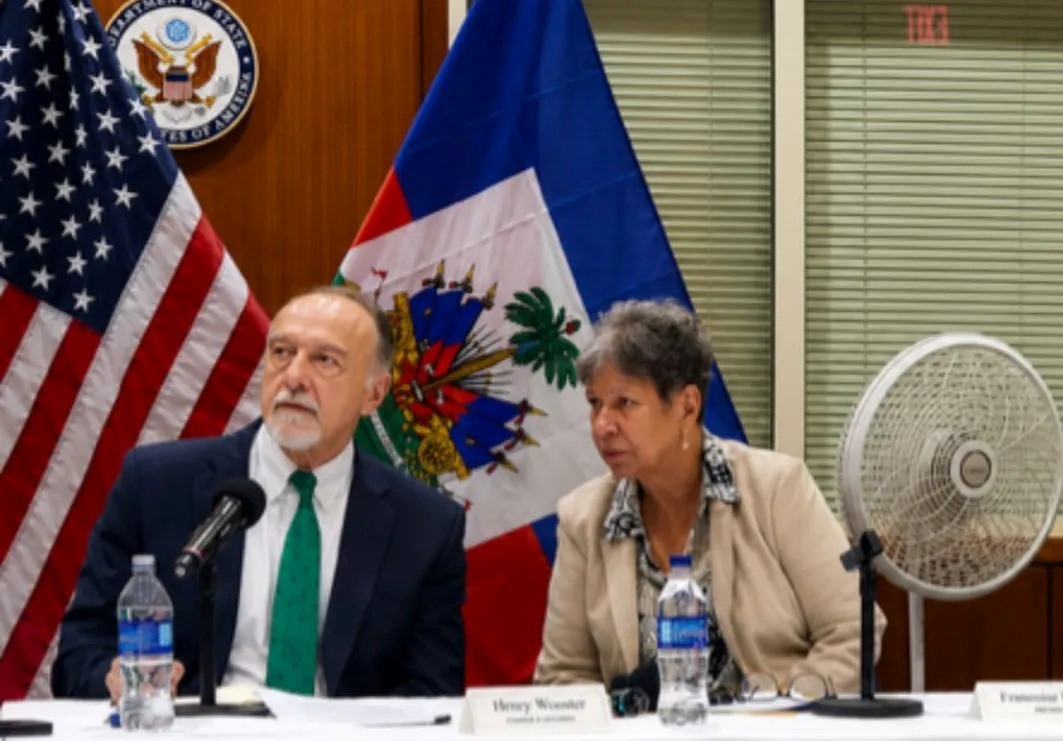
As he concludes his mission at the helm of the American chancery in Haiti, Chargé d’Affaires Henry Wooster delivered a farewell address this Thursday, July 23, that serves both as a candid assessment and a roadmap for the months ahead. Having returned to Haiti in June 2025 after a first assignment 28 years ago, the diplomat praised the “resilience, spirit, and strength of the Haitian people” while outlining the contours of a stabilization that begins first and foremost with security and a return to constitutional order.
Security as a Prerequisite for Stability
In his address, Henry Wooster took care to establish a fundamental distinction between the concepts of “security” and “stability”—two pillars of American strategy for Haiti. “Security constitutes a narrower operational framework that enables the holding of safe and credible elections, while stability is the longer-term result of legitimate institutions, economic growth, and effective governance,” he explained.
This conceptual clarification reflects a pragmatic approach: without security, no credible election can be organized, and without elections, no lasting stability can be established. The diplomat emphasized that this security effort is the sine qua non condition for “reviving the Haitian economy, creating jobs, allowing children to return to school safely, and restoring access to healthcare.”
The FRG: A “Gradual but Promising” Deployment
At the heart of the American security strategy lies the Gang Repression Force (FRG), a multinational mission approved by the United Nations Security Council in October 2025 through Resolution 2793. Henry Wooster announced that operations by this force began last month and that the current deployment stands at approximately 25% of its full strength. “Operations will intensify as the forces currently being deployed arrive during the summer and fall,” he specified, indicating that the force should reach full capacity between September and October 2026.

The FRG, which currently brings together contingents from Chad, El Salvador, Guatemala, Jamaica, Mongolia, and Sri Lanka, has already begun field operations. Its missions are multiple: arresting gang members and handing them over to the Haitian National Police (PNH), seizing and destroying illegal weapons, and clearing roads to allow the Haitian state to regain control of territory, according to the diplomat.
The upcoming arrival of 750 Chadian police officers and gendarmes—the first elements of whom have already been deployed—should give operations new momentum. Unlike the previous mission led by Kenya, which never reached full capacity, the FRG “already has sufficient troop contribution pledges to fill its 5,500 positions.”
Henry Wooster insisted on a crucial point: “Long-term solutions must be led by Haitians themselves.” International support, however important, constitutes only a temporary response. The sustainable restoration of security depends above all on Haitian institutions’ ability to strengthen themselves.
In this perspective, the diplomat welcomed the “P4000” program, funded by the U.S. State Department, which aims to recruit, train, and graduate 4,000 new police officers by early 2027. Furthermore, he recalled that the U.S. Congress had lifted decades-old restrictions on cooperation with the Haitian Armed Forces (FAd’H), paving the way for their revival.
An Unprecedented Denunciation of Complicity Networks
One of the most striking passages of the conference was Henry Wooster’s explicit denunciation of ties among certain police officers, political actors, private-sector members, and armed gangs. The American diplomat thus echoed warnings he had already issued in his end-of-year 2025 messages, where he cautioned against actors “involved in arms trafficking, financing armed gangs, as well as certain political figures accused of supporting instability.”

This denunciation is part of a strategy of enhanced accountability, symbolized by the adoption of the “Haiti Criminal Collusion Transparency Act,” which expands U.S. authority to identify, sanction, and prosecute Haitian officials accused of collaboration with armed groups. “These individuals, whether in Haiti or the United States, have supported gangs through arms trafficking, financing, or other means. The Trump administration will continue to hold them accountable,” Wooster had declared.
Return to Democratic Order: Credible Elections
Beyond security, Henry Wooster firmly advocated holding free and credible elections. The United States welcomes the Haitian government’s commitment to returning the country to democratic governance, he affirmed, while calling for “collective action by political leaders, private sector actors, and civil society to reject corruption, end impunity, and work for the common good.”
The Economy as a Foundation for Sustainable Stability
Henry Wooster also emphasized that security and democratic governance cannot ensure stability without economic opportunities. “Job creation is essential for the survival of individuals and families, for the recovery of the Haitian economy, and to offer alternatives to the recruitment of young people by terrorist gangs,” he declared.
The United States, “by far the leading bilateral donor to Haiti,” has mobilized more than $800 million in assistance programs, including $125 million for the Common Humanitarian Fund, $24 million for food aid, and $11 million for hurricane recovery support. The diplomat called on the Haitian private sector to be the engine of this effort, judging it “impossible to restore an economy to the growth levels needed to lift a population out of a humanitarian crisis without all businesses operating at full capacity.”
In conclusion, Henry Wooster emphasized that “a stable Haiti serves the interests of everyone—Haitians, Americans, and the region alike.” This stability, he recalled, can only be achieved through a collective effort where solutions led by Haitians themselves are prioritized.
The diplomat also addressed a message to Haitian media, whose essential role he praised for “disseminating accurate information and combating disinformation” in support of a democratic future. Acknowledging the difficulty of “determining ‘the truth’ here,” he advocated for “ethical and professional journalism” that allows Haitians “to understand who is doing what, so that your nation can make informed decisions in defining its next steps.”
https://ctninfo.com/security-emergen…re-leaving-haiti/
https://www.facebook.com/CaribbeanNewsMedia