

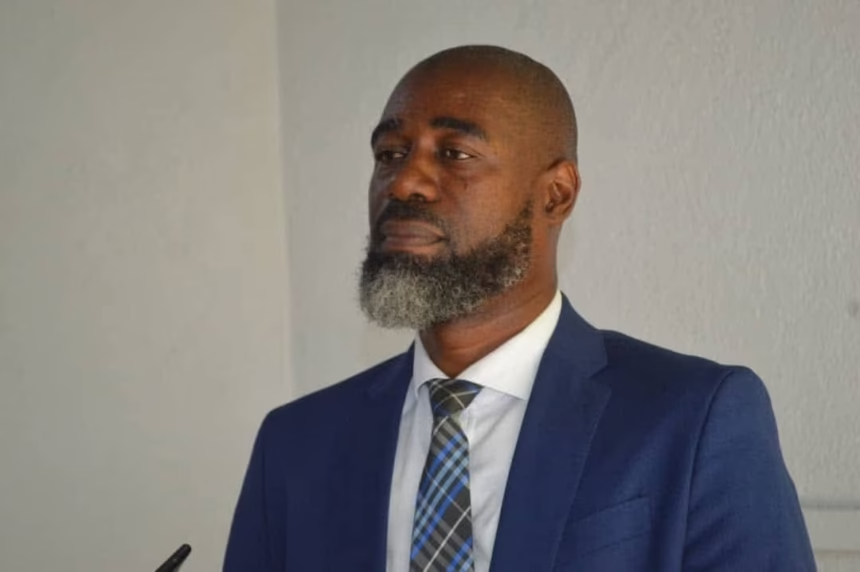
Radio Télé Métropole journalist Wesly Renaud Jean was released on Sunday, September 27, 2026, after twenty-two days in captivity. Kidnapped on September 6 in Delmas 31, he was reportedly freed after a ransom was paid, the amount of which has not been disclosed. The news, welcomed with relief by his loved ones and colleagues, brings an end to nearly three weeks of anguish for the radio station’s team and for the Haitian press as a whole. However, this happy outcome cannot mask a far darker reality: kidnappings continue to multiply in the Port-au-Prince metropolitan area, where armed gangs control a large portion of the territory.
Unfortunately, Wesly Renaud Jean’s case is not isolated. Among the missing, Professor James Broyard, inspector general of the National Police and chief of staff to the Minister of Defense, has remained in captivity for nearly four months. Kidnapped on June 11 between Bouron and Delmas, he has still not been released by his captors. His daughter, kidnapped at the same time as him, also remains in the hands of the kidnappers. Despite several student mobilizations and repeated calls from civil society, the authorities’ silence on this case is deafening. That a senior official responsible for national security matters can be held captive for nearly four months without the state managing to free him speaks volumes about the scale of the crisis.
This situation is part of a context of widespread violence. According to United Nations data, violence left at least 3,050 dead and 1,401 wounded in Haiti during the first half of 2026. Gangs control most of the capital and its strategic corridors. While security operations have achieved gains in certain neighborhoods, they produce a “compression effect”: violence shifts toward areas where the state is even weaker. In a position paper published in September, the national alternatives platform “Table de concertation pour la refondation nationale” (TRN) states it plainly: the “real reconquest” of territory cannot be measured solely by military operations. It must be verified by citizens’ ability to move freely, to work, to send their children to school, and to access public services without living under the threat of armed groups.
It is in this context that Prime Minister Alix Didier Fils-Aimé addressed the 81st United Nations General Assembly on September 25, 2026. In his speech, he placed security at the level of an “absolute priority” for his administration. He explicitly asked the international community to keep its promises by proceeding with the full deployment of the Gang Suppression Force (FRG), authorized by the Security Council in 2025. This multinational force, which should number 5,500 police officers and soldiers, remains far below its theoretical strength. “Pwomès se dèt” — a promise is a debt — he hammered home at a press conference upon his return. But beyond the shortfall in troop numbers, the Prime Minister recalled a truth Haitians know all too well: the weapons that kill in Haiti are not manufactured in Haiti. They arrive through transnational criminal networks that strengthen the gangs’ capacity for harm and threaten the stability of the entire region.

In the short term, Alix Didier Fils-Aimé implored international partners not to “save Haiti, but to help Haiti save itself,” by providing the FRG with the personnel, equipment, and resources needed to complete its deployment. In the long term, he announced a plan to strengthen law enforcement: more than 2,000 police officers already trained, 1,500 new soldiers integrated into the army, and the planned training of 15,000 additional military personnel over three years. He also mentioned the entry into force, on January 1, 2027, of a new Penal Code and a new Code of Criminal Procedure, as well as the creation of two judicial centers specializing in the fight against impunity and financial crime. These institutional endeavors are essential, but they come too late for Professor Broyard, who has been languishing in an unknown jail for nearly four months.
In his address from the UN podium, the Prime Minister had sought to strike the tone of a Haiti that “stands tall,” invoking Toussaint Louverture’s tree of liberty to rekindle national dignity. But a nation’s “standing tall” is not measured solely by the strength of its rhetoric on international platforms. It is measured by its ability to protect its citizens. When a defense minister’s chief of staff can be kidnapped on a capital highway and remain captive for nearly four months without the state appearing able to do anything about it, the very notion of “standing tall” demands to be redefined.