


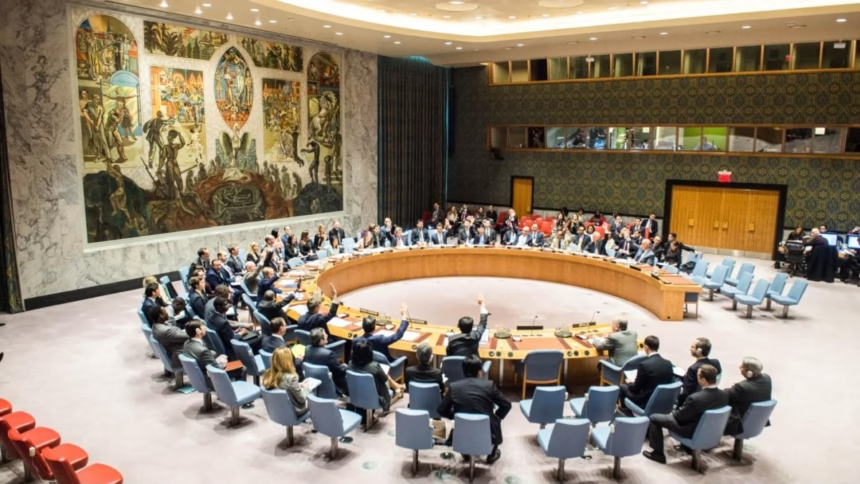
On Tuesday, the United Nations Security Council decided to extend the mandate of the Gang Suppression Force in Haiti until 31st March 2027, maintaining the international mission there even though gang violence is increasing and the force is still well below the size it had been promised. The resolution passed by 12 votes, with none against it; China, Russia and Pakistan voted against it, citing reservations about the force’s mandate, its financing and the dangers faced by troops on the ground.
Nearly a year after the Council approved the force under Resolution 2793 in September 2025, the difference between the mission as stated and the mission actually carried out remains great. By early July, about 1,083 uniformed personnel had been deployed — representing only about a fifth of the 5,500 the resolution authorized.
Igor Rugwiza, a spokesperson for the force, admitted it would not be able to achieve full operational capacity on the original schedule. The difficulties in question are practical and persistent: the need to get heavy equipment into the country, the necessity of coordinating troops recruited from a range of countries including Chad, Sri Lanka, Mongolia, El Salvador, Guatemala and Jamaica, and the task of establishing a supply chain in a nation where gangs control a large number of the main roads.
Money is also a limiting factor, since the organization depends heavily on voluntary contributions from member states to cover personnel costs. As a result, its financial situation is uncertain from year to year, making long-term planning difficult. The same lack of stability was partly responsible for the shortcomings of the mission it replaced—the Kenya-led Multinational Security Support mission, which ended earlier in 2026.
Earlier, Haitian Prime Minister Alix Didier Fils-Aimé had requested the extension.
At the UN General Assembly on Friday, he told the international community that approval alone would not change the situation on the ground. “A mandate is not sufficient; we need troops, we need equipment, and we need the determination to see things through to the end,” he said.
Fils-Aimé referred to Haiti as being at a “pivotal moment”, with criminal violence affecting the entire society. However, he rejected the idea of viewing the country as being under the care of the international community. According to him, Haiti was “neither defeated nor asking other countries to determine its future”, and he urged his partners “not to save Haiti but to stand by it as it takes charge of its own destiny”. He also said the government was training its own security forces, including a program to train 4,000 police officers, of whom more than 2,000 have already completed training, and an additional 15,000 soldiers over three years.
After giving his statement about the vote, Haiti’s ambassador to the UN, Pierre Ericq Pierre, warned that taking territory would not be sufficient. “It is not sufficient simply to take territory away from the gangs,” he said, adding that authorities must be able to hold the territory and prevent the gangs from returning once operations end.
On Monday in the Artibonite department, members of the Kokorat San Ras gang killed at least 11 people – the mayor of the area said the number was between 11 and 12 – in the commune of Gros-Morne. Local officials stated that the attack was in response to an operation carried out a few hours earlier by a Sri Lankan unit of the Gang Suppression Force, which had driven the gunmen away from the illegal toll posts they had established in the region before the troops went back to their base in Gonaïves.
Hubert Cénéac, who is the mayor of Gros-Morne, told Radio Kiskeya that the gunmen began attacking the residents after the soldiers had departed, killing people and setting homes on fire in the hamlets of Savann Long and Grépin. Local officials in the area have described this sequence before: a short security operation followed by retaliatory action against civilians after the forces withdraw. Gros-Morne is a stronghold of the Kokorat San Ras, one of the gangs which have expanded out of Port-au-Prince into the Artibonite, Haiti’s main agricultural region.
The total number of deaths is still rising. United Nations figures show that over 3,000 people were killed as a result of gang violence in the first six months of 2026, and about 1.5 million Haitians are now internally displaced – a record, as the UN and the International Organization for Migration data indicate.
Beneath the crisis lies a continuous supply of weapons which keeps the gangs armed.
The weapons get to Haiti mainly by sea and are connected to other criminal networks, such as those involved in drug trafficking. Yet at the same time, port security is still poor – a combination that UN experts have on numerous occasions pointed out as contributing to the violence.
The renewal gives the operation a legal basis until 2027. However, both Haitian officials and the Council members who had abstained referred to the same unresolved questions which have plagued the mission since it began: there are too few troops, funding is not predictable, and there is no definite plan for protecting civilians in the towns and in the rural areas beyond the capital, as the case of Gros-Morne this week has shown, where the cost of the gap is seen in lives.
https://ctninfo.com/haiti-security-council-renews-mandate-of-gang-suppression-force/
https:// www.facebook.com/CaribbeanNewsMedia
https://ctninfo.com/haiti-security-council-renews-mandate-of-gang-suppression-force/
https://
 www.facebook.com/CaribbeanNewsMedia
AI Use Policy:
Some of CTN’s journalists are not native English speakers and draft their work in French or Haitian Creole. We then use AI-assisted translation software to produce the English versions, and traces of machine-generated phrasing may occasionally remain. Every article — in any language — is written, reviewed, and edited by CTN’s staff writers and editors, who remain responsible for its accuracy. CTN also uses AI to convert text into audio.