


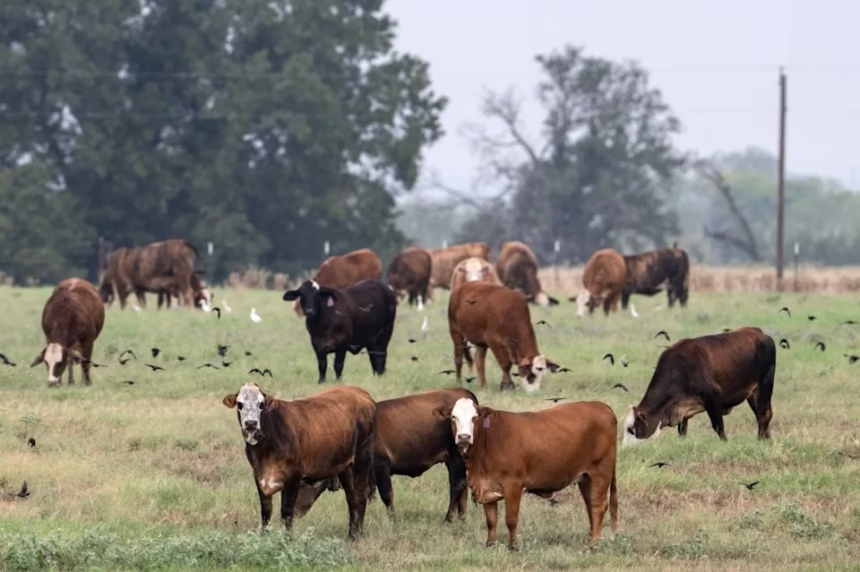
Several organizations representing a large part of the American cattle industry have issued an unusual public warning that the Trump administration’s immigration enforcement in the southern Plains is disrupting beef transport from feedyards to processing plants and that consumers should expect higher grocery prices.
On September 24, a joint statement issued from Topeka said the Kansas Livestock Association, the Oklahoma Cattlemen’s Association and the Texas Cattle Feeders Association were “closely monitoring reported U.S. Immigration and Customs Enforcement (ICE) activity affecting agricultural communities in Oklahoma, Kansas, and Texas”. The three organizations represent producers and feeders in an area which supplies a large portion of the nation’s beef.
The main issue was one of practicality, not politics. As the associations pointed out, thousands of cattle meant to be taken to processing plants were delayed, resulting in “millions of dollars worth of lost revenue and extra costs”. The problems had not been limited to the feedlots but had spread over to dairies, meatpacking plants, suppliers of feed and grain, trucking centers, and the small-town services which rely on them.
At the heart of the industry’s position is an assertion that runs counter to the administration’s account of who it aims at. The groups claim that the enforcement action is having “a massive chilling effect on legitimate, properly documented, skilled workers who provide the beef for the market.” They argue that authorized workers, not just those without status, are staying home out of fear, causing a labor shortage that hampers an industry dependent on strict timetables and perishable animals.
Plants running short-handed
The effects are clearest in southwest Kansas, home to some of the largest cattle slaughter plants in the country. According to reporting by the agricultural news service Agri-Pulse, the facilities in Dodge City, Liberal, Garden City, and Holcomb—these including Cargill and National Beef operations which each process around 6,000 head of cattle per day—have been identified as affected, one of the plants in Liberal having changed its shift times as a result of ICE activity.
Nick Levendofsky, executive director of the Kansas Farmers Union, said enforcement actions had been reported in Dodge City and Garden City. Martin Rosas, president of United Food and Commercial Workers Local 2, the union that represents the packing-house workers, called it “an unimaginably difficult time” for the communities of Liberal and Dodge City, since the plants are among the largest employers there.
The decline was evident in the figures; the estimated number of U.S. cattle slaughtered on September 24 was about 90,000, down from about 107,000 a week earlier, according to agricultural data Reuters reported. The industry said the drop was partly because packing workers avoided the plants in Dodge City and Liberal.
While not everyone in the area wanted the operations to stop, some felt they should be carried out differently. As reported by Agri-Pulse, Senator Roger Marshall, a Republican from Kansas, said ICE “needs to coordinate with our local law enforcement”; this indicated tension from a member of the president’s own party in a state that strongly favors him.
A dispute over what is happening
The Department of Homeland Security objected to the suggestion. “ICE is not carrying out worksite operations in Kansas,” a DHS spokesperson told Newsweek, the magazine that first published the association’s warning. The agency stated that its officers had conducted operations “targeting heinous criminals such as murderers, rapists, and drug traffickers”, as well as people who have final orders of removal.
To support that explanation, DHS cited several recent arrests in Kansas. It cited as examples a Mexican national who was arrested in Dodge City and who the agency stated had convictions for kidnapping and sexual assault, and two Laotian nationals who were arrested in Hutchinson and who it described as having homicide convictions. The department’s list focused on the offenders’ violent criminal histories; it did not deal with the association’s main claim that the wider climate of enforcement was causing documented workers to leave their jobs.
The discrepancy between the government’s account of targeted arrests of individuals with serious convictions and the industry’s claim that its workforce has become too frightened to turn up remains at the heart of the issue. The cattle groups did not challenge the government’s authority; instead, they stated that they “recognize the federal government’s responsibility to enforce immigration law”, while at the same time arguing that sudden losses of workers have serious implications for animal welfare and food safety beyond the individual businesses that have been raided. They asked the officials to enforce the law “in a lawful, orderly, and transparent manner”, to respect due process, and to communicate with the employers and the towns affected.
The price pressure behind it
The administration was already under pressure due to high beef prices when the warning was issued. The Bureau of Labor Statistics reported that the average price of 100 percent ground beef in the United States was $6.92 per pound in August. President Donald Trump has faced ongoing criticism over grocery prices. In an attempt to address the issue, his administration has employed various measures: the Justice Department is currently looking into beef pricing at eight major retailers, such as Walmart, and on August 21, the president announced that up to 300,000 metric tons of beef could enter the country without tariffs for a period of 90 days. A Newsweek analysis of Civiqs polling showed no immediate change in prices after that announcement and found that the president’s net approval had dropped since the beginning of his term in all ten of the largest beef-producing states, such as Kansas, Texas, and Oklahoma.

https://ctninfo.com/?p=44770&preview=true
https://www.facebook.com/CaribbeanNewsMedia
https://ctninfo.com/?p=44770&preview=true
https://www.facebook.com/CaribbeanNewsMedia
AI Use Policy:
Some of CTN’s journalists are not native English speakers and draft their work in French or Haitian Creole. We then use AI-assisted translation software to produce the English versions, and traces of machine-generated phrasing may occasionally remain. Every article — in any language — is written, reviewed, and edited by CTN’s staff writers and editors, who remain responsible for its accuracy. CTN also uses AI to convert text into audio.
Some of CTN’s journalists are not native English speakers and draft their work in French or Haitian Creole. We then use AI-assisted translation software to produce the English versions, and traces of machine-generated phrasing may occasionally remain. Every article — in any language — is written, reviewed, and edited by CTN’s staff writers and editors, who remain responsible for its accuracy. CTN also uses AI to convert text into audio.