


Dozens of people filled City Hall Plaza on Thursday under a coalition of more than 53 organizations, demanding the United States Senate pass legislation to extend Temporary Protected Status for Haiti — and answering, directly and by name, the senator who had blocked that bill on the floor a day earlier.
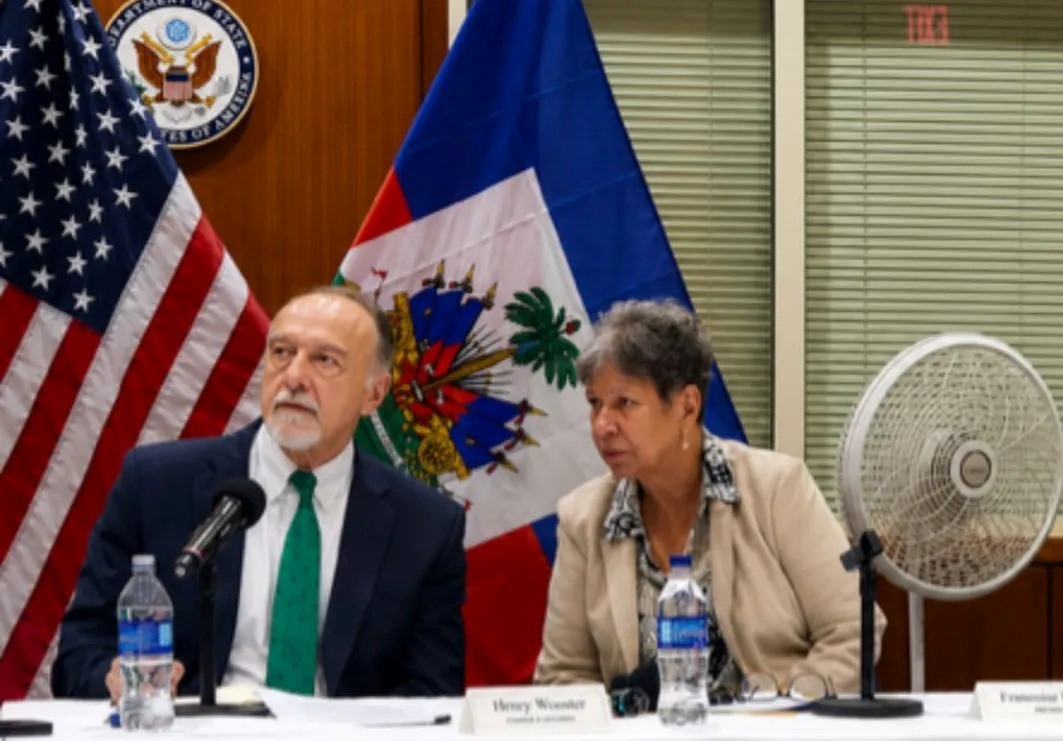
Senator Eric Schmitt, Republican of Missouri, objected Wednesday to Senator Ed Markey’s request to pass H.R. 1689 by unanimous consent. In his floor remarks, Schmitt said that “when house guests become squatters, you don’t delay enforcement. You call the sheriff, and you send them home.”
That line traveled to Boston overnight, and the rally’s opening speaker took it up before anything else.
“When Senator Eric Schmitt yesterday had a chance to be on the right side of history, guess what he said?” pastor Dieufort Fleurissaint, who opened the program, asked the crowd. “Oh yes, we are here. This is our country. And when the squatters are too much, we just ask them to leave.”
He answered it himself: “Shame on you to call us. Shame, shame, shame — to call our people, those who have devoted themselves, have given so much to this country, you call them squatters. You remove the image of God that we all carry, and then you call yourself a senator.”
The demand from the plaza was specific, and the crowd repeated it on cue through the afternoon: pass Senate Bill 4814, the companion measure Markey introduced with Senator Lisa Blunt Rochester, and pass it before Haitian work authorization runs out in a matter of days.
“Congress must act now,” the crowd chanted. “When do they act? Now.”
‘I am angry’
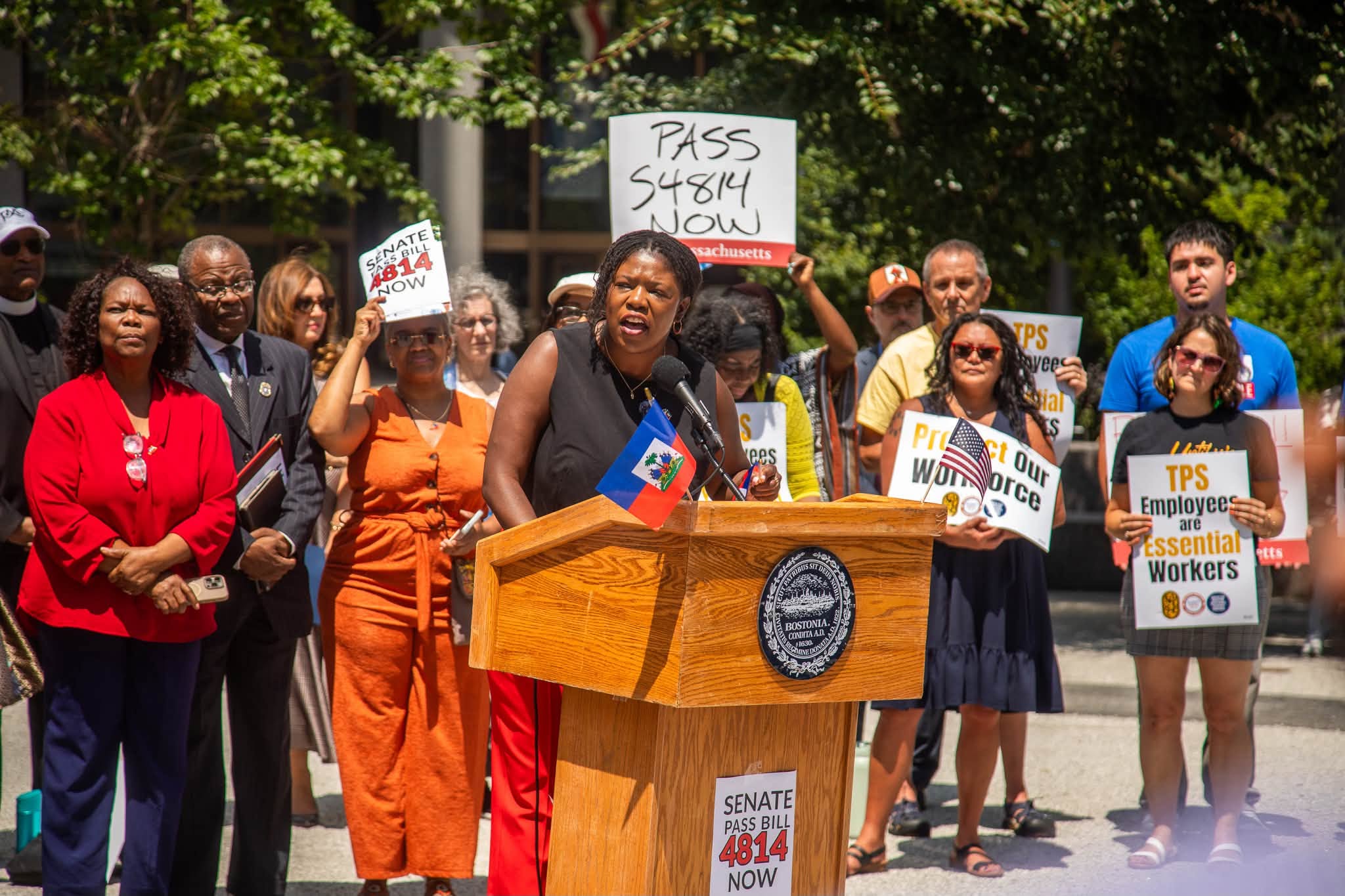
Boston City Councilor at-Large Ruthzee Louijeune, the first Haitian American elected to the council, opened her remarks without preamble.
“I am angry,” she said. “I am angry at who they are trying to tell us we are by these actions of a racist administration that is trying to put people against each other. They want us to blame the immigrants so we don’t blame the billionaires.”
Louijeune, who grew up in Mattapan and Hyde Park, described a legal clinic she had attended the week before — a room, she said, full of people who have been in the country for decades and now cannot answer basic questions about their own lives.
“They’re asking me, ‘Will I have my job? What will happen to my children?” She said. And while she was in that room trying to answer them, she said, she received an article reporting that the administration would be increasing deportation flights to Haiti.
She laid the two facts against each other.
“A country where kidnapping is rampant, that is leading in hunger, where 90 percent of the capital is controlled by gangs, where our very country has said level four, do not travel there, but yet we believe that it is safe to send human beings who have been our neighbors back there,” Louijeune said. “Make it make sense. It doesn’t.”
She spoke about the case that produced this moment as one that reaches beyond Haiti.
“Today, we are talking about Haiti. This was a Supreme Court case about Syria and Haiti. But it is about all of the countries that have TPS. All 17 countries. They all matter,” she said. “As we have very clearly seen by a Supreme Court that is comfortable on treading on voting rights, treading on environmental rights — tomorrow it will be you.”
Louijeune rejected the argument that the Senate is a dead end, pointing to the chamber that has already acted.
“Everyone says, ‘Oh, we can’t pass it in the Senate.’ They said that at the House level as well. They said we couldn’t pass it, and then a coalition was built to pass it at the House level,” she said. “We must have hope. When we don’t have hope, we have nothing else.”
She closed on a Haitian proverb — men anpil, chay pa lou, many hands make the burden light.
“As I started, saying I’m angry — I am still angry,” she said. “But I know that our collective anger can move mountains.”
‘You belong’
Lieutenant Governor Kim Driscoll began by reading the crowd’s signs aloud, then delivered the state’s position in two words.
“Here in our state, in our Commonwealth of Massachusetts, we have a different message. It’s very simple,” Driscoll said. “You belong.”
She rejected the premise underlying the termination, citing the government’s own assessment. “Our own State Department does not believe Haiti is safe, or Syria is safe,” she said. “Sending people back to extraordinary violence and instability is not compassionate. It is not practical, and it is not worthy of our country’s values.”
Driscoll described what the decision has already done in Massachusetts before anyone has been removed. “This decision is already creating fear for thousands of families across Massachusetts. Thousands of children across Massachusetts. Parents are wondering whether they’ll be separated from their kids. Workers won’t know if they’ll be able to keep their jobs. Employers are losing valued employees. Communities are losing neighbors who’ve become part of the fabric of our state.”
Then she named the neighbors.
“These aren’t strangers. They’re the nursing assistants caring for your loved ones. They’re the child care providers, the small business owners, the construction workers, the home health aides, the entrepreneurs,” she said. “They pay taxes, they volunteer, they worship alongside us, and they’re helping build a stronger Massachusetts every single day.”
The Lieutenant Governor, who described herself as the daughter of an immigrant from Grenada, said the policy tells people something she does not accept.
“It tells people who have done everything we’ve asked of them, everything — that they no longer belong, that there isn’t a place here,” she said.
She quoted the Nobel laureate and Holocaust survivor Elie Wiesel, who taught for decades at Boston University, paraphrasing his warning that silence serves the oppressor, not the oppressed.
“When you think it doesn’t matter if you stand up, or you have that conversation with your neighbor, or you’re here today — it does,” Driscoll said. “It is not over. This fight is not over. Congress must act. Our federal government must choose compassion over cruelty and common sense over politics.”
Driscoll then presented a governor’s citation to Geoffrey Pipoly, the attorney who argued the Haitian TPS case at the Supreme Court, “in recognition of your courageous defense of TPS status.” The City Council also presented him with a resolution.
“People are worth fighting for,” Driscoll said. “That’s what this is about today.”
The lawyer who took it to the Supreme Court
Pipoly, a partner at Bryan Cave Leighton Paisner who argued Miot v. Trump before the justices in April, opened by refusing the spotlight.
He directed it first at his clients — five people who put their names on a lawsuit accusing the President of the United States of racism while their own status hung in the balance.
“That’s Fritz. That’s Ma. That’s Marlene. That’s Philbrun. And that’s Rudolph,” he said. “Do not forget them. They have more courage in their little finger than most people have in their entire bodies.”
He then recognized his co-counsel, Andrew Tauber, who sat beside him at counsel table in the Supreme Court, and described a schedule that ran from 350 pages of district court briefing in December to oral argument in April — “which, just let me tell you as an appellate lawyer, is incredibly fast.”
Pipoly told the crowd his own family’s story: Hungarian immigrants who arrived roughly 110 years ago and settled in northeast Ohio, where his grandfather was discriminated against for being Hungarian, his father could not get a job, and, within two generations, the family produced doctors, lawyers, and business people.
“My grandfather and my family view supporting immigrants as an act of patriotism,” he said.
He said he is saddened that so many Americans with family histories like his have forgotten them. “As I told Justice Alito in the Supreme Court, a hundred years ago, Italians were not considered white, and they were excluded,” Pipoly said. “Hell, the Irish weren’t considered white. I’m in Boston. There’s plenty of knowledge about that around here.”
He recounted asking his grandfather how the family got into the country through the port of Philadelphia.
“He said, ‘Well, what do you mean? We walked on shore. They changed our name, and then we set up shop in Ohio,” Pipoly said. He asked what would have happened if they had been turned away. “My grandfather said, ‘We would have jumped off the boat at night and swam to shore.'”
That exchange, he said, is the answer to a familiar line.
“The only reason that folks who look like me and who have family stories like me say things like, ‘My ancestors did it the right way,’ is because there was no wrong way,” Pipoly said. “My family had a shot. Countless other families have a shot. Families from Haiti, Honduras, Nicaragua, and Syria deserve a shot, too.”
He described a lunch of Haitian-American lawyers in Chicago the weekend before the Supreme Court ruled. Everyone stood, hands over hearts, for the national anthem, and a Christian pastor said a blessing.
“My first thought was, what more assimilation do people want? What is it? What more do you want these folks to do?” Pipoly said. “No one loves America like immigrants love America. They make our country better.”
On the case itself, he was deliberately spare.
He referred the crowd to the joint status report filed July 10 and said the legal team is evaluating options in light of the ruling.
“I would rather the government not know what I’m thinking right now,” he said. But he offered an assurance: “Every decision that we have made and will make in this case is made with one and only one consideration in mind, and that is what is best for our clients and for the TPS community at large.”
He said seven and a half years of representing TPS holders had taught him something about the people he represents. “They are a bunch of tough cookies,” he said. “The amount of stuff that they’ve been through in their home country just to get here and work.”
Pipoly closed with an organizing instruction, aimed at anyone in the crowd with family elsewhere.
“If you’ve got friends and family in other states, any state, tell them to support 4814,” he said. “Lives depend on it, and America will suffer if we don’t pass it.”
He said he had been skeptical the bill could pass the House, and it did. “If there’s one thing working for the Haitian community has taught me, it’s that miracles do happen. And I’m holding out hope for a miracle on 4814.”
The mayor
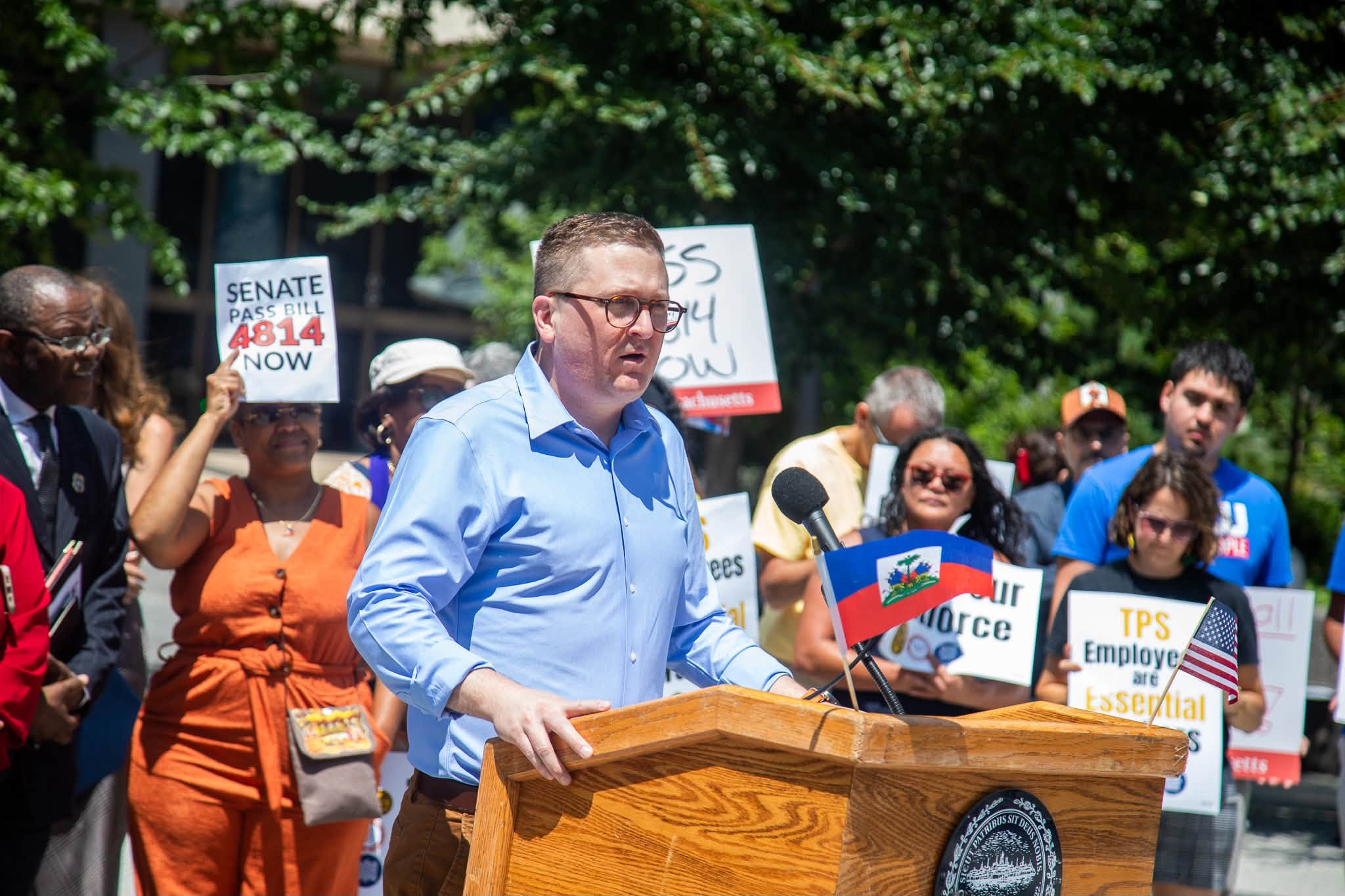
Mayor Michelle Wu opened with gratitude rather than anger, and then made the case through her own family.
“Forty-some years ago, my parents left Taiwan and took a chance on America. Not every moment has been happy or easy. There have been many days of struggle, of sacrifice, and I’ve witnessed that as the oldest kid in my immigrant family,” Wu said. “But at every step along the way, my parents would say that they took the right chance. That their bet on America paid off.”
She said the community gathered on the plaza is the reason the city works.
“Our immigrants are the reason why Boston is the greatest city on the planet. Our Haitian neighbors are the reason,” Wu said. “And we will do whatever it takes on any day to stand with our neighbors.”
Wu pointed out that the current position contradicts an earlier one taken by the same President’s own administration.
“In 2017, Donald Trump’s own Secretary of Homeland Security declared that Haiti was not safe for people to go back to, and therefore that TPS needed to be extended,” she said. “The conditions have only gotten worse in the years since then.”
She framed the harm as running past the people who hold the status.
“It is cruel and unjust for our entire community to face the level of fear and losing our loved ones, our colleagues, the people who care and build our community to who we are,” Wu said. “We’re not asking for charity. We’re not asking for exceptions. We’re asking simply for the values of this country to still be reflected in the decisions that are made.”
Wu invoked the city’s own record — 1776 — and the Boston Vigilance Committee, formed in 1850 in defiance of the Fugitive Slave Act.
“In every major moment and movement for justice along the way, this city has led, because we know how to organize,” she said. “We never give up, and we will always, always take care of each other.”
She reached, too, for something more recent. “We all cheered when Lenny Joseph knocked that one in from the right corner with Haiti’s first World Cup goal in 52 years,” Wu said. “And we were cheering for our community, our neighbors, who we feel are part of what makes Boston Boston. We’re not going to let that change.”

The faith leaders
The Rev. Dr. Ray Hammond of Bethel AME Church, an executive member of the Greater Boston Interfaith Organization, led the opening prayer alongside his wife and co-pastor of 53 years, the Rev. Dr. Gloria White-Hammond.
Before praying, he asked the crowd to turn to the people around them and greet anyone they did not know.
He said his congregation had hosted 120 migrant neighbors living under TPS. “We know the progress that they made, the sacrifices, the things that they face, the contribution that they are making,” Hammond said, “and we do not want to see that go away.”
His prayer set the crowd’s demand in scripture. “Our scriptures teach us, ‘You shall not oppress a stranger, for you know the heart of the stranger, since you were strangers in the land of Egypt,'” he said. He recalled Ruth, who left her homeland and found refuge in a foreign field, and “the one who had to find temporary protected status in Egypt to escape a callous and murderous leader named Herod.”
He prayed for the Senate, for Markey and for S. 4814, and for “every senator still deciding.” He prayed for Pipoly and for the courts still weighing the cases. And he prayed for the people standing on the plaza.
“Protect us from fatigue. Protect us from despair,” Hammond said. “And let us be less enraged and more engaged in organizing, resisting, and moving our country forward, not backward.”
Pastor Dieufort Fleurissaint, who emceed the rally, opened the program on the same ground, describing a gathering not of officials but of “neighbors, people of faith, employers, caregivers, and community leaders united by one conviction. Every person deserves dignity, justice, and compassion.”
TPS, he noted, has allowed families from more than 17 countries to “work, worship, raise their children, care for our elders, and strengthen our communities.”
“They are essential workers, business owners, taxpayers, church members, and beloved neighbors,” he said. “They have invested in America, and America must not abandon them.”
Contents
‘I am angry’She laid the two facts against each other.‘You belong’Then she named the neighbors.The lawyer who took it to the Supreme Court“My grandfather and my family view supporting immigrants as an act of patriotism,” he said.On the case itself, he was deliberately spare.The mayor“It is cruel and unjust for our entire community to face the level of fear and losing our loved ones, our colleagues, the people who care and build our community to who we are,” Wu said. “We’re not asking for charity. We’re not asking for exceptions. We’re asking simply for the values of this country to still be reflected in the decisions that are made.”The faith leaders“Protect us from fatigue. Protect us from despair,” Hammond said. “And let us be less enraged and more engaged in organizing, resisting, and moving our country forward, not backward.”“They are essential workers, business owners, taxpayers, church members, and beloved neighbors,” he said. “They have invested in America, and America must not abandon them.”“They say the title is temporary. But there are two ways to record time,” he said. “One is chronologically, with your watch or your calendar, and that’s the way they think. But the other way, and I feel the right way, is kairos — the opportune moment. Now you tell me that this is the opportune moment for our Haitian brothers and sisters to be sent back to Haiti.”The employers’ caseCorrecting the recordWhat comes next“Let’s say together,” Wu told the crowd near the end. “Congress must act now.”
https://ctninfo.com/shame-on-you-bos…itians-squatters/
https://www.facebook.com/CaribbeanNewsMedia
He returned to it later, more bluntly: “Our TPS families, they are our neighbors. They are our brothers and sisters. They are the ones taking care of so many in the hospital. They are not disposable, and we cannot remain silent.”
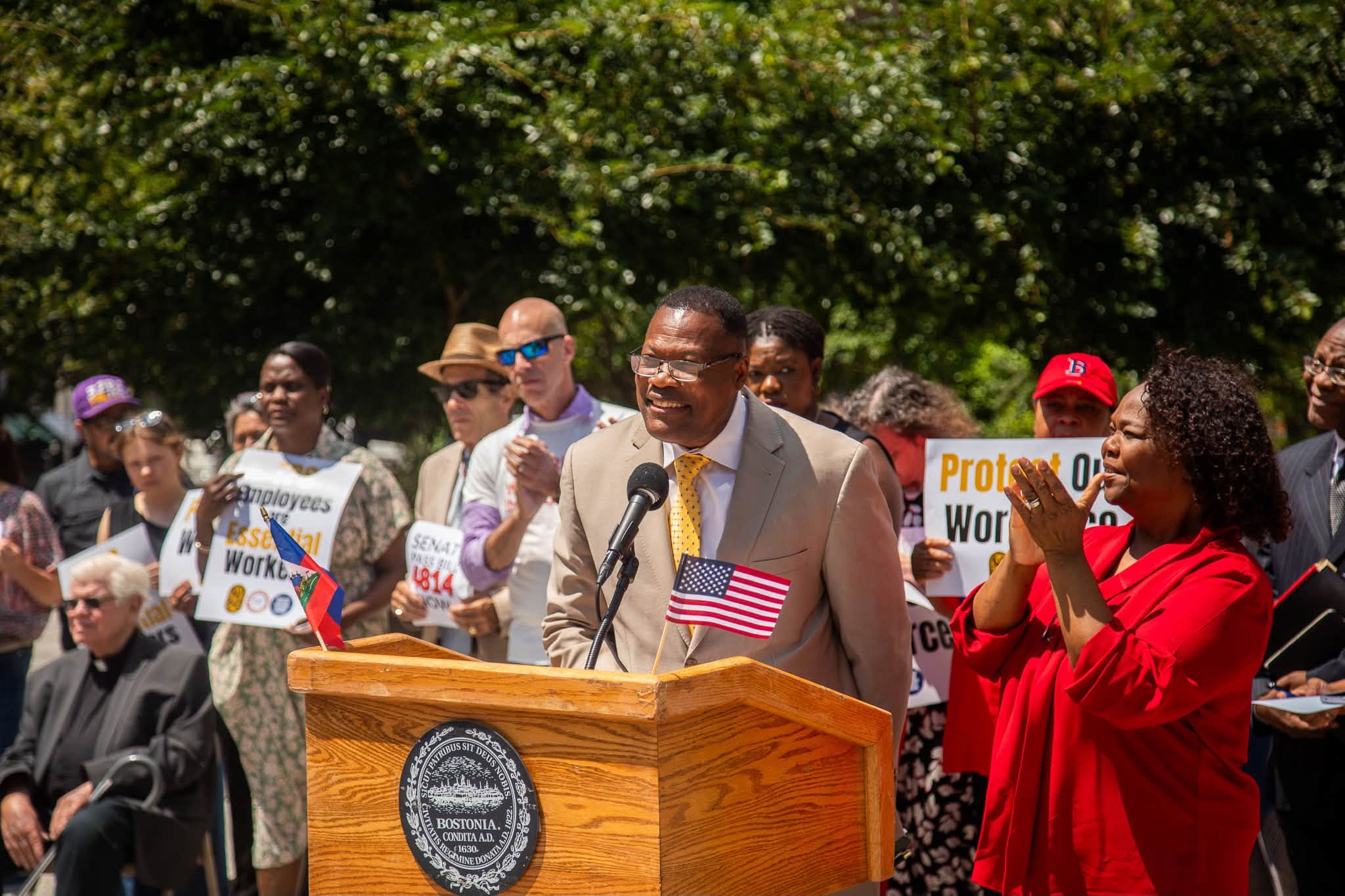
A Catholic priest who spoke later introduced himself as an outsider offering help. “Who am I? I’m a Samaritan, a foreigner who’s hoping that he can help. And I think there are many other Samaritans here as well.”
He walked the crowd through Haitian history for those who did not know it: independence in 1804, the first Black republic in the Western Hemisphere, followed by what he called “a new slavery” — the indemnity Haiti was forced to pay France, borrowed at high interest and not fully repaid until 1947.
Then he took apart the word at the center of Schmitt’s objection.
“They say the title is temporary. But there are two ways to record time,” he said. “One is chronologically, with your watch or your calendar, and that’s the way they think. But the other way, and I feel the right way, is kairos — the opportune moment. Now you tell me that this is the opportune moment for our Haitian brothers and sisters to be sent back to Haiti.”
He pointed to a detail in the State Department’s Level 4 advisory that the other speakers had not mentioned: guidance that Americans who travel to Haiti anyway should leave DNA samples and dental records with their families so their remains can be identified.
“How horrendous is that?” he said. “This is the atmosphere that we’re sending our Haitian brothers and sisters back to.”
He offered a Haitian proverb of his own — tout moun se moun. “In Washington, they’ve never heard the expression,” he said. “And indeed, everybody is a somebody.”
He described Haitian TPS holders’ remittances home — by his figures, $1.7 billion a year from TPS holders and roughly $4 billion from Haitians in the United States overall — and argued those transfers should be seen as an instrument of policy rather than a loss.
“It seems to me that you are a valuable commodity to our country,” he said, and offered what he called a dream: TPS holders sending money home to feed families, school children, and pay for health care, working alongside a restored U.S. Agency for International Development building roads, schools, and hospitals.
“Peace through strength is not the answer. Peace through development is the answer,” he said. “If I dream alone, it’s only a dream. But if we dream together, it will be a reality.”
The employers’ case
A representative of Eastern Bank and the Eastern Bank Foundation, which has been calling Massachusetts employers to build support for S. 4814, made the economic argument directly.
“The future of temporary protected status for TPS holders is not just a humanitarian issue, but it is an important economic issue whose impact will be felt not only by those with TPS, but by the businesses that employ them and the people of Massachusetts who benefit from their presence,” she said.
She said nearly 45,000 Haitian TPS holders live in Massachusetts, employed across every sector of the state economy — nursing aides, home health care workers, retail and warehouse employees, food service workers, drivers, cleaners, construction workers, and small business employees.
“Removing these workers without a practical and thoughtful strategy will compound the negative impacts caused by the termination of the temporary protected status,” she said, warning that care for older people will likely deteriorate quickly if nursing employees holding TPS disappear without a plan. That state and local tax bases will take lasting damage.
Correcting the record
One of the rally’s organizers used the presence of the press to challenge a claim made by Homeland Security Secretary Markwayne Mullin, who said in a television appearance after the ruling that TPS holders following the law could simply apply for another status.
“As if it were that easy,” she said. “If it were easy for people who had TPS to apply for another status, they would have done that.”
She noted what TPS eligibility already requires. “For you to have TPS, you cannot have any felony convictions,” she said. “Inherent in being a TPS holder means that you are a law-abiding resident here in this city, in the country.”
She added a criticism of the program itself that sat uneasily beside the day’s demand to preserve it. “Temporary protected status was never the gold standard. It was always, and continues to be, problematic, because it doesn’t provide a permanent pathway.”
“We cannot lie to the American people about who our TPS holders are,” she said. “We cannot lie to the American people about who our immigrants are, or about what the data shows about the vast majority of our immigrants who are here, who love this country, who pay taxes in this country, and who are law-abiding residents.”
What comes next
The coalition on the plaza ran past 53 organizations and crossed lines that do not always meet — 1199SEIU and the Greater Boston Labor Council, the Painters Union, which supplied the signs, the ACLU, Catholic Charities, the Greater Boston Interfaith Organization, the International Institute of New England, the Brazilian Women’s Group, the Boston Haitian Resource Hub, the National TPS Alliance, the True Alliance Center, the Immigrant Family Services Institute and the Association of Haitian Women in Boston, among many others.
“A big shout out to the Greater Boston Labor Council and the Painters Union for our signs, for their solidarity, and for recognizing that immigrant rights are workers’ rights,” an organizer said.
Organizers said a phone bank assembled in three days drew 25 volunteers calling senators to co-sponsor and vote for S. 4814, and they distributed cards and QR codes directing attendees toward more calls and toward funds set up by the Immigrant Family Services Institute, the Association of Haitian Women, the United Way, and the Boston Foundation.
“We need everyone to use their time, their talent, and their treasure in this moment,” an organizer told the crowd.
Also present were state Rep. John Moran, Boston City Councilors John FitzGerald and Brian Worrell, Randolph Town Councilor Natacha Clerger, and staff from the offices of Senators Markey and Elizabeth Warren.
The Senate has not scheduled H.R. 1689 for further action. After Wednesday’s objection, moving it requires ordinary floor time and the cooperation of the chamber’s Republican majority.
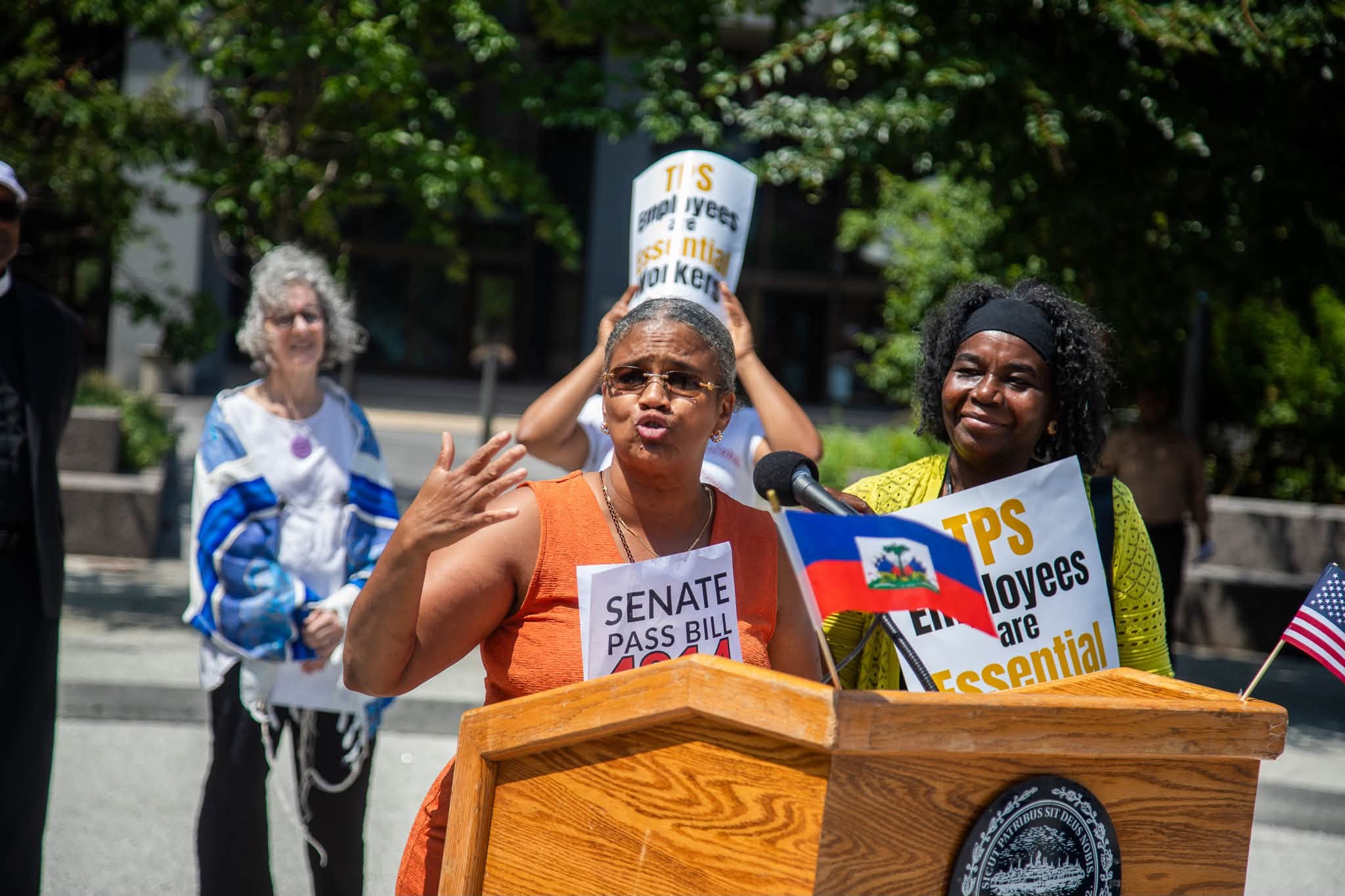
“Let’s say together,” Wu told the crowd near the end. “Congress must act now.”
https://ctninfo.com/shame-on-you-bos…itians-squatters/
https://www.facebook.com/CaribbeanNewsMedia
https://ctninfo.com/shame-on-you-bos…itians-squatters/
https://www.facebook.com/CaribbeanNewsMedia
Editorial Disclaimer:
This article was originally written in English. The French and Haitian Creole versions are produced using AI translation software, and errors are possible — the English version is authoritative. CTN also uses AI to convert text into audio.