


A single Republican senator blocked legislation to extend Temporary Protected Status for Haiti on the Senate floor Wednesday afternoon, halting a bill that had already passed the House and leaving hundreds of thousands of Haitian nationals days away from losing their legal authorization to work.
Senator Edward J. Markey of Massachusetts asked the Senate to take up and pass H.R. 1689 by unanimous consent — a request that clears a bill immediately if no member objects. Senator Eric Schmitt, a Republican of Missouri, rose to object, arguing that TPS was meant to be temporary.
The objection ends the fast path, not the bill. H.R. 1689 remains on the Senate calendar and can still be brought up through regular order, which would require floor time, debate, and a cloture vote before passage — a far heavier lift than the motion Markey attempted, and one that would require Republican cooperation to schedule.
Four Democrats spoke in support before and after the objection: Markey, Senate Democratic Leader Chuck Schumer of New York, Senator Lisa Blunt Rochester of Delaware, and Senator Chris Van Hollen of Maryland. Congresswoman Ayanna Pressley of Massachusetts, who forced the bill through the House in April, was present in the chamber.

The objection
Schmitt built his objection around the word “temporary.”
“Washington has invented a new definition of temporary,” he said. “It means permanent.”
He traced the designation to its origin. “Haitian TPS was supposed to be just 18 months when it began in 2010. 16 years later, 350,000 Haitians are still here.” He described a pattern he said applies across the program: “An emergency creates temporary status. Then the emergency passes, but the status stays. The deadline arrives, but Washington extends it. The voters demand enforcement, but Democrats refuse.”
Schmitt called that pattern “the TPS racket,” and said its purpose was political. “Democrats can use this scam to build a new political constituency, a new voter base.”
He argued the bill’s sponsors were disguising what they wanted. “If Democrats want 350,000 Haitians to stay permanently, they should say it plainly. Introduce a bill. Put your name on it. Vote for the permanent status. Then explain that vote to the American people.”

Schmitt also framed the measure as a cost borne by Americans. He said supporters “never seem to have any compassion for the American worker, competing against an ever-expanding cheap labor supply,” citing families priced out of housing, wages being undercut, and schools pushed past capacity.
He closed with an image that drew directly on the language of trespass. “America is not a global refugee camp,” he said. “America is our home. And when house guests become squatters, you don’t delay enforcement. You call the sheriff, and you send them home.”
Then: “Mr. President, I have the power to stop this nonsense bill, and I’m going to use it.”
Schmitt also said a child born when Haitian TPS began is “nearly old enough to vote or sponsor their family for green cards.” A child born in January 2010 is 16. The voting age is 18. A U.S. citizen must be 21 to petition for a parent.
The request that was blocked
Markey’s motion was procedurally narrow. He asked that the Senate proceed to immediate consideration of calendar item 374, H.R. 1689, that the bill be read a third time and passed, and that the motion to reconsider be laid on the table. Schmitt’s objection stopped it all.
The bill itself consists of a single operative sentence: it directs the Secretary of Homeland Security to designate Haiti for Temporary Protected Status until three months after January 20, 2029. Markey described the target plainly on the floor — a designation running “until after the next presidential election.”
The bill reached the Senate because Pressley collected 218 signatures on a discharge petition in March, forcing a vote that House leadership had not scheduled. It passed the House on April 16 by 224 to 204, with 10 Republicans joining Democrats. Markey and Blunt Rochester introduced the Senate companion, S. 4814, on June 17.
Markey opened his floor remarks by assigning credit elsewhere — to Blunt Rochester for leading the Senate effort, to Schumer, and to Pressley.
“I would really like to thank Massachusetts Congresswoman Ayanna Pressley for leading the successful effort in the House of Representatives to extend Haiti’s TPS designation,” he said, adding thanks “for her partnership not only today but in her years-long fight to advocate for our Haitian and Haitian-American communities.”
The contradiction Democrats pressed
The argument Markey returned to most forcefully was not economic. It was that the government is telling Americans and Haitians opposite things about the same country.
“The State Department currently advises American citizens against traveling to Haiti because of the dangers and instability,” Markey said. “And that’s utter hypocrisy.”
He put the point in its starkest form: “You can’t tell Americans it’s too dangerous to go to Haiti and then say that you’re going to tell 350,000 Haitians they’ve got to go back to a place that’s too dangerous for any American to go and visit.”
Van Hollen made the same argument from the floor, tying it to the program’s statutory logic. “The State Department continues to warn Americans not to travel to Haiti because of crime, kidnapping, terrorism, unrest, and other factors,” he said. “The country remains under a state of emergency and the United States government has extremely limited ability to provide any emergency assistance even to our own citizens who are there now.”
Van Hollen added a standard he said the assessment ought to follow: “When you’re evaluating whether it’s safe to force anybody back to their country of origin, we’re supposed to look at whether the situation’s getting better or worse. It’s getting worse over a long period of time in Haiti.”
Markey described armed groups exerting control over much of Port-au-Prince, and kidnappings, targeted violence, and blockades making it difficult for people to reach hospitals, attend school, or obtain basic services — compounded, he said, by earthquakes, hurricanes, and recurrent flooding damaging infrastructure already stretched past its limit.
“It is clear that Haitian TPS holders cannot return home safely,” he said.
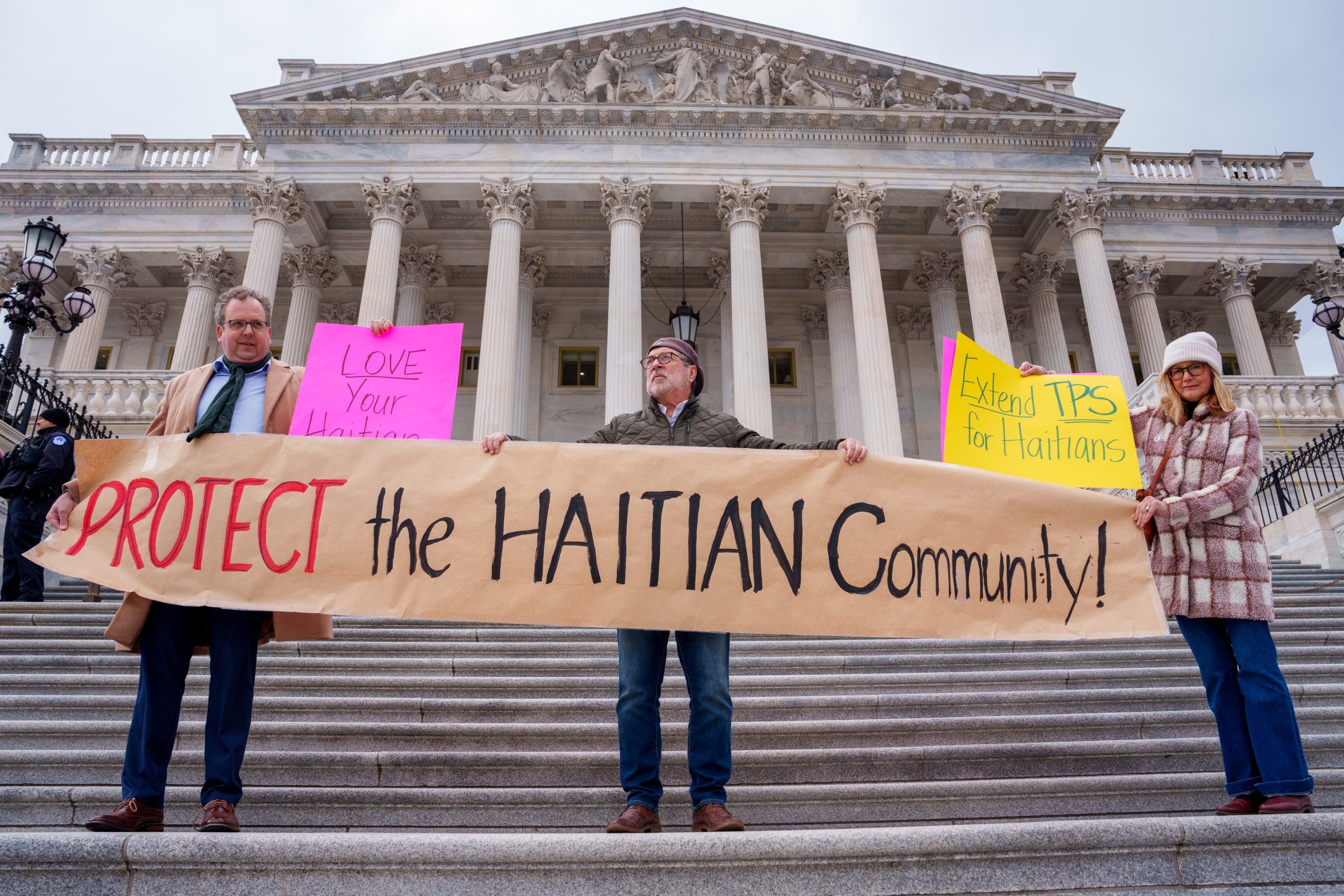
Blunt Rochester grounded her remarks in the experiences of two Delaware residents.
The first was a woman she identified as Marie, who came to Delaware with her family at 12. Blunt Rochester described a childhood organized around church — “Sundays spent at church, going to mass in the morning, spending the day with her family at the pastor’s house, and then going back to afternoon service.” Marie, she said, became one of the first Haitian realtors in the state, “where she helps families buy their first homes, establish roots, and get one step closer to the American dream.”
The second was a woman she identified as Ann, whose family fled to Delaware after gang war followed Moïse’s assassination. Ann received a deportation letter last April.
“Everyone in her family received the letter,” Blunt Rochester said, “including her one-year-old niece.”
Blunt Rochester described the choice that followed as one with no acceptable option. “Do you stay here illegally? They don’t want to do that. Do you try to figure it out and go back to a country with danger and chaos with a small child? Or do you flee?”
Ann and her entire family have left the country.
“Delaware is a state of neighbors, and we are losing neighbors,” Blunt Rochester said.
She said more than 5,000 Delaware residents hold Haitian TPS, and that her office has already heard from private employers being forced to let workers go as authorizations tied to the designation expire.
Markey drew the same picture at the scale of a kitchen table. He described a parent weighing whether to take a U.S.-citizen child who has never left the country into a place the State Department tells every American to avoid, or to leave that child behind.
“Imagine a mother or father sitting at their kitchen table tonight looking across at their child and trying to decide if that child has a better chance of survival returning to Haiti, a country consumed by violence, or staying in the United States, separated from the loving care of their parents,” he said. “If we do not act, this is the brutal reality of family separation that will play out in thousands of homes across this country.”
For those who remain, Markey said, the loss of status converts ordinary life into exposure. “No one should have to live through that constant fear of a sudden knock on the door or the panic of a random traffic stop.”
The workforce argument
Schumer, speaking minutes before Markey, made the case through the health care system.
“Revoking Haitians’ temporary protected status will not only hurt them, it hurts our entire country,” the Democratic leader said. “In New York, you can’t go into a hospital, a nursing home, or a clinic without seeing scores of dedicated health care professionals who are fiercely proud of their Haitian heritage. That’s true in cities and towns throughout the country.”
He said the warnings have been specific: that removing Haitian TPS holders “will strain our health system, create a gap in caregiving workforce that will be difficult to fill.”
“These people are our friends. They’re our neighbors,” Schumer said. “They take care of the elderly and people with disabilities. They’re entrepreneurs and small business owners. They work hard. They pay taxes.”

Blunt Rochester made the same argument and named the sectors — health care, agriculture, education, nursing homes, hospitals, senior centers — before adding a note about what she called the moral case coming first. “If the moral imperative doesn’t convince you, I’ll try the economic,” she said.
Markey listed the jobs by their relationship to the people who depend on them. “A Haitian TPS holder is a friend and a home health aide who has taken care of grandma or grandpa for years. A Haitian TPS holder is a co-worker and a construction worker who has helped build homes in our neighborhoods. A Haitian TPS holder is a neighbor and a small business owner on Blue Hill Avenue who helps support the livelihoods of others.”
He named the communities: Mattapan, Brockton, and Malden.
“They’ve protected our babies. They’ve soothed our sick,” Markey said. “They are us.”
Van Hollen argued that the program being dismantled was not a partisan creation.
“Temporary protective status, TPS, was established decades ago with bipartisan support because Congress understood then a very basic truth,” he said. “When people cannot safely return to their countries of origin, we do not put their lives at risk by forcing them to go back. That is the essence of the protection in TPS, and that principle is worth defending today.”
He drew a contrast with an immigration vote the Senate had taken earlier. Members had agreed, he said, that people who commit crimes and endanger communities should be deported. TPS holders are a different population.
“These are people who are working legally in our country. These are people paying taxes. These are not the worst of the worst,” Van Hollen said. “In fact, they have to check in every single year and make sure that they continue to meet the requirements of the law.”
He described the effect of ending the designation midstream as changing terms on people who had followed them: “Now we’re changing the rules on them midstream because what had been a bipartisan law, the temporary protective status program, is now having the protective status part of it ripped out.”
Markey traced the statute to a Massachusetts predecessor — Congressman Joe Moakley, a principal author of the TPS provision enacted in 1990. Markey quoted Moakley’s defense of the provision on the House floor that year, invoking a “deep moral obligation to protect innocent victims fleeing violence abroad.”
“His words remain as urgent and relevant today as they were when he spoke them,” Markey said. “Protecting the vulnerable is not a political choice. It is a moral duty.”
Markey on the Supreme Court, and on Trump
Markey reserved his sharpest language for the Supreme Court ruling last month that cleared the administration to proceed with the termination, reversing two lower courts.
“The far-right justices green-lit the Trump administration’s unlawful racist termination of TPS for Haiti and for Syria,” he said. “The court failed a test of morality. It slammed the doors of justice in the face of more than a million TPS holders, including 45,000 Haitian TPS holders in Massachusetts. It is an outrage. It is a travesty.”
He accused the President directly. “For years, Donald Trump has demonized and attacked Haitian TPS holders. Trump has spewed racist, cruel lies about Haitians.”
Markey and Van Hollen, with Pressley and Congresswoman Debbie Wasserman Schultz, led an amicus brief in that case in April on behalf of more than 180 members of Congress.
Markey also recalled traveling to Haiti after Hurricane Matthew in 2016 to deliver relief goods, at a time the country was still fighting the cholera epidemic introduced by United Nations peacekeepers after the 2010 earthquake. He said he led the effort that ultimately led to a UN apology to Haiti.
“I came away from that trip knowing that Haiti would continue to hurt and that the United States should do everything in its power to help the Haitian people,” he said. “Sadly, Haiti is still hurting.”
What happens now
Van Hollen and Blunt Rochester both closed by saying the objection settles nothing permanently.
“They may be able to block it today in the United States Senate, but we will keep working on this matter because it is a matter of important American principles,” Van Hollen said. He called it “a very sad day when what once was a bipartisan consensus” had been abandoned.
“Today, we had a chance to set things right,” Blunt Rochester said. “We had a chance to extend these protections to our Haitian neighbors. We had a chance to do the right thing. But I’m here to tell you, yes, elections have consequences and people are watching, and we’re not giving up.”
She thanked, by category, the people carrying the weight outside the chamber: “Thank you to all of the individuals who are supporting these families. Thank you to our staff who are receiving the phone calls. Thank you to the pastors who are praying.”
Markey said he would continue pressing. “I have called on every recent administration to designate, extend, and redesignate TPS for Haiti,” he said. “I will keep supporting this community.”
The immediate calendar does not wait for any of it. Work authorization tied to Haitian TPS is set to lapse at the end of this week — a deadline Van Hollen named from the floor as “as soon as the end of this week.”
H.R. 1689 stays on the calendar. Moving it now requires the ordinary machinery of the Senate: floor time, sixty votes to break a filibuster, and a majority to pass. Whether it gets that time is a decision for the chamber’s Republican majority.

https://ctninfo.com/republican-objec…-on-senate-floor/
https://www.facebook.com/CaribbeanNewsMedia
Editorial Disclaimer: This article was originally written in English. Other language versions are produced using AI translation software, and errors are possible — the English version is authoritative. CTN also uses AI to convert text into audio.