


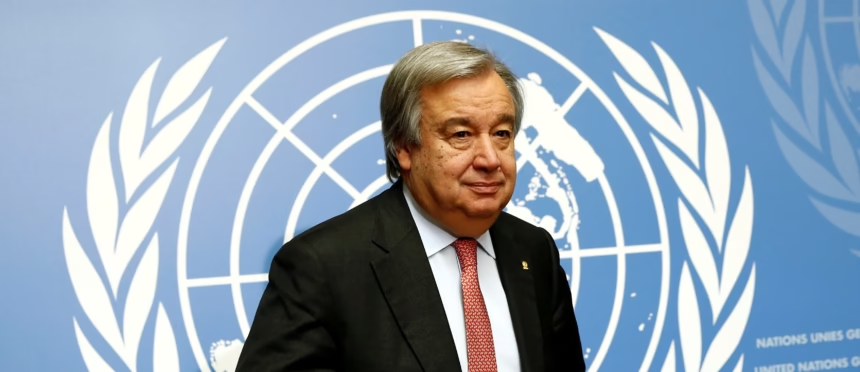
The international community has made its decision. The United Nations has categorically rejected the idea of opening any dialogue with the armed groups terrorizing Haiti. The UN expressed this unequivocal position after a surreal move: Wilson Joseph, the fearsome leader of the “400 Mawozo” gang, better known by the nickname “Lanmò San Jou” (“Death Has No Day”), recently sent an official letter to UN Secretary-General Antonio Guterres. In that letter, the crime boss requested international mediation as part of a possible dialogue with the authorities. The request was immediately swept aside by the world body.
By rejecting this request, the UN is sending an absolutely clear message: there is no place for negotiation with those who have plunged the country into chaos.
For the United Nations, armed gangs are not actors to be negotiated with, but criminal organizations that must be fought and neutralized. Accepting dialogue with warlords like “Lanmò San Jou” would amount to legitimizing their actions and endorsing impunity. The international community therefore maintains its hard line: the only language the UN intends to use with these groups is that of force, through the deployment of the Gang Repression Force (FRG) and unwavering support for the Haitian National Police (PNH).
Wilson Joseph’s move illustrates both the arrogance and the strategic calculation of these criminals. By writing to Antonio Guterres, the leader of “400 Mawozo” was probably seeking to buy time, to present himself as an indispensable interlocutor, or to negotiate some form of amnesty or transition. But the UN’s response serves as a reminder that justice is not negotiable.
“400 Mawozo”: A Macabre Record
To understand the UN’s categorical refusal, one must recall the appalling toll of armed groups in Haiti, and particularly that of the “400 Mawozo” gang. This group, which controls the strategic routes of Croix-des-Bouquets and part of the Plaine du Cul-de-Sac, has built a reputation for absolute terror.

Its crimes are innumerable and of unimaginable violence. “400 Mawozo” is notorious for having institutionalized mass kidnapping. In October 2021, the gang shocked the entire world by kidnapping 17 American and Canadian missionaries, including five children, and demanding a ransom of one million dollars per hostage. But beyond the high-profile cases, it is thousands of ordinary Haitian citizens—students, merchants, doctors, taxi drivers—who are kidnapped, tortured, and held for ransom every day.
The gangs do not stop at kidnapping; they kill with extreme savagery.
Massacres of civilian populations, collective rape used as a weapon of war, forced recruitment of child soldiers, and the burning of entire neighborhoods are their modus operandi. They have also brought the national economy to its knees by imposing illegal “tolls” on roads, extorting businesses, and blocking ports and oil terminals, plunging the country into repeated humanitarian crises and depriving hospitals of electricity and drinking water.
The macabre irony of Wilson Joseph’s letter to the UN lies in the fact that the man now requesting “mediation” is one of the main architects of the destruction of Haiti’s rule of law. For the Haitian population, this request for dialogue sounds like an insult. Residents of gang-controlled areas live in constant fear, forced to flee their homes and take refuge in unsanitary displacement camps, where hunger and disease lie in wait.
The UN’s position is therefore also a message of hope for the victims: the international community will not abandon Haiti to the hands of bandits. Secretary-General Antonio Guterres, who has recently multiplied calls for increased support for the security mission, insists on the need to restore state authority.
https://ctninfo.com/haiti-the-un-giv…-end-to-impunity/
https://www.facebook.com/CaribbeanNewsMedia