

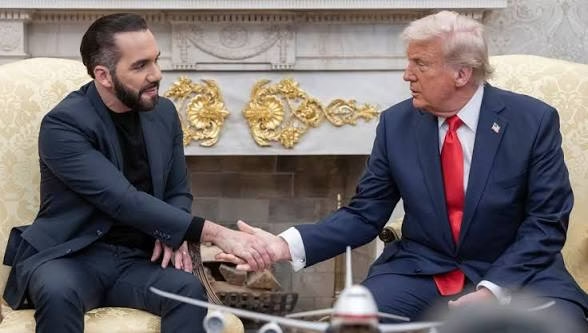
Donald Trump confirmed on Saturday that he had spoken with Nayib Bukele about the massive deployment of Salvadoran soldiers in Haiti. The U.S. president said he had spoken by phone with his Salvadoran counterpart and had left him free to act, reporting an unambiguous phrase: “I told him: listen, you run your country, you have to do what you have to do.” According to him, the exchange concerned the sending of more than 2,000 Salvadoran soldiers to Haitian territory, an operation presented as a response to the disappearance of four Salvadoran military aviation technicians, who were ambushed on October 18 in a neighborhood north of Port-au-Prince.
Trump specified that Bukele had not requested American help, judging that the Salvadoran leader “is in very good shape” and knew what he was doing. The White House confirmed the substance of the call, while the American press revealed that El Salvador had wanted to ensure, before committing its troops, that Washington would not oppose it.
It was in this context that Nayib Bukele stepped forward to categorically reject the accusations of a Haitian non-governmental organization accusing him of bombing civilian areas. In a statement published on his X account on Saturday, October 31, 2026, the Salvadoran president called the report by the United Nations Association – Haiti (UNA-Haiti) a pure invention; the report claims that Salvadoran forces have been shelling civilian neighborhoods since October 22. Bukele countered the accusation with a chronological argument that he presents as decisive: the attack helicopters that his army is accused of using only arrived in Haiti on October 29, a week after the alleged strikes began. “Bombs? Our mission does not even have bombs,” he said, before adding: “Our combat helicopters have not flown a single mission to date.” According to him, the arrival of these aircraft was widely documented by the media and on social media, which would make the accusation all the more absurd because it precedes the arrival of the aircraft in question.
The controversy arose from a letter addressed to UN Secretary-General António Guterres by Harvey Dupiton, founder of UNA-Haiti, a Haitian diaspora advocacy group that, despite its name, is not part of the United Nations, EFE reports. In this document dated October 28, Dupiton maintains that since October 22, Salvadoran forces have attacked the civilian neighborhoods of Croix-des-Bouquets, Canaan and the Plaine du Cul-de-Sac by means of airstrikes, armed helicopters and heavy weapons. He reports the testimony of terrified families: “Our families tell us they are hiding under the beds,” he writes, adding that “children are not dying under gang bullets, but under foreign bombs.” The organization calls for an independent UN investigation and a Security Council statement affirming that El Salvador does not have the right to wage a unilateral war on Haitian soil.

Far from being content to deny, Bukele counterattacked vigorously, questioning the legitimacy and motivations of his critics. “These NGOs lie with complete impunity, while exerting enormous influence over international organizations,” he denounced, before delivering the final thrust: they are “nothing more than pressure groups in the service of criminals and cartels, disguised as humanitarian organizations.”
This massive deployment, decided after the kidnapping or disappearance of the four Salvadoran soldiers, deeply divides opinion. Presented by San Salvador as a rescue mission, it was authorized by a bilateral agreement approved last Wednesday, allowing Salvadoran forces to operate on Haitian territory. Bukele nevertheless assured that this intervention “is not an operation against the Haitian people, nor an invasion.” But observers are worried about a precedent: it is one of the largest bilateral military deployments on the island, carried out outside conventional UN missions, in a country already ravaged by gang violence, the American media outlet The New York Times points out.
“The risks and stakes are extremely high,” warned Romain Le Cour, of the Haiti Observatory, in an interview with the NYT. “Are Bukele and his troops becoming the vehicle for a new form of intervention, more direct and less constrained by multilateral rules, carried out by Washington’s allies on its behalf?” Le Cour asked.
For now, the fate of the four missing soldiers remains uncertain, and the allegations of Salvadoran bombardments have not been clarified.
Photo credit: RFI