


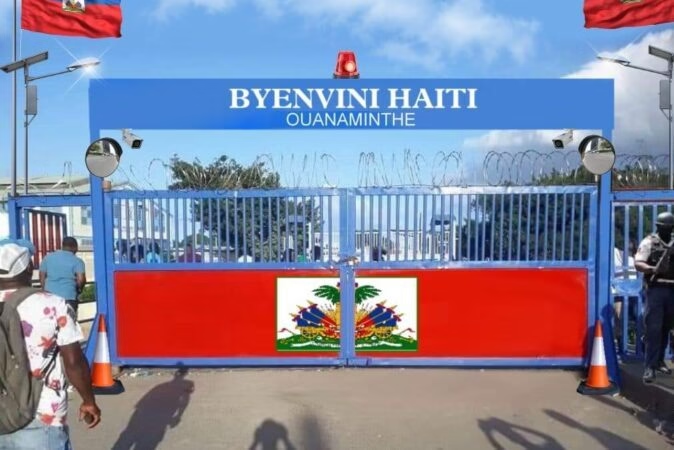
Since Monday, September 14, 2026, Haitian authorities have closed land access to a series of goods from the Dominican Republic. The blockade applies at the Dajabón/Ouanaminthe border crossing, according to the Dominican daily Diario Libre. The decision concerns around twenty products that had until now used the land route to reach the Haitian market.
The restriction targets basic necessities such as wheat flour, cooking oil, laundry soap, foam containers, drinking water, butter, and margarine. The restriction also affects materials and everyday consumer products: construction iron, pasta, powdered juice, soft drinks, beer, snacks, and plastic household utensils. Heavy equipment destined for the construction sector is also impacted.
According to an official document cited by Diario Libre, these goods must now be transported to Haiti by air or sea, rather than through the Dajabón/Ouanaminthe land crossing.
A Measure That Revives an Old Decision
This restriction is not entirely new. According to the document obtained by Diario Libre, it stems from a September 2015 decision by Haiti’s Ministry of Economy and Finance, which already prohibited the land entry of 23 categories of products from the Dominican Republic. These goods were then required to transit through the seaports of Port-au-Prince or Cap-Haïtien, or by air. The measure took effect on October 1, 2015. At the time, Haitian officials said it was not an import ban but a redirection of legal entry channels, aimed at better controlling product quality and combating tax evasion and smuggling.

The list applied this time at Ouanaminthe contains 22 products, compared to 23 in 2015. No public information yet explains this discrepancy.
Concerns in Dajabón, Market Resumes
On the Dominican side, merchants in Dajabón are expressing concern. They believe this restriction will hinder trade that has been conducted for decades at the border and that constitutes one of the province’s main economic pillars. Cross-border trade supports thousands of families on both sides.
However, according to the Dominican daily Hoy Digital, the border market resumed “totally normal” operations as early as September 15. Noël Fernández, president of the Association of Retailers of the Dajabón Border Market, indicated that Haitian merchants would seek to negotiate with the authorities to find a solution.
Long-Tense Bilateral Relations, a Timid Resumption of Dialogue
This new measure comes amid particularly strained Haitian-Dominican relations in recent years. Immigration, border control, and water resource issues have regularly poisoned dialogue between the two countries, which nonetheless share the island of Hispaniola.

However, since Raina Forbin took the helm of the Ministry of Foreign Affairs and Worship (MAEC), meetings have taken place with Dominican authorities. On September 3, 2026, Raina Forbin met with Dominican Foreign Minister Víctor O. Bisonó Haza at the CODEVI industrial park in Ouanaminthe. Discussions covered border security, the fight against illegal activities, migration, and trade development. Both parties reaffirmed the need to strengthen cooperation mechanisms to improve border governance and migration management. They also expressed support for the UN-authorized Gang Suppression Force (GSF) and called for extending its mandate to restore security in Haiti.
A Security Problem That Remains Entirely Unresolved
For that is precisely where the heart of the problem lies. Haiti is experiencing a security crisis of exceptional gravity. According to the United Nations Office on Drugs and Crime (UNODC), Haiti produces neither weapons nor ammunition: virtually all those circulating in the country are imported, and a large portion travels through illegal channels. In a report submitted to the Security Council, UNODC indicates that weapons and ammunition are primarily shipped from the United States, particularly from Florida, but can also transit through intermediaries based in the Dominican Republic.
These weapons end up in the hands of the “Viv Ansanm” gang coalition and many other armed bands, active mainly in Port-au-Prince and the Artibonite.
More troubling still: members of Dominican security forces have been directly implicated in arms trafficking to Haiti. In November 2024, Dominican authorities arrested a senior officer and nine police officers, accused of removing weapons and ammunition from National Police arsenals and illegally reselling them to Haitian criminals. The investigation revealed that a woman residing in the border province of Pedernales received dozens of crates of ammunition of various calibers, which she resold for between 86 and 99 dollars per crate to Haitian buyers using these weapons for criminal purposes. One implicated officer, Colonel Narciso Antonio Feliz Romero, organized these transactions through a subordinate officer in contact with Haitian buyers, transporting cash in backpacks.
Haitian authorities, both police and customs, face enormous difficulties in stemming these flows. The UNODC report highlights insufficient controls at Haitian ports, airports, and border posts; the active participation of certain public and private ports in the transshipment of weapons and ammunition; and doubts about the integrity and capabilities of certain public security officials.
A Commercial Measure in a Context of Deep Mistrust
Officially, the restriction imposed on September 14, 2026, at the Dajabón/Ouanaminthe border crossing falls under commercial and customs matters. But in a context where relations between the two countries remain marked by mistrust, and where the question of weapons fueling Haitian gangs poisons the neighborhood, this decision cannot be read in isolation. The September 2026 ministerial meeting certainly opened a window for dialogue, but arms trafficking — documented, prosecuted, and still active — remains an unresolved problem. Every blockage of goods at the border, every truck immobilized, every negotiation between merchants reminds us that, behind economic exchanges, a far graver issue is at stake: a country’s security and the shared responsibility of its neighbors.
https://ctninfo.com/haiti-restricts-entry-of-dominican-products-behind-the-border-measure-bilateral-relations-and-the-grave-security-problem/
https://www.facebook.com/CaribbeanNewsMedia
AI Use Policy:
Some of CTN’s journalists are not native English speakers and draft their work in French or Haitian Creole. We then use AI-assisted translation software to produce the English versions, and traces of machine-generated phrasing may occasionally remain. Every article — in any language — is written, reviewed, and edited by CTN’s staff writers and editors, who remain responsible for its accuracy. CTN also uses AI to convert text into audio.