


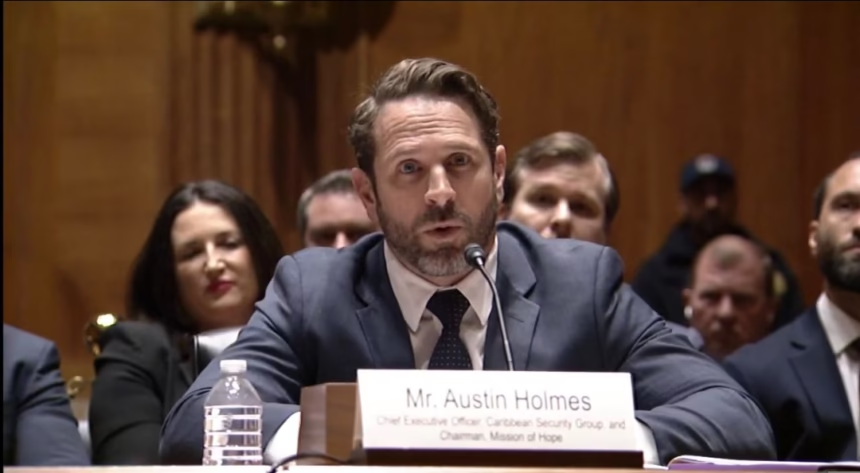
President Donald Trump has nominated Austin Holmes, a Florida native, as Ambassador Extraordinary and Plenipotentiary of the United States of America to the Republic of Haiti, the White House announced Monday. The White House officially transmitted the nomination to the Senate. However, Austin Holmes currently holds only the status of “nominee”: he must still clear a series of legal steps before he can travel to Port-au-Prince to take up his duties.
Under the U.S. Constitution and State Department rules, the president’s appointment of an ambassador is only the first step. Before Holmes can officially become the highest-ranking diplomatic representative of the United States in Haiti, he must complete the following key stages:
The White House has transmitted Holmes’s nomination to the Senate. The Foreign Relations Committee first examines the candidate’s background, financial disclosure, and professional record in detail. It may hold closed-door briefings or public hearings to question Holmes on his knowledge of the situation in Haiti and his foreign policy positions. Given that Holmes already testified in February 2026 before the Senate Appropriations Subcommittee on Haiti’s security crisis, the committee’s questions will likely focus on the concrete modalities for implementing policies.
If the Foreign Relations Committee approves the nomination by majority, it will be placed on the agenda for the full Senate session. The Senate must hold a debate and then proceed to a formal vote. Under current rules, the candidate must generally obtain at least 51 votes, a simple majority, to be confirmed.

If Holmes is confirmed, he will succeed Henry Wooster, who left office in July 2026.
At his farewell press conference, Wooster left a very severe diagnosis of the Haitian situation. He stressed that Haiti faces “unprecedented challenges” and that its very existence is threatened by “terrorist gang networks” constituting an “existential threat.” His mandate centered on collaborating with the UN Security Council to promote the creation of a “Gang Suppression Force” to respond to the security vacuum. His departure coincides with a continuous escalation of gang violence and the displacement of more than 1.3 million Haitians. In his farewell message, Wooster insisted on the role of the media in “countering disinformation” and promoting a “democratic future,” which suggests that Holmes inherits a diplomatic front where information is chaotic and security institutions are nearly collapsed.
Austin Holmes: From Humanitarian to Future Diplomat
Holmes’s career path differs radically from that of a traditional American career diplomat. A native of Florida, he is currently CEO of RallyX, a business group active in defense, health, construction, and transportation.
Solid Field Experience in Haiti
Holmes claims nearly 20 years of experience working in Haiti, dating back to before the 2010 earthquake. He has long been active in Haiti as an NGO operator and humanitarian entrepreneur:
Education and food aid: he led the “Haiti One” educational network, supervising 900 Haitian employees and distributing more than 130,000 meals per day.

Disaster response: he participated in relief operations after Hurricane Matthew in 2016 and the 2021 earthquake, working closely with USAID and the U.S. military.
Security and kidnap management: as co-founder of the “Caribbean Security Group,” he participated between 2020 and 2024 in coordinating the release of 47 kidnapping victims, in collaboration with American and Haitian authorities.
Unique Political Capital and Shortcomings
Holmes speaks Haitian Creole and lived in Haiti with his family from 2017 to 2019, until gang violence forced them to leave. During his Senate testimony in February 2026, he argued that security and freedom of movement must be guaranteed first for humanitarian aid and long-term reconstruction to succeed, insisting on building “Haitian-led security capacity” rather than an unlimited foreign presence. His weakness, however, lies in his lack of traditional experience in diplomatic negotiation and bureaucracy. His profile as a “humanitarian operator” means he may have to face a learning curve in coordinating the State Department’s internal mechanisms and managing complex issues of sanctions and diplomatic immunity.
Haitian-American Relations: A Double Game Between Security Crisis and Commercial Pillars
If he takes office, Holmes will find himself at the heart of the most tense and complex phase of Haitian-American relations. Since diplomatic relations began in 1862, they have been marked by an interweaving of intervention, aid, and commercial dependence.
The absolute center of gravity of Haitian-American relations today is the fight against gang violence. At their meeting in April 2026, U.S. Secretary of State Rubio and Haitian Prime Minister Fils-Aimé clearly made the deployment of the “Gang Suppression Force” a priority. Supported by the United States and the UN, the force will be expanded to 5,500 personnel with dual military and police competence, with the objective of “neutralizing, isolating, and deterring gangs” under intelligence leadership. The U.S. Permanent Representative to the UN stressed that the force’s central objective is to create the conditions for local Haitian security forces to “expand, professionalize, and ultimately assume responsibility.” Holmes’s “operator” profile, having participated in the release of kidnapping victims, aligns well with this security agenda, but he will have to find a delicate balance between “foreign intervention” and “Haitian leadership.”
Despite the deteriorating security situation, economic ties remain a stabilizing factor.
The United States is Haiti’s leading trading partner, with Haitian exports to the United States mainly concentrated in the textile and apparel sector, thanks to duty-free access offered by the “HOPE/HELP” laws. The Trump administration has asked Congress to extend these two preferential trade laws for several years, as part of a strategy aimed at “associating credible prospects with real economic opportunities,” attempting to substitute employment for violence. In addition, the Haitian diaspora in the United States, numbering more than 2 million people, constitutes a vast network of remittances and political lobbying. Holmes’s position during his testimony, that “security comes before aid,” in reality reflects the current dominant American viewpoint: without basic security, commerce and investment are impossible.
The nomination of Austin Holmes reflects the Trump administration’s tendency to approach the Haitian question with a more operational, field-experience-based perspective. However, from his nomination to the effective presentation of his letters of credence in Port-au-Prince, he must still patiently wait for Senate confirmation. Even once in office, he will not face a country functioning normally, but a capital fragmented by gangs and in urgent need of an external security transfusion. His ability to transform the “informal influence” accumulated in humanitarian aid and crisis management into “formal diplomatic effectiveness” within the State Department, capable of effectively promoting security assistance and the extension of trade agreements, will determine whether Haitian-American relations can emerge from the current impasse of intervention in the coming years.
https://ctninfo.com/a-floridian-at-haitis-bedside-austin-holmes-the-future-face-of-washington-in-port-au-prince/
https://www.facebook.com/CaribbeanNewsMedia