


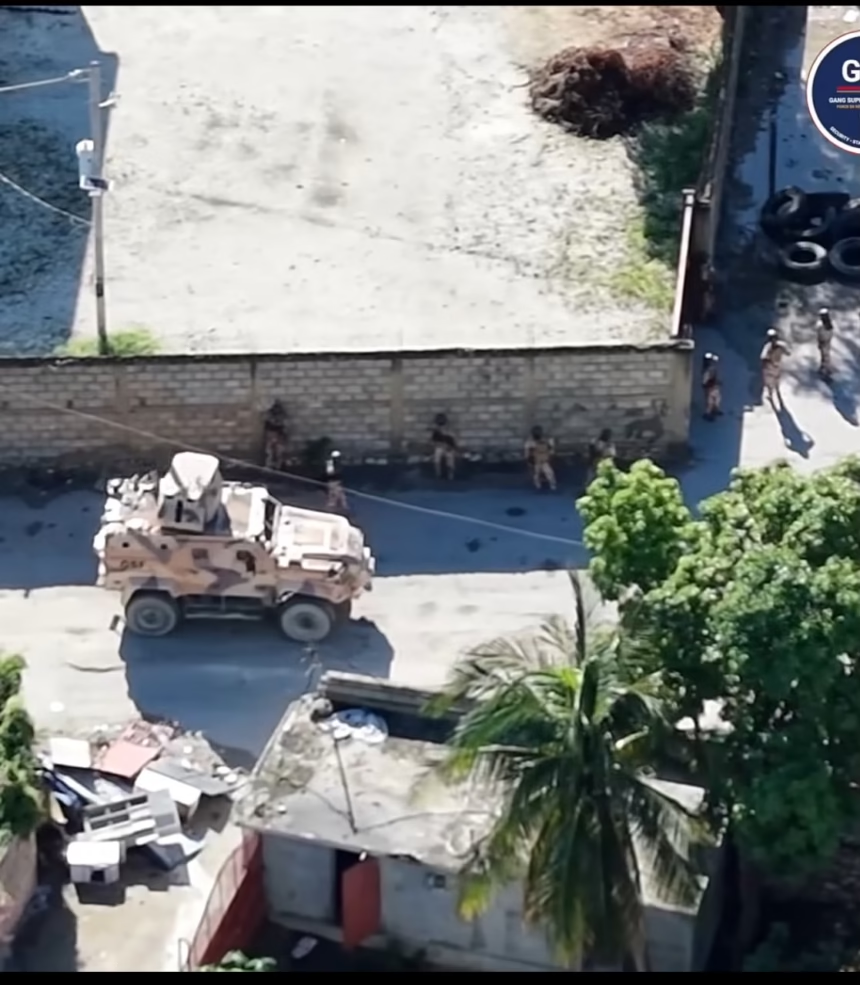
The Haitian National Police (PNH) announced this Tuesday, October 6, 2026, that it had retaken control of Belot, a strategic locality in the commune of Kenscoff. In parallel, the Gang Suppression Force (FRG) released the results of its operations conducted on October 5 and 6 in Tabarre and Cité Soleil, in the Port-au-Prince metropolitan area. These two developments mark a coordinated attempt by the security forces to regain the initiative against armed groups.
The PNH’s announcement came on the institution’s official social media channels. According to available information, the operation to retake Belot mobilized armored vehicles as well as, for the first time in this area, kamikaze drones used against the positions of armed men. The stated objective was clear: to dislodge members of the Viv Ansanm coalition from this strategic sector and restore state authority there.
This recapture is not an isolated event. Since late September, law enforcement forces have been conducting simultaneous operations in several localities of Kenscoff, notably Godet, Vialet 1, Vialet 2, and Bois d’Avril. Belot is the latest point to be claimed as “retaken” by the police. Heavy exchanges of gunfire have been reported in the area, a sign that resistance from armed groups remains fierce.
The human toll of this reconquest, however, remains difficult to establish with precision. What is known, on the other hand, is the cumulative cost of nearly two years of violence in this commune once considered a peaceful refuge southeast of the capital.

The gangs’ offensive against Kenscoff began in January 2025. Between January 27 and March 27 of that year, the United Nations Human Rights Office recorded at least 262 people killed and 66 wounded in attacks targeting Kenscoff and certain areas of Carrefour. Approximately 200 homes were destroyed and more than 3,000 people displaced. At the time, human rights organizations had warned about the absence of any real strengthening of security arrangements, despite the gravity of the situation.
The situation deteriorated further in 2026. The National Human Rights Defense Network (RNDDH) documented two attacks of extreme violence, on the nights of July 7 and August 23. In total, at least 164 people were killed, 23 wounded, and 71 kidnapped during these two massacres. Among the victims were 21 people aged 65 to 90, seven children — including a four-year-old — and 36 women.
The August 23 attack will remain one of the deadliest in Kenscoff’s recent history. At least 47 people were killed, including 22 executed in a church where they had sought refuge. The Office for the Coordination of Humanitarian Affairs (OCHA) reported more than 4,200 displaced persons following that single attack.
The FRG strikes in Tabarre and Cité Soleil
On another front, the Gang Suppression Force published a statement detailing its operations on October 5 and 6 in the Port-au-Prince metropolitan area. On October 5, several hundred FRG soldiers, supported by armored vehicles and helicopters, conducted a security operation in Tabarre. Personnel extended their actions to areas inaccessible to armored vehicles, including narrow passageways and abandoned buildings suspected of serving as hideouts for gangs. Barricades were removed and improvised explosive devices seized. Following clashes, suspected gang members withdrew from the area, allowing the FRG to extend its presence in the sector.

In the early hours of October 6, based on intelligence gathered beforehand, the FRG conducted a targeted sweep and security operation along Route Soleil 9, in Cité Soleil. The objective: to retake positions held by gangs, dismantle barricades, disrupt their activities, and reduce their operational capacity. During the operation, soldiers confronted suspected gang members. Two of them were arrested, two were killed, and several others were seriously wounded. The FRG also seized three firearms, magazines and ammunition, a radio, two motorcycles, and other equipment.
Route Soleil 9 constitutes an important corridor for access to strategic infrastructure and neighboring communities. Securing it therefore represents a major stake for freedom of movement in the capital.
A national context that remains critical
These tactical gains must be placed in a national context that remains extremely concerning. According to the United Nations Integrated Office in Haiti (BINUH), at least 3,050 people were killed during the first half of 2026. Since the beginning of 2022, more than 21,000 people have lost their lives in gang violence. Approximately 1.47 million people are displaced within the country, or 12% of the Haitian population.
The FRG indicated that following the operations conducted in Tabarre and Cité Soleil, it will maintain an enhanced security presence and continue its targeted operations and patrols in order to consolidate gains, deter any resumption of gang activities, and promote freedom of movement for affected communities.
The retaking of Belot and the blows dealt in Cité Soleil demonstrate a determination to reclaim ground. But as the United Nations and Haitian organizations have repeatedly reminded, security gains can only be lasting if they are accompanied by a return of the state to liberated areas: basic services, schools, health centers, and economic prospects for young people. Without that, armed groups will simply wait for the next vacuum to return.
