

At least 390 people were killed between March 6 and May 16 during clashes between armed gangs in Cité Soleil and Croix-des-Bouquets, according to a new United Nations report published this week. The violence, linked to territorial control struggles, also led to the burning of 87 homes and public buildings, severely disrupting health, education and commercial services.
In an alarming assessment, the UN stated that several victims were shot in their homes or while trying to flee. Others were deliberately targeted, wrongly suspected of collaborating with rival factions. Sexual violence was also used as a “form of punishment” against civilians, according to the same source.
10,000 displaced in five days, according to IOM
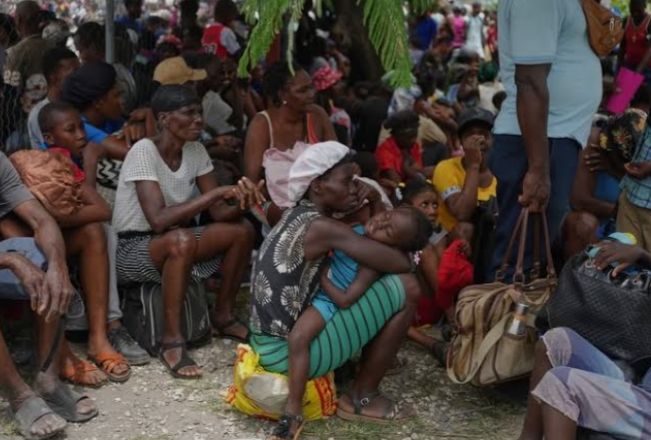
The International Organization for Migration (IOM) said Friday that more than 10,000 people were displaced between May 10 and May 15 in the Port-au-Prince metropolitan area. This figure is nearly double the initial estimates, which had projected 5,300 displaced persons.

The UN agency specified that more than 70% of the displaced are currently being housed in 20 reception sites, five of which have recently opened. Others are staying in already overcrowded communities with inadequate infrastructure.
A direct consequence of this situation is increased pressure on an already fragile health system. In the Port-au-Prince area, only 11% of hospital units remain fully operational, according to the UN.
Tension in Canapé-Vert: barricades against the hosting of displaced persons
This Friday, May 22, high tensions were observed in Canapé-Vert, east of Port-au-Prince. Residents blocked the road with barricades, disrupting traffic and slowing commercial activities.
Protesters were denouncing the hosting of displaced families from the Plaine du Cul-de-Sac in a designated area of the neighborhood. They are demanding more active involvement from authorities in response to the humanitarian crisis caused by armed violence.

For several days, clashes between armed groups in the Plaine du Cul-de-Sac have forced many residents to leave their homes under precarious conditions.
Government announces “zero tolerance” against gangs
On Wednesday, May 20, 2026, Prime Minister Alix Didier Fils-Aimé convened officials from the Haitian National Police (PNH), the Armed Forces of Haiti (FAd’H), the Ministry of Defense, and members of the Gang Repression Force at the Prime Minister’s office.
Following the meeting, the Executive branch announced the establishment of a permanent coordination mechanism between the various security structures. Strategic meetings will now be held weekly to ensure follow-up on interventions.
Authorities plan to focus on three priority areas: the immediate reinforcement of joint operations in gang-controlled territories; the implementation of a “zero tolerance” policy against gangs, their logistical supporters, and their financing networks; and weekly coordination between the PNH, the army, and the Gang Repression Force.
On the ground, the PNH, supported by the Task Force and the Armed Forces, has conducted several operations in recent weeks in northern Port-au-Prince as well as in the Artibonite department.
Clashes between armed gangs in Haiti, particularly in the Port-au-Prince metropolitan area and its peripheries (Cité Soleil, Croix-des-Bouquets, Plaine du Cul-de-Sac), have caused mass displacement of populations for several months.
Essential services — health, education, drinking water, food distribution — are severely disrupted in affected areas. Humanitarian organizations, including IOM and the UN Office for the Coordination of Humanitarian Affairs (OCHA), are calling for an emergency response.