

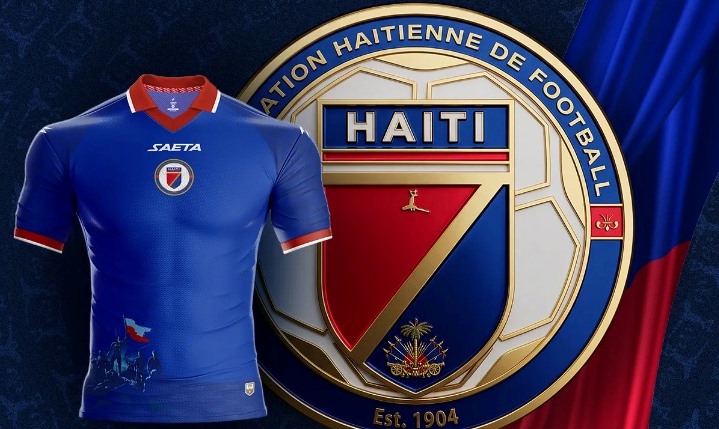
Just days before the kickoff of the 2026 World Cup, FIFA, world football’s governing body, demanded that kit manufacturer Saeta modify the Grenadiers’ official jersey, ruling that certain visual elements on the shirt did not fully comply with its regulations on political neutrality. The news has since spread across social media, sparking strong reactions among the Haitian diaspora and football fans.
According to available information, the illustrations depicting Haiti’s independence heroes are precisely at the heart of this controversial decision. These images, which adorned the original jersey design, were conceived as a tribute to the historical heritage and resilience of the Haitian people. Toussaint Louverture, Jean-Jacques Dessalines, Henri Christophe, and Alexandre Pétion – these emblematic figures of the fight against slavery and colonization – were meant to accompany the players onto the field, a powerful symbol of a nation proud of its history.
Yet FIFA judged that these representations could be interpreted differently under its strict rules governing messages and symbols displayed on official kits. The governing body’s regulations, which prohibit any political, religious, or commercial display outside authorized frameworks, were thus applied to what was merely a patriotic homage.
Faced with this demand, the manufacturer Saeta responded quickly.
In a statement, the company firmly asserted that the initial design had “no political purpose” and aimed solely to “celebrate Haitian national identity” – a reminder that football is also, and perhaps above all, a vector of cultural and identity expression.

However, aware of the stakes and FIFA’s authority, Saeta indicated that it had complied with the governing body’s requirements by making the requested modifications. The manufacturer stated that the changes had already been made and that the Grenadiers would wear a new version of the jersey during the competition.
“Although this interpretation differs from our original intention, Saeta has respected the process and applied the final requirements communicated by FIFA,” the company soberly stated, without hiding a certain bitterness. The Grenadiers have already taken their official photos with this modified version of the jersey.
A highly anticipated first match against Scotland
Despite this last-minute controversy, the Haitian national team remains fully focused on its sporting objective. The Grenadiers will make their competition debut on Saturday, June 13, in Boston against Scotland. A historic match for the Caribbean nation, which will play its first World Cup match since its sole participation in 1974.
Haiti’s schedule has also been revealed. The players will hold a training session on June 10 at Stockton University before heading to Boston the following day. June 12 will be marked by the pre-match press conference at Boston Stadium, followed by the final training session at the NER Training Center. The team will thus complete its preparations before entering the competition against the Scots.

An Algerian referee for Haiti – Scotland
Furthermore, FIFA has appointed the refereeing team for this match. Algeria’s Mustapha Ghorbal, 41, will referee Haiti’s first match of the 2026 World Cup. An experienced referee, Mr. Ghorbal, will be taking charge of his second World Cup finals match, having previously officiated during the 2022 edition in Qatar. A sign of confidence from the international governing body, which is entrusting a seasoned referee with the responsibility of this match, the stakes of which are already significant for both nations.
Between national pride and regulatory constraints: a debate reignited
This jersey affair reignites a recurring debate in the football world: how far can one express national identity on sports equipment?
For Haiti, the essential thing lies elsewhere: to deliver a worthy performance against Scotland and, why not, cause a surprise in a group that also includes other formidable nations. The Grenadiers, deprived of their heroes on their jersey, now hope to embody, through their play and fighting spirit, the spirit of resistance and pride that has always characterized the Haitian people.
See you on June 13 in Boston for the kickoff of an adventure that, beyond the simple sporting result, already carries a strong historical and symbolic dimension. The ball itself has no political color. Whether it will roll in Haiti’s favor remains to be seen.
https://ctninfo.com/2026-world-cup-fifa-forces-saeta-to-modify-haitis-jersey/
https://www.facebook.com/CaribbeanNewsMedia