

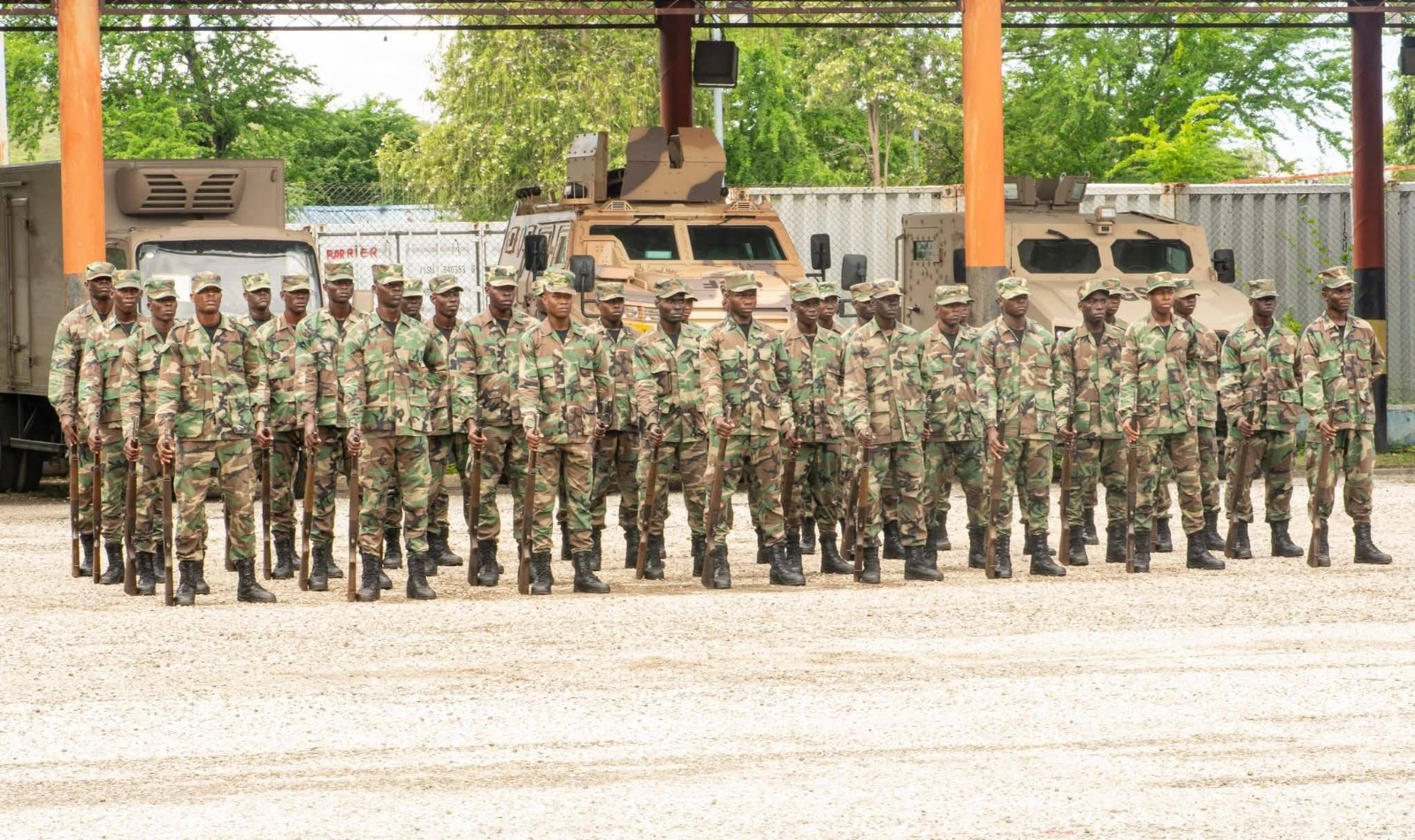
In a still-critical security context, the Haitian army is reaching a new milestone in its reconstruction. On Tuesday, April 21, 2026, 339 recruits officially joined the ranks of the Armed Forces of Haiti (FAd’H) during a solemn ceremony held at the Vertières military base. This graduating class is named “François Capois,” in homage to the hero of independence. The Ministry of Defense’s stated goal is to recruit 2,500 to 3,000 new soldiers by the end of the year.
In an atmosphere charged with emotion and patriotic fervor, the 339 new soldiers of the “François Capois” class took their oath on Tuesday, April 21, at the Vertières military base. Dressed in their crisp new uniforms, the recruits pledged to respect the Constitution and to “serve and defend” the nation, in accordance with the 2015 decree that governs the Ministry of Defense.
The choice of name for this class is no coincidence. François Capois, nicknamed “Capois-la-Mort,” is one of the most emblematic heroes of the Battle of Vertières (1803), which sealed the defeat of Napoleon’s army and Haiti’s independence. By evoking this memory, the military institution intends to anchor its rebirth in the continuity of the struggle for national sovereignty.
Trained by experienced instructors and monitors, the recruits followed a solid training program including, beyond basic military skills, modules on respect for human rights, equality between men and women, and the protection of civilians – a crucial requirement in a country where accusations of human rights violations have regularly tarnished security forces.

Speaking at the ceremony, Colonel Neoxles P. Arné, head of FAd’H training, welcomed the new soldiers while urging them to demonstrate “discipline, maturity, and a great sense of duty” to fully assume their responsibilities. He also hailed the growing interest of young Haitians in military careers, a sign, according to him, of renewed confidence in the institution.
Colonel Arné did not fail to thank all the actors involved in training this class, from the instructors to the technical and financial partners supporting the reconstruction of the Haitian army.
200 soldiers are soon to be deployed to reinforce the Task Force
Beyond the ceremonial aspect, concrete announcements regarding the deployment of the new troops reveal the scale of the government’s ambitions. A source within the Ministry of Defense, cited by Le Nouvelliste, detailed the assignment of the 339 newly graduated soldiers:
200 of them will receive special training to reinforce the “task force” – the elite unit responsible for the most sensitive operations against armed gangs.
100 others will join the ranks of the National Guard, based in Clercine. Their primary mission is to secure the immediate vicinity of Toussaint Louverture International Airport, a vital strategic axis for the country.

About fifty soldiers will likely be sent as reinforcements to the Artibonite department, a region regularly shaken by gang violence where the state has until now struggled to impose its authority.
This distribution shows a dual priority: retaking the most sensitive urban areas (Port-au-Prince and its periphery) and securing critical infrastructure, while consolidating territories that are already partially stabilized.
A Massive recruitment plan: 900 soldiers trained every four months
The graduation of the “François Capois” class is only the first step in a vast force reinforcement plan. According to the same ministerial source, 570 candidates have already passed all tests and medical examinations and are awaiting their call to begin their individual basic training.
These recruits will spend four months at the training center before being deployed on the ground. Infrastructure is being adapted: repairs are currently underway at the Vertières base to accommodate these new waves, with a first call scheduled for the third week of May 2026, if the timeline holds.
The Ministry of Defense’s stated goal is ambitious: to recruit between 2,500 and 3,000 new soldiers by the end of 2026. To achieve this, authorities are banking on a gradual increase in training capacity.
Ultimately, the Vertières base will be able to train 500 soldiers per four-month cycle, while the Anacaona base – located between Gressier and Léogâne – can accommodate 400, after its facilities are rehabilitated. That makes a total of 900 soldiers trained every four months, a sustained pace that would significantly renew and expand the ranks.
Three new recruitment offices are also scheduled to open soon: one at the Anacaona military base, another in Petit-Goâve, and a third in the Grand Sud region, specifically in Les Cayes. This is a way to decentralize recruitment and attract young people from across the country.
Equipment and materiel: orders awaiting delivery
Ramping up troop numbers is not enough: the soldiers must also be equipped. According to the Ministry of Defense source, equipment orders have been placed and are due to arrive “imminently” in Haiti. Without going into detail, these deliveries should cover needs for uniforms, individual weapons, communication devices, and light vehicles.
Still, the question of funding this buildup remains sensitive. While the Haitian government is devoting an increasing share of its budget to defense, international partners – the United States, Canada, and the United Nations program – are also contributing, through technical assistance and equipment programs.
On the ground: 200 troops already engaged in consolidating retaken zones
The new Haitian army is not waiting until it reaches full strength to act. Asked about the concrete support the FAd’H is providing to the Haitian National Police (PNH), the ministerial source indicated that 200 soldiers are already engaged in stabilizing retaken areas in downtown Port-au-Prince.
The “consolidated points” – areas once controlled by gangs and now secured by law enforcement – number five, including the upscale neighborhood of Pacot. A strong symbol: Pacot, perched on the capital’s heights, had been infiltrated and then partially controlled by armed groups in recent years, causing the exodus of many residents.
The military presence in these areas aims to prevent the return of gangs and to create a secure environment that enables the progressive return of displaced populations, as well as the reopening of businesses and public services.
While these announcements reflect a clear political will to rebuild the Haitian army – dissolved in 1995, then reestablished in 2017 – the challenges remain immense. The accelerated training of thousands of soldiers raises questions about the quality of supervision, psychological follow-up, and the integrity of recruits in a country where political and criminal allegiances have sometimes infiltrated the ranks of security forces.
Moreover, the cohabitation between the PNH and the FAd’H – two institutions with different cultures and traditions – remains a work in progress. While complementarity is publicly stated, tensions on the ground cannot be ruled out, particularly regarding the division of roles and intervention zones.
Finally, the overall security context allows no respite. Gangs still control vast portions of the territory, and reconquest operations are costly in terms of human lives and equipment. The training of 3,000 soldiers by the end of 2026, if achieved, would represent only a first step: the real needs to secure the entire country far exceed this number.
For Haitian authorities, the “François Capois” class is far more than just a graduating class of soldiers. It embodies the state’s determination to retake control of its security destiny, in a country where gang violence has driven hundreds of thousands of people into internal exile and paralyzed the economy.
“The goal is to reach between 2,500 and 3,000 new soldiers by the end of 2026,” they repeat at the Ministry of Defense. A figure that, if met, would mark a decisive step in the rebirth of an institution long decried but whose role is now considered indispensable by a large segment of the population.
The question remains whether time – and resources – will follow. Because of facing heavily armed and structured gangs, the battle for Haiti’s security will not be won solely on parade grounds. It will be fought on the ground, in the alleyways of Martissant, Croix-des-Bouquets, in the hills of Kenscoff, and in Artibonite, where every soldier must prove their worth.
https://ctninfo.com/the-fadh-are-ram…0-by-end-of-2026/
https://www.linkedin.com/company/100253760/admin/dashboard/
By Darbouze Figaro and André Louis