


Contents
Haitian master painter and Vodou priest André Pierre, considered the spiritual successor to Hector Hyppolite, will have his work installed at the Museum of Fine Arts Boston starting June 19, 2026. This historic recognition of Haitian art within one of America’s most comprehensive museum collections was announced by the founder of the Haitian Artists Assembly of Massachusetts, Charlot Lucien, during an interview with CTN, prior to the exhibition’s 2026 opening.Who Was André Pierre?A Painter With a MissionCharlot Lucien and the Haitian Artists Assembly of MassachusettsEditorial Disclaimer
Haitian master painter and Vodou priest André Pierre, considered the spiritual successor to Hector Hyppolite, will have his work installed at the Museum of Fine Arts Boston starting June 19, 2026. This historic recognition of Haitian art within one of America’s most comprehensive museum collections was announced by the founder of the Haitian Artists Assembly of Massachusetts, Charlot Lucien, during an interview with CTN, prior to the exhibition’s 2026 opening.
By Emmanuel Paul, Caribbean Television Network (CTN)
BOSTON — A piece of art by Haitian artist André Pierre will be displayed at the Museum of Fine Arts of Massachusetts beginning on June 19, 2026, as part of a newly announced exhibition.
Starting on June 19, 2026, the artwork of André Pierre will be exhibited at the MFA for 5 years. The announcement was made by the president and founder of the Haitian Artists Assembly of Massachusetts, Charlot Lucien, in an interview with Caribbean Television Network (CTN). Professor Lucien will be in charge of the initial presentation on June 19. During this event, he will discuss the life and work of André Pierre, one of the most prolific and well-known Haitian artists. André Pierre was also a Vodou priest.
Starting on June 19, 2026, the artwork of André Pierre will be exhibited at the MFA for 5 years. The announcement was made by the president and founder of the Haitian Artists Assembly of Massachusetts, Charlot Lucien, in an interview with Caribbean Television Network (CTN). Professor Lucien will be in charge of the initial presentation on June 19. During this event, he will discuss the life and work of André Pierre, one of the most prolific and well-known Haitian artists. André Pierre was also a Vodou priest.
For Boston’s Haitian community and the diaspora, placing André Pierre’s work at the MFA is highly significant, said Charlot Lucien. The MFA is one of the most comprehensive art museums in the Americas, housing over 450,000 works and ranking as the 20th-largest by public gallery area.
For five years, beginning next month, visitors from across the United States and the world will encounter the spiritual vision of one of Haiti’s greatest 20th-century painters on the walls of one of the country’s most respected museums.
For five years, beginning next month, visitors from across the United States and the world will encounter the spiritual vision of one of Haiti’s greatest 20th-century painters on the walls of one of the country’s most respected museums.
The exhibition’s timing is significant in itself. June 19 falls within Haitian Heritage Month and arrives just six days after the historic opening of Haiti’s first FIFA World Cup match in 52 years, scheduled for June 13 at nearby Gillette Stadium. For the Haitian diaspora in Massachusetts and beyond, the summer of 2026 is shaping up to be one of the most culturally consequential periods in recent memory — and the André Pierre exhibition at the MFA will be one of its enduring contributions, according to Professor Lucien, who also announced a partnership with 5 other museums in Massachusetts this summer.
Who Was André Pierre?
To understand the weight of this moment, it is worth understanding the artist whose work will now hang at the MFA.
André Pierre was born in Port-au-Prince, Haiti, in 1915, and moved at an early age to Croix-des-Missions, a community on the outskirts of the capital, where he would spend the rest of his life. He made his living as a farmer, but he had practiced Vodou since childhood, and it was within that tradition that his artistic life would eventually take shape.
In the late 1940s, Pierre met the American filmmaker Maya Deren, who had come to Haiti to make a film on Haitian dance. Deren became an initiate in the houmfour — the Vodou temple — where Pierre served as La Place, the second-in-command. The houmfour was decorated with hollowed gourds on which Pierre had painted images of Vodou spirits. Deren, recognizing the unusual gift in those paintings, suggested that Pierre transfer his work to canvas and offer it to the Center d’Art in Port-au-Prince. He did, joining the Center d’Art in 1949 — the institution that had helped launch the careers of Haitian modernist painters, including Hector Hyppolite, Philomé Obin, and others.
Shortly afterward, Pierre began a more than 20-year working relationship with the celebrated Haitian dealer Issa el Saieh. Every morning, he would travel from Croix-des-Missions to the capital to paint in the atelier el Saieh provided him. As his reputation grew — both for his art and for the depth of his personality — Pierre eventually stopped traveling to the capital and painted instead within the family compound and Vodou community he had built at Croix-des-Missions.
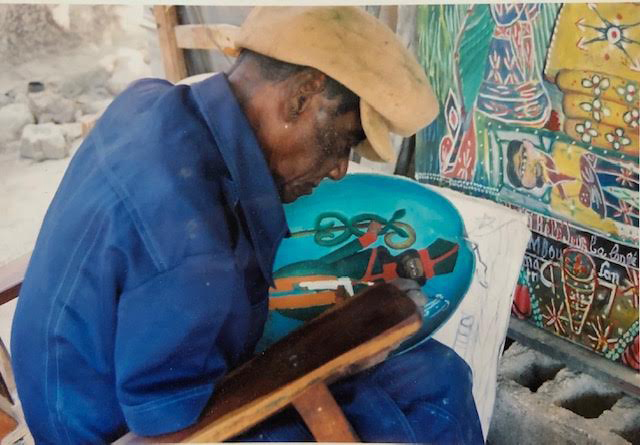
Pierre’s main subjects were the lwa—the spirits of Vodou. He painted them in vivid, symbol-rich compositions, capturing their personalities and energy. He often wrote on his paintings, identifying spirits and their actions.
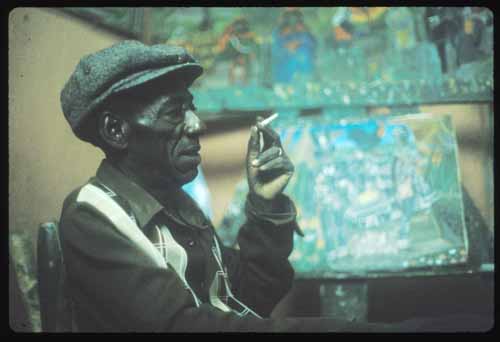
By his death in October 2005, Pierre was seen as the spiritual successor to Hector Hyppolite, who brought Vodou imagery to the international art world. Pierre advanced this tradition through a body of work collected and studied worldwide.
A Painter With a Mission
Describing Pierre solely as a painter overlooks his uniqueness. He was both an artist and a houngan—Vodou priest—combining both paths in his mission.
Pierre aimed to present Vodou as a legitimate religion deserving of respect alongside major world faiths. For him, painting was theology: each Lwa portrait was an act of faith, education, and cultural assertion against Vodou misrepresentation.
Collectors, journalists, scholars, and filmmakers from around the world made the journey to Croix-des-Missions to visit him in the modest hut where he painted by the light of an oil lamp. He received them with characteristic generosity — often opening a bottle of rum, pouring three drops on the dirt floor of the hut to honor the Trinity, and speaking at length about the spiritual dimension of his work and the philosophy of Vodou as a whole.
As the political situation in Haiti deteriorated in the mid-1990s, the road to Croix-des-Missions grew increasingly dangerous, and Pierre’s contact with the outside world diminished. In his final years, he was diagnosed with diabetes, which affected his eyesight. By 2004, he had become almost totally blind and had stopped painting altogether. He died on October 4, 2005, at his home in Croix-des-Missions.
Pierre’s legacy has grown. In 1996, he won gold at the 5th Venezuelan Biennale. His work is in the permanent collections of major American museums, including the Milwaukee Art Museum, the Figge Art Museum in Iowa, the Wadsworth Atheneum in Connecticut, and Ramapo College in New Jersey. His art appears in major books on Haitian and naïve art, including Haiti: Art Naïf, Art Vodou (1988), Selden Rodman’s Where Art Is Joy (1988), and Island on Fire (1995) by Jonathan Demme and Edwidge Danticat.
Now, beginning June 19, his work will also be on display at the Museum of Fine Arts, Boston.

Charlot Lucien and the Haitian Artists Assembly of Massachusetts
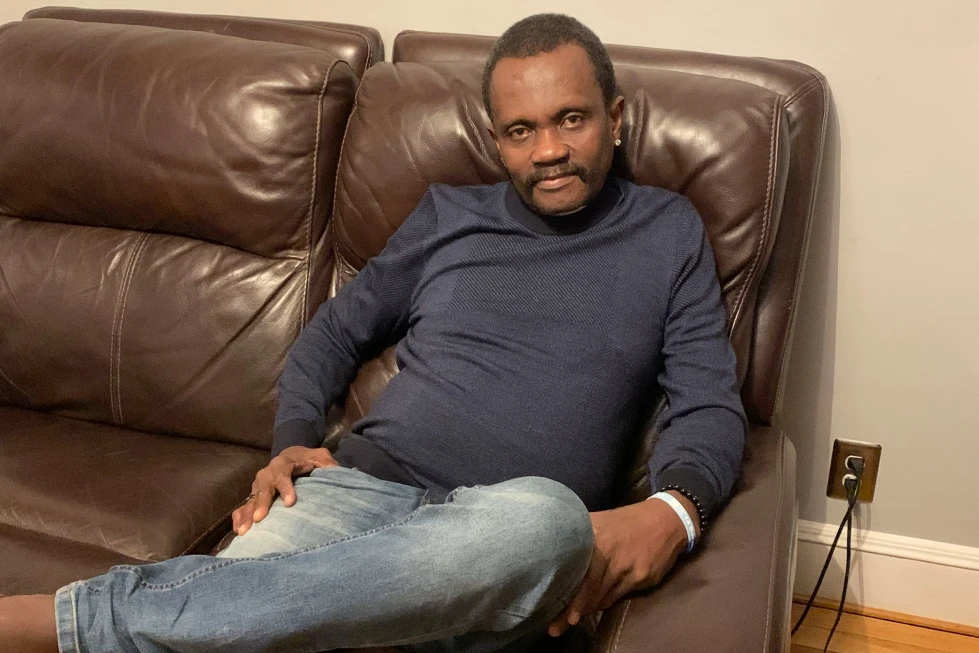
The exhibit announcement came from Charlot Lucien, the founder and director of the Haitian Artists Assembly of Massachusetts (HAAM), in an interview with CTN. Lucien, a celebrated Haitian-born storyteller, visual artist, lecturer, and public health administrator based in Massachusetts, will lead the opening presentation on June 19, speaking about Pierre’s life, creative practice, and lasting influence.
HAAM was founded in January 1995 by more than 60 Haitian visual artists, writers, storytellers, and performers in New England. For three decades, the volunteer group has promoted new narratives about Haiti, elevated Haitian art, and bridged cultural gaps. Through exhibits, workshops, lectures, and partnerships, HAAM is central to Haitian artistic life in the region.
Lucien himself has played a pivotal role in that work, both as the founder of HAAM and as a leading figure in efforts to establish a permanent Haitian cultural institution in Massachusetts — most recently as a member of the executive committee that helped bring the Toussaint L’Ouverture Cultural Center to fruition in Boston’s West End in 2025.
Editorial Disclaimer
This article was originally written in English. Versions in other languages — including French and Haitian Creole — are made available through AI translation software. Errors and inaccuracies may be present in translated versions. Also, CTN uses AI software to convert articles into audio for accessibility and community reach. Listeners should refer to the original English text to verify facts, names, or figures. verification of any specific facts, names, or figures.
https://ctninfo.com/andre-pierres-wo…n-for-five-years/
https://ctninfo.com/andre-pierres-wo…n-for-five-years/
Sources
- Haitian Art Society memorial page: https://haitianartsociety.org/pierre-andre-haitian-1916-2005
- Indigo Arts profile: https://indigoarts.com/artists/andr-pierre
- Documenta 14 artist page: https://www.documenta14.de/en/artists/14561/andre-pierre
- Central Fine exhibition essay (curated by Tomm El-Saieh and Diego Singh, 2016–2017): https://www.centralfine.com/andre-pierre
- Myriam Nader Haitian Art Gallery biography: https://www.naderhaitianart.com/collections/pierre-andre
- Galerie Macondo Haitian art profile: https://www.artshaitian.com/Pages/haitianartapierre.html
- Artsy artist page: https://www.artsy.net/artist/andre-pierre
- iArtX artist page: https://iartx.com/artists/pierre-andre/
- ArtCloud artist biography: https://artcloud.market/artist/andre-pierre-haitian-1914-2005