


Federal Judge Darrin Gayles approves removal of SOGENER executive within seven days on a commercial flight, with U.S. authorities barred from sending him to Haiti — marking the second high-profile Haitian businessman in recent months to accept removal to a third country
By Emmanuel Paul, Caribbean Television Network (CTN)
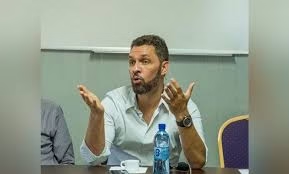
MIAMI — Haitian businessman Dimitri Vorbe, the executive director and vice president of SOGENER and one of the most influential figures in Haiti’s energy sector, will be deported from the United States to the Dominican Republic under a court-approved agreement reached with federal authorities, according to a ruling issued Tuesday by U.S. District Judge Darrin Gayles.
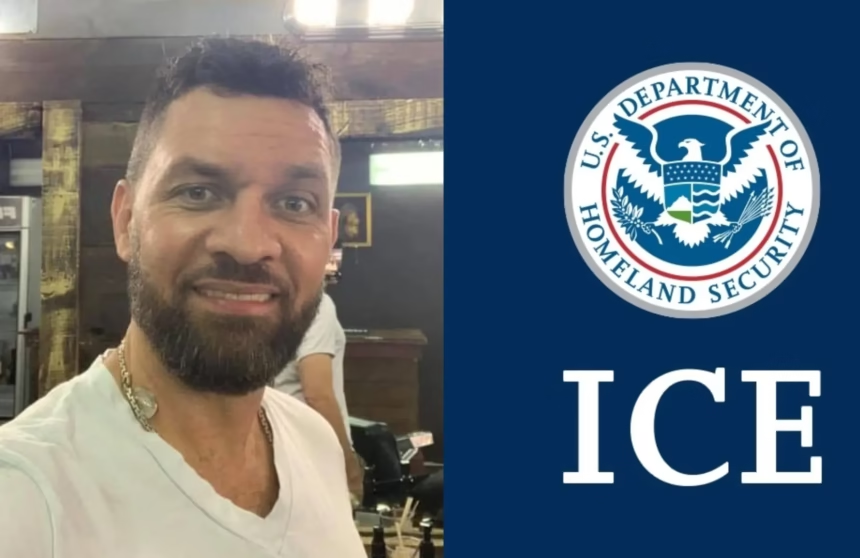
The order, confirmed by Miami-based immigration attorney Frandley Denis Julien, brings to an end nearly eight months of immigration detention for Vorbe, who has been held at the Krome North Service Processing Center in Miami since his arrest by Immigration and Customs Enforcement at his Florida home on September 23, 2025.
Under the terms of the agreement, the Department of Homeland Security will transport Vorbe to a commercial flight bound for the Dominican Republic within seven days of the order. The court has explicitly barred the U.S. government from deporting Vorbe to Haiti.

“In no case can we deport him to Haiti. That is the agreement the two parties have reached,” Judge Gayles wrote in the order, according to Attorney Julien.
The resolution closely mirrors the path taken last month by another prominent Haitian businessman, Pierre Réginald Boulos, who was deported under a nearly identical court-approved arrangement.
Boulos, given the choice between Colombia and Mexico, selected Colombia and departed the United States on April 7, 2026. Vorbe, who offered a similar option, has chosen the Dominican Republic.
Both cases have been followed by Attorney Frandley Denis Julien; both detainees were held at the Krome North facility in Miami, and both were targeted under the same provisions of U.S. immigration law tied to alleged contributions to Haiti’s destabilization. The parallel between the two cases is unmistakable — and tells a broader story about the Trump administration’s approach to Haiti’s economic and political elite.
The Terms of the Agreement
Under the agreement approved by Judge Gayles, two days after Vorbe’s arrival in the Dominican Republic, the legal action he had filed against the administration challenging his detention will be formally dismissed. The arrangement effectively closes the legal saga that has consumed nearly eight months of Vorbe’s life and his family’s, while resolving the case without a definitive ruling on the underlying allegations brought against him by U.S. authorities.
The dismissal clause is not unique to Vorbe’s case. Boulos’s deportation was similarly tied to the end of his legal challenge, allowing both the government and the detainee to reach a resolution without a contested ruling on the merits.
The seven-day window for Vorbe’s removal is somewhat faster than the 15-day window agreed to in the Boulos case. As with Boulos, Vorbe will travel on a commercial flight rather than being transported on a chartered ICE deportation aircraft — a distinction that, in the context of Haitian immigration enforcement, carries its own significance.

The Arrest and the Charges
Vorbe was apprehended at his Florida home on September 23, 2025, by agents of Homeland Security Investigations, a branch of the U.S. Department of Homeland Security. He was taken to the Krome North Service Processing Center in Miami, where he has remained in custody throughout his case.
In a statement released two days after the arrest, ICE confirmed that Vorbe was being held for “violating the Immigration and Nationality Act and contributing to the destabilization of Haiti.” The agency described him as having “engaged in a campaign of violence and gang support that contributed to Haiti’s destabilization.” The investigation, ICE noted, was conducted jointly with Homeland Security Investigations, Enforcement and Removal Operations, the U.S. Department of State’s Diplomatic Security Service, and U.S. Citizenship and Immigration Services’ Fraud Detection and National Security Directorate.
The U.S. Embassy in Haiti echoed those allegations in a statement posted on social media on September 25, 2025, describing Vorbe’s detention as the result of a joint investigation by multiple U.S. government agencies into his alleged involvement in violent gang activities that have fueled chaos in Haiti.
Vorbe and his family have consistently denied wrongdoing. No criminal charges have been filed against him in U.S. courts, and the case has proceeded entirely within the immigration system.
The Vorbe Family and SOGENER
To understand the gravity of Vorbe’s case, it is necessary to understand the role his family has played in Haiti’s economic and political life over the past several decades. Dimitri Vorbe is the executive director and vice president of Société Générale d’Énergie S.A., known as SOGENER — a private electricity company that, for years, was one of Haiti’s largest energy providers. The company supplied a significant portion of the country’s electrical generation capacity through contracts with the Haitian government dating back to the presidency of René Préval.
The Vorbe family’s history with Haitian state contracts has been a source of both wealth and controversy. They have won lucrative contracts not only in the energy sector but also in roads and infrastructure during multiple administrations.
That arrangement collapsed in 2020, when then-President Jovenel Moïse, who would be assassinated the following year in July 2021, accused Vorbe and other members of Haiti’s economic elite of corruption and ordered the seizure of SOGENER. The episode exposed the deep tensions that had been brewing between Haiti’s traditional oligarchic class and a sitting president attempting to assert state control over the energy sector, which Moïse claimed was draining public resources.
Vorbe has also been a vocal critic of corruption in Haiti’s PetroCaribe program, publicly clashing with former Prime Minister Laurent Lamothe over fund mismanagement in 2018. In 2019, the Port-au-Prince Prosecutor’s Office issued an arrest warrant against him in connection with the SOGENER dispute. He has consistently denied any connection to the events surrounding President Moïse’s assassination.
The Boulos Parallel
The similarities between Vorbe’s case and that of Pierre Réginald Boulos are striking, and they suggest a discernible pattern in how the current U.S. administration is handling high-profile members of Haiti’s economic elite.
Boulos, a Haitian physician and former presidential candidate, was arrested by ICE on July 17, 2025, at his home in Palm Beach County, Florida — roughly two months before Vorbe. He, too, was held at Krome North. He, too, was accused of violating the Immigration and Nationality Act and contributing to Haiti’s destabilization through what U.S. officials described as a campaign of violence, gang support, and trafficking of weapons and drugs.
U.S. Secretary of State Marco Rubio had personally invoked a rarely used foreign policy provision of immigration law to authorize Boulos’s removal. That same legal mechanism appears to underpin the Vorbe case, although the public record in Vorbe’s case has been less detailed than that in Boulos’s.
After nearly eight months of detention, Boulos accepted a deportation arrangement on April 2, 2026, under which he could choose to be deported to Mexico or Colombia. He chose Colombia and was placed on a commercial flight from a South Florida airport on April 7, 2026. The U.S. State Department and the U.S. Embassy in Haiti issued coordinated statements on April 11, 2026, confirming the deportation and declaring: “The Trump Administration will not allow anyone who supports the brutal gangs terrorizing Haitians to remain on American soil.”
Now Vorbe will follow a nearly identical procedural path — with one notable difference. Where Boulos chose Colombia, Vorbe has chosen the Dominican Republic, Haiti’s neighbor on the island of Hispaniola.
Why Not Haiti?
A central feature of both deportation arrangements has confounded observers in the Haitian community: the U.S. government is barred from sending either businessman to his country of origin. Why?
The reasons appear to lie in a combination of legal, security, and humanitarian considerations. Haiti remains in the midst of one of the worst humanitarian and security crises in its modern history, with armed gang coalitions controlling more than 90 percent of Port-au-Prince. The U.S. State Department maintains a “Level 4: Do Not Travel” advisory for Haiti — the highest such designation. Deportation to Haiti could expose both men to the very violence the U.S. government has accused them of fueling, creating both legal liability and practical impossibility.
There is also the strategic dimension. By removing Vorbe and Boulos to third countries rather than to Haiti, U.S. authorities accomplish the stated goal of expelling them from American soil while avoiding the optics — and the legal risks — of placing them directly in the path of a Haiti they are accused of destabilizing.
A Broader Pattern
The Vorbe deportation is the second known instance in recent months of the Trump administration successfully removing a prominent Haitian businessman from the United States. Together, the Boulos and Vorbe cases represent a coordinated enforcement effort directed at Haiti’s economic elite — particularly those individuals whom U.S. officials have linked, however publicly or privately, to the Viv Ansanm gang coalition that the administration designated a foreign terrorist organization in early 2025.
The cases have unfolded against the broader backdrop of the Trump administration’s aggressive posture toward Haitian immigration generally. The Department of Homeland Security has moved to terminate Temporary Protected Status for some 500,000 Haitians, deportation flights have continued, and enforcement operations have intensified across major Haitian diaspora communities in Florida, New York, and Massachusetts. The administration has cast all of these actions — from rank-and-file TPS terminations to the removal of high-profile businessmen — as part of a single, coordinated effort to address what it has framed as the role of Haitian nationals in their own country’s collapse.
What Comes Next
Within the coming week, Dimitri Vorbe is expected to board a commercial flight from South Florida to Santo Domingo or another destination within the Dominican Republic. Two days after his arrival, his legal challenge against the U.S. administration will be formally dismissed.
His departure will mark the end of one chapter in the long story of his family’s relationship with Haiti’s energy sector — and perhaps the beginning of another, conducted from the Dominican capital rather than from Port-au-Prince or Miami. What role he chooses to play from there, if any, remains to be seen.
For now, the U.S. immigration system has produced a result that few outside observers might have predicted nine months ago: two of Haiti’s most prominent businessmen, accused but never criminally charged, removed to third countries by agreement rather than by trial, with their cases closed not by ruling but by compromise.
Caribbean Television Network will continue to follow the Vorbe case as developments emerge.
Caribbean Television Network (CTN) is a multilingual digital news organization serving the Haitian diaspora and broader Caribbean community across the United States. CTN holds FIFA media accreditation for the 2026 FIFA World Cup.
Editorial Disclaimer
This article was originally written in English. Versions in other languages — including French and Haitian Creole — are made available through AI translation software. Errors and inaccuracies may be present in translated versions. Only the English version should be considered the authoritative record.
Additionally, CTN uses AI software to convert article text into audio format for accessibility and broader community reach. Listeners are encouraged to refer to the original written English text for verification of any specific facts, names, or figures.
https://www.facebook.com/CaribbeanNewsMedia
https://ctninfo.com/dimitri-vorbe-to…nald-boulos-path/