



If you or a loved one is arrested by ICE, Massachusetts and the American Bar Association have lawyers available 24 hours a day. This guide lists the phone numbers to call, the free legal programs you can use, and the documents every family should sign now — before an arrest — to protect their children and their property.
By Manny Paul — Caribbean Television Network (CTN)
The most dangerous moment in an immigration case is the first hour after an arrest — and it is also the moment when families are least prepared to act. Someone is detained. The family does not know who to call. Hours pass. The person is moved to another state before a lawyer is ever reached.
That does not have to happen. Massachusetts has built a network of free and low-cost legal help specifically for this situation, and the state — working with the American Bar Association — now makes attorneys available around the clock. This guide explains exactly who to call, and just as important, what every family should do before an arrest ever occurs.

Keep these numbers somewhere you can find them without a phone or a computer — written on paper, taped inside a cabinet, given to a trusted relative. In a real emergency, you may not have time to search.
If ICE arrests you or a family member, the numbers to call
Legal Representation Fund (LRF). This program connects detained immigrants with attorneys who can act quickly — often to file for bond or to stop a person from being transferred out of Massachusetts. There are two separate lines:
- If you have been arrested/detained: (617) 637-8195
- For family members and friends trying to help someone who has been detained: (617) 396-7143
Either line can be used. The detained person can call from the facility, or a relative or friend can call on their behalf. Speed matters: once someone is transferred out of state — to Louisiana or Texas, for example — it becomes much harder for a local lawyer to help and for the family to keep track of where the person is.
The Habeas Project. This project works on habeas corpus petitions — legal filings that challenge unlawful detention. If someone is being held and you believe the detention is improper, this is a resource:
The ORI Legal Help Desk. Run through the Massachusetts Office for Refugees and Immigrants (ORI), the Help Desk connects people with vetted attorneys who can review a case and identify options:

- Email: ORI-Helpdesk@mass.gov
- Online form: forms.office.com/g/tYzYHCE0Yi
- You can also search “Legal Help Desk” on Mass.gov

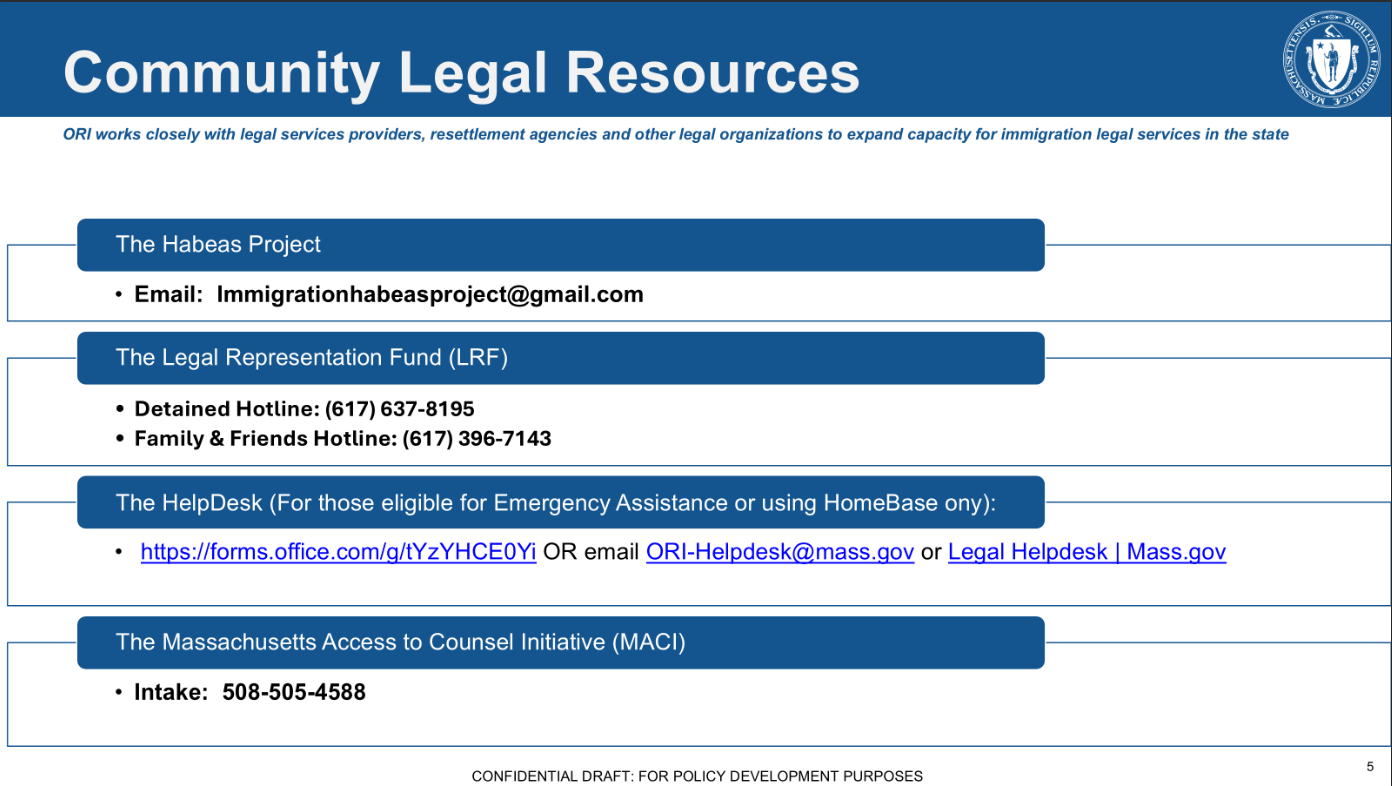
Massachusetts Access to Counsel Initiative (MACI). This state-funded program provides legal representation to income-eligible people who are in immigration court:
- Intake line: 508-505-4588
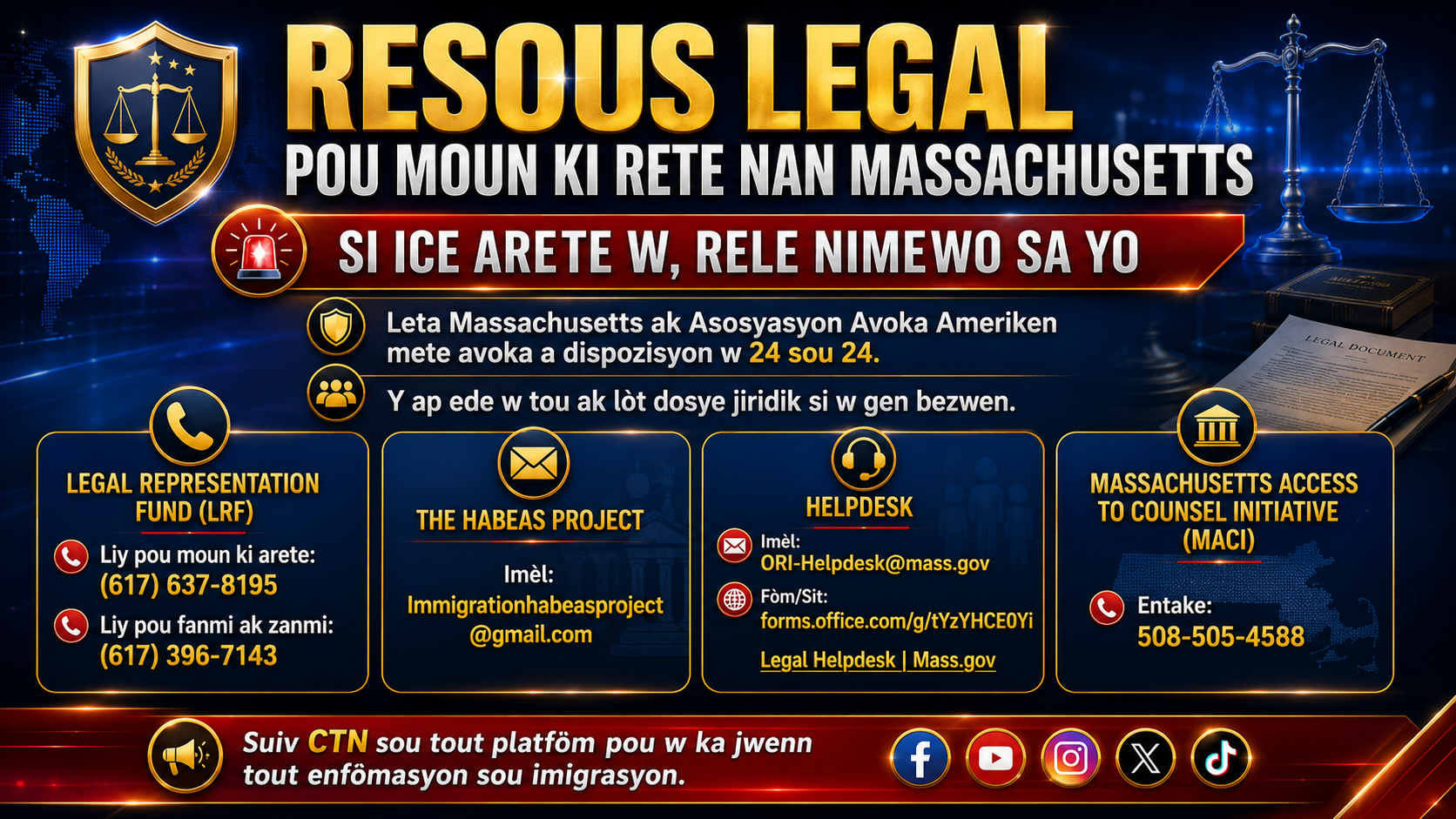
As the flyer from CTN states, the State of Massachusetts, together with the American Bar Association, has made attorneys available to you 24 hours a day, and these programs will also help you with other legal matters if needed.
A word of caution that applies to every one of these programs: they are trustworthy because they are run by the state or by established legal organizations. Do not replace them with someone you found on TikTok, WhatsApp, or Instagram who claims to be a lawyer. A person who is not a licensed attorney or a DOJ-accredited representative can permanently damage a case. Always ask: Are you a licensed attorney, and in what state? Or are you a DOJ-accredited representative? If so, with which organization? If the answer is neither, walk away.
Before anything happens: protect your children
This is the part families most want to avoid thinking about, and the part that matters most. If you have children, it is important to sign a document now that says who is responsible for them if you are not there. This is not a small formality. It is the difference between your children being cared for by a person you chose and your children being caught in a child-protection system that is already overwhelmed.
Signing this document does not mean you are giving your children up for adoption. It does not transfer custody. It does not mean the person you name gets to raise your children or take them from you. It simply names a trusted adult who can make everyday decisions — medical and educational — for your children if you are suddenly unable to.
In Massachusetts, the simplest version of this is called a Caregiver Authorization Affidavit. ORI publishes the form in several languages, including Haitian Creole, on its website. It allows the caregiver you choose to make school and medical decisions for your child. And because it is revocable, you can cancel it at any time — if you and that person have a falling-out, you simply tear it up, and it has no further effect.
Two practical steps make this protection real:
First, put the trusted person’s name on your child’s school pickup list. Schools will not release a child to an aunt, an uncle, or a family friend who is not on the authorized list — even a close relative — unless there is paperwork naming them. A verbal agreement is not enough. As immigration advocates in Massachusetts repeatedly stress, the American legal system runs on paper and evidence, not spoken promises. Write it down.
Second, get passports for your children — from both countries. If your child was born in the United States, they are a U.S. citizen and need a U.S. passport to return here. A family separated in an emergency, with no documents on either side, cannot reunite in either country. Do this now, while offices are open and while you are free to act.
Before anything happens: protect your home and your property
If you own a house, a car, a business, or other property, you do not have to sell everything because you fear deportation. But you do need to plan — because managing property from another country is nearly impossible without the right documents in place beforehand.
That document is a power of attorney. It gives a person you trust the legal authority to manage your affairs — to pay bills, deal with your bank, hire a contractor to repair your roof, collect rent, or handle your property — while you are outside the country. Without it, no one can lawfully act on your behalf, and no bank or contractor will deal with a person who cannot show authority over your property.
As CTN’s guidance puts it: if you own a home and other assets, you can sign a document authorizing someone to manage them for you while you are in another country — and those assets can continue to generate income for you. A house you keep and rent out supports your family from a distance and remains yours to return to. A house lost to a foreclosure you could not respond to from Port-au-Prince is gone.
A power of attorney does not require an immigration lawyer — almost any attorney can prepare one. And like the caregiver affidavit, it is revocable: if you no longer trust the person you named, you can cancel it, and it has no further legal effect.
Other legal resources and what to remember
Losing an immigration status does not automatically make a person undocumented, and it does not close off every path. There are often other avenues to lawful status — asylum, among them — that a qualified attorney can identify. The programs listed above exist precisely to help people find those paths.
A few things worth holding onto:
You have the right not to open your door to ICE unless they show you a warrant signed by a judge. A document that says “Department of Homeland Security,” “ICE,” or “alien” is an administrative warrant that ICE prints itself — it is not a judicial warrant and does not give them the authority to enter your home. A judicial warrant is issued by a court and typically carries the word “court.” Know the difference.
Prepare, but do not lose hope. Making a plan does not mean the worst will happen. It means that if it does, your children are protected and your property is secure. You can hope for the best and prepare for the worst at the same time — and you should do both.
And if the moment comes, call one of the numbers above immediately. Do not wait. The first hour is the one that counts.
Quick reference — save these numbers
- Legal Representation Fund — if you are detained: (617) 637-8195 · for family/friends: (617) 396-7143
- The Habeas Project — Immigrationhabeasproject@gmail.com
- ORI Legal Help Desk — ORI-Helpdesk@mass.gov · forms.office.com/g/tYzYHCE0Yi · “Legal Help Desk” on Mass.gov
- Massachusetts Access to Counsel Initiative (MACI) — intake: 508-505-4588
- Caregiver Authorization Affidavit (Haitian Creole available) — Massachusetts Office for Refugees and Immigrants (ORI) website
Follow CTN on all platforms — Facebook, YouTube, Instagram, X, and TikTok — for all the latest information on immigration.
This article is a public-service information guide and is not legal advice. Immigration law is complex, and every case is different. Eligibility for the programs described here, and for any form of legal relief, depends on your individual circumstances. Please consult a licensed immigration attorney or a DOJ-accredited representative about your own situation. Program contact information is current as of publication and may change; confirm details with each program directly.
https://ctninfo.com/?p=43846&preview=true

This article was originally written in English. Other language versions are produced using AI translation software, so errors may occur. The English version is authoritative.
CTN also uses AI to convert text into audio.