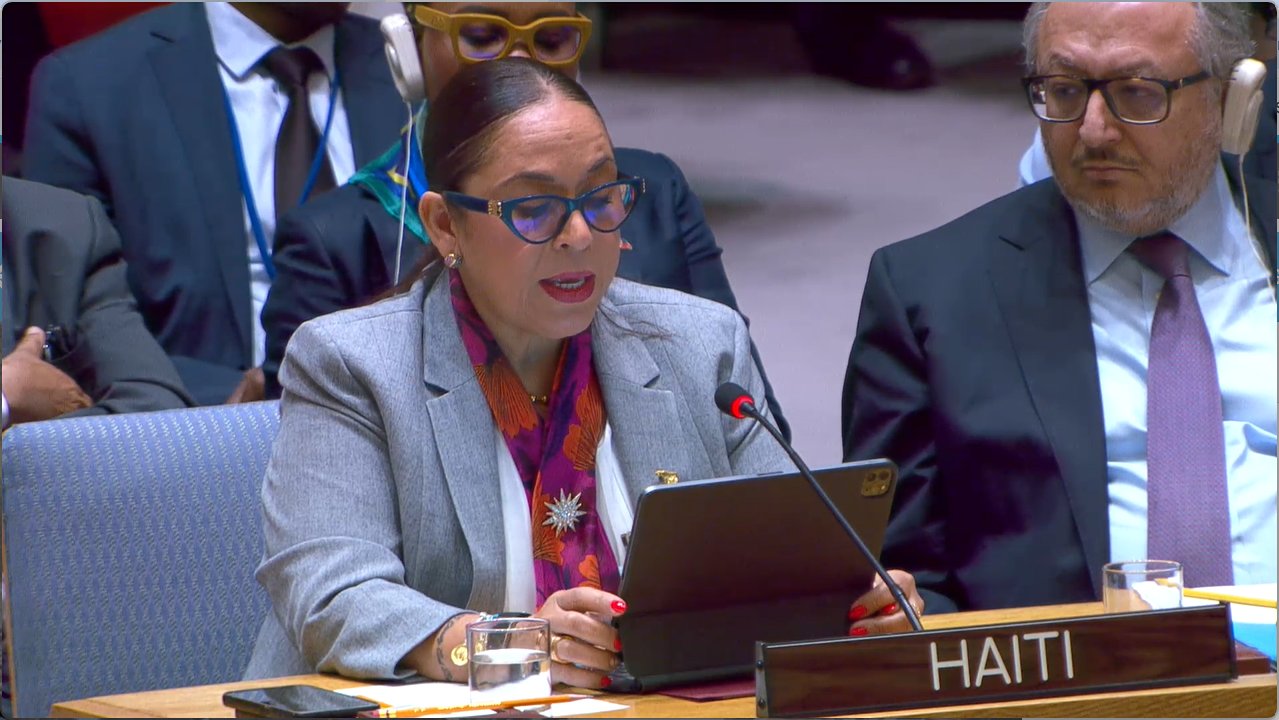
Meeting this Monday, July 20, 2026, at United Nations headquarters in New York, the Security Council held a crucial session dedicated to the situation in Haiti. As the Caribbean nation sinks deeper into a multidimensional crisis, speakers multiplied calls for decisive action on both the political and security fronts. While a “window of opportunity” appears to be opening for the transition, threats remain immense and the international community is urged to maintain its commitment.
Carlos Ruiz Massieu: A “Credible and Realistic” Electoral Calendar as an Imperative
The Special Representative of the Secretary-General and head of BINUH, Carlos Ruiz Massieu, opened the debate by welcoming recent advances: the adoption of a revised version of the electoral decree, agreement on a $120 million budget for electoral operations, and the launch, this very Monday, of the voter registration process. He nonetheless insisted on the need to take a new decisive step. “The challenge now is to maintain this momentum and translate it into tangible improvements for the Haitian people,” he stressed, calling on authorities to publish a “clear, credible, and realistic” electoral calendar.
For Mr. Ruiz Massieu, electoral preparations and the fight against insecurity must imperatively proceed hand in hand. While gang violence remains the main obstacle to stability, it cannot serve as a pretext for indefinitely postponing the political process. He also warned of the catastrophic humanitarian situation, recalling that millions of Haitians are displaced or facing food insecurity, and that gang violence continues to severely hit areas such as Cité Soleil, Kenscoff, and Artibonite.

Jack Christofides: A Call to Strengthen the FRG Deployment
The Special Representative of the Gang Repression Force (FRG) in Haiti, Jack Christofides, also addressed the Security Council to call for a strengthening of the mission’s deployment. He urged UN member states to maintain the current momentum, highlighting recent progress in the force’s operationalization, whose tactical capabilities have improved.
Deployed in several strategic zones, the FRG has already carried out arrests, destroyed hundreds of Molotov cocktails, and dismantled barricades erected by gangs, notably in the Tabarre area, said Mr. Christofides. These actions, though limited, reflect a gradual buildup of the mission’s capabilities.
However, the FRG chief tempered expectations, warning that Haiti’s security problems would not be solved overnight. “No one should believe that Haiti’s security problems will be solved overnight,” he stated, recalling that the FRG is still in its early stages and that the fight against gangs will require sustained, long-term effort. He advocated for an increase in personnel and logistical resources to intensify pressure on armed groups and create conditions for a progressive return of state authority.
Mike Waltz: An American Promise of Firmness and a Call for Mobilization

The U.S. Ambassador to the United Nations, Mike Waltz, for his part, announced that the United States would soon target an insidious source of gang financing: social media. “It is extremely troubling,” he said regarding gang leaders’ use of platforms like TikTok, Facebook, and Instagram to celebrate their atrocities, recruit children, and spread propaganda. “We are going to put an end to this,” he promised, without providing operational details.
Mr. Waltz also issued an urgent appeal to the international community, urging countries with airlift capabilities to accelerate the deployment of foreign troops within the FRG. “Maritime transport takes too long; Haitians need help now,” he argued, citing Sri Lanka, Bangladesh, or Côte d’Ivoire. He underscored the urgency of the situation by citing examples of atrocious violence: Haitian police officers recently “flayed alive” in the streets by gangs, their bodies pinned to a vehicle as a warning.
Raina Forbin: Haiti’s Voice for Strengthened Mobilization
Haitian Minister of Foreign Affairs and Worship, Raina Forbin, took the floor to express her government’s gratitude to the international community, while underscoring the magnitude of remaining challenges. She recalled that the crisis is not limited to security aspects and demands a comprehensive response, including massive humanitarian support and political accompaniment to ensure inclusive elections.
Her presence at this session was welcomed by all speakers, reflecting the Haitian government’s willingness to maintain dialogue with its international partners, as the FRG’s mandate is due for renewal this September. The minister advocated for strengthening the resources allocated to the FRG, so that the force can fulfill its mission and enable the return of the rule of law across the entire territory. She also stressed the need for close coordination between security efforts and the political process, the only guarantee of a sustainable way out of the crisis.