



Exceeding expectations, Democrats retook both chambers of Congress by large margins, flipping Senate seats in Texas, Kansas, Iowa, Ohio, Maine, South Carolina and North Carolina — places out of reach for a generation — while Massachusetts returned Maura Healey and Ed Markey as expected
By Manny Paul — Caribbean Television Network (CTN)
Democrats performed well above expectations in Tuesday’s midterm elections, seizing control of both the House of Representatives and the Senate by large margins in a result that amounted to more than a blue wave — a political tsunami that carried the party to victories in states it had not won in decades.
The scale of the night was unmistakable. Democrats flipped Senate seats in Ohio, Texas, Kansas, Iowa, Maine, North Carolina, and South Carolina — deep-red or long-Republican territory — and, as counting continued, were in good position to add Alaska and Mississippi, which would push their majority even higher. They also retook the House after four years in the minority, with a commanding majority projected. Together, the two outcomes hand the party control of Congress and the power to check President Trump for the second half of his term.
The clearest measure of the shift came in the Senate, which Democrats were projected to flip from Republican control.
CNBC’s Election Desk projected that the majority was secured when Democrats won in Iowa — the result that put them over the top. Because the Senate has 100 seats and Vice President JD Vance, a Republican, holds the tie-breaking vote, Democrats needed at least 51 seats for outright control; they blew past that threshold.
As counting continued, Democrats held 54 seats to Republicans’ 44, with Alaska and Mississippi still to be decided and Democrats positioned to win both.
The gains stretched across the map. In Texas, Democrat James Talarico defeated Republican Attorney General Ken Paxton. In Ohio, Sherrod Brown unseated the incumbent Republican, Jon Husted — the fourth Democrat of the evening to flip a Republican-held seat, according to Associated Press projections.
Democrats also flipped seats in North Carolina, where Roy Cooper won, and South Carolina, where Annie Andrews prevailed, along with Kansas. In Maine, Democrat Troy Jackson sent Senator Susan Collins into retirement after more than three decades in the chamber, ending one of the Republican Party’s most durable careers and claiming a seat the party had long counted on.
Democrat Jon Ossoff held his seat in Georgia. Not every contest broke the Democrats’ way — the Florida Senate seat went to Republicans.

A Senate majority gives Democrats control of the chamber’s floor and its committees, along with the power to shape confirmations of judicial and executive-branch nominees and to set the terms of debate on legislation.
In the House, Democrats were projected to win back the chamber after four years of a narrow Republican majority, according to CBS News and CNN.
The practical consequences begin in January: committee gavels, subpoena power, and a share of authority over federal spending would all pass to the Democrats.
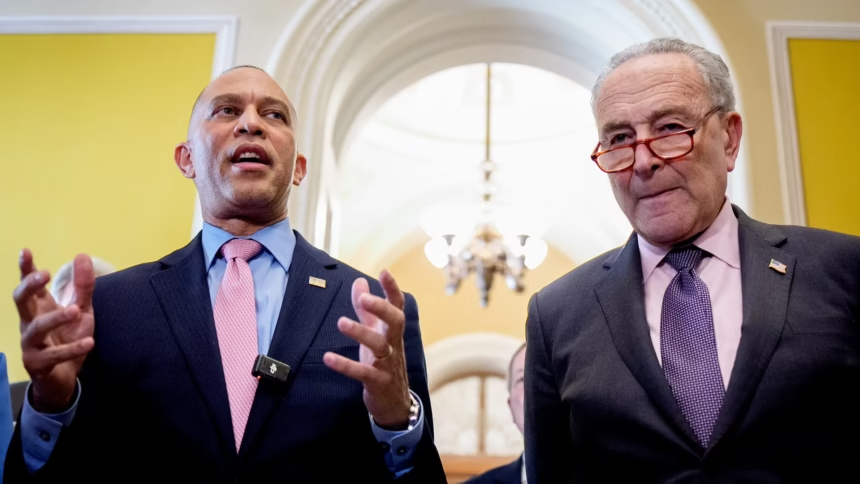
House Democrats are preparing an aggressive oversight agenda. They are expected to examine the president’s and his family’s business dealings, the administration’s immigration enforcement, the Jeffrey Epstein scandal, Mr. Trump’s pardons, and the rushed construction projects around the capital — an effort likely to be led by Representatives Robert Garcia of California and Jamie Raskin of Maryland, the top Democrats on the Oversight and Judiciary committees, and one that could end up in court. Whether the party attempts a third impeachment of Mr. Trump remains an open question; Democratic leader Hakeem Jeffries has said the party has not “ruled anything out” or “ruled anything in.”
Jeffries has said the party’s program will center on affordability, with early priorities that include reversing the Medicaid cuts enacted under Mr. Trump’s One Big Beautiful Bill Act, extending the Affordable Care Act premium tax credits that lapsed last year, ending the war with Iran, and rolling back the president’s tariffs. Those goals point to a standoff: a Democratic House can pass bills and block parts of the administration’s agenda, but control of Congress alone does not give the party the votes to enact its priorities over the president’s objections.
No result captured the scale of the Democratic surge like Texas, where the party pulled off a historic double.
Alongside Talarico’s Senate win, Democrat Gina Hinojosa defeated Republican Governor Greg Abbott to become the first Latina governor of Texas, handing Democrats the governor’s mansion and a Senate seat at once in a state Mr. Trump carried comfortably just two years ago. The twin defeats of Abbott and Paxton — two of the most prominent Republicans in the country — turned Texas blue at the top of the ticket for the first time in roughly three decades.
The Texas races also delivered a costly rebuke to one of the Republican Party’s biggest financial backers. Elon Musk’s roughly $224 million effort to keep the state in Republican hands failed, with about $212 million directed toward Paxton’s unsuccessful Senate bid, according to CNBC. Musk, who has moved much of his business empire to Texas, spent roughly $474 million nationwide this cycle, making him the largest known donor — and, on Tuesday, among its biggest losers.
The forces behind the result had been building for months.
CBS News attributed the Democratic gains primarily to economic discontent, reporting that frustration over the cost of living overturned a Republican majority that had ceded much of its legislative initiative to the Trump administration. The network pointed to an unpopular war with Iran now in its ninth month, trade conflicts it said pushed up inflation, and the optics of costly construction projects in Washington — including a large ballroom at the White House — set against voters’ affordability concerns. History compounded the problem for Republicans: since 1934, the sitting president’s party has gained House seats in a non-presidential election year only three times.
Republicans had framed the contest as a choice between “common sense” and “crazy,” and, at the president’s urging, redrew House maps in several states to create more favorable seats — but CBS reported the move had minimal effect. Democrats countered with their own redistricting in California.

Massachusetts delivers as expected
Closer to home for CTN’s Greater Boston audience, the results in Massachusetts went as anticipated in one of the nation’s most reliably Democratic states.
Governor Maura Healey, a Democrat, was reelected to a second term, and Senator Ed Markey won reelection to another term in the U.S. Senate. Both victories were widely expected, and they kept the Commonwealth’s top offices firmly in Democratic hands as the party surged nationally.
The combination of a flipped Senate, a reclaimed House, and marquee wins in Texas reshapes the balance of power in Washington for the final two years of Mr. Trump’s term. Democrats will control the committees, the subpoenas, and much of the oversight machinery of Congress, even as the president retains the veto and command of the executive branch.
Several races, including Alaska and Mississippi, remained to be called as counting continued — contests that will determine just how large the Democratic wave ultimately proves to be.

https://ctninfo.com/a-political-tsun…house-and-senate/
https://www.facebook.com/CaribbeanNewsMedia
AI Use Policy:
Some of CTN’s journalists are not native English speakers and draft their work in French or Haitian Creole. We then use AI-assisted translation software to produce the English versions, and traces of machine-generated phrasing may occasionally remain. Every article — in any language — is written, reviewed, and edited by CTN’s staff writers and editors, who remain responsible for its accuracy. CTN also uses AI to convert text into audio.