



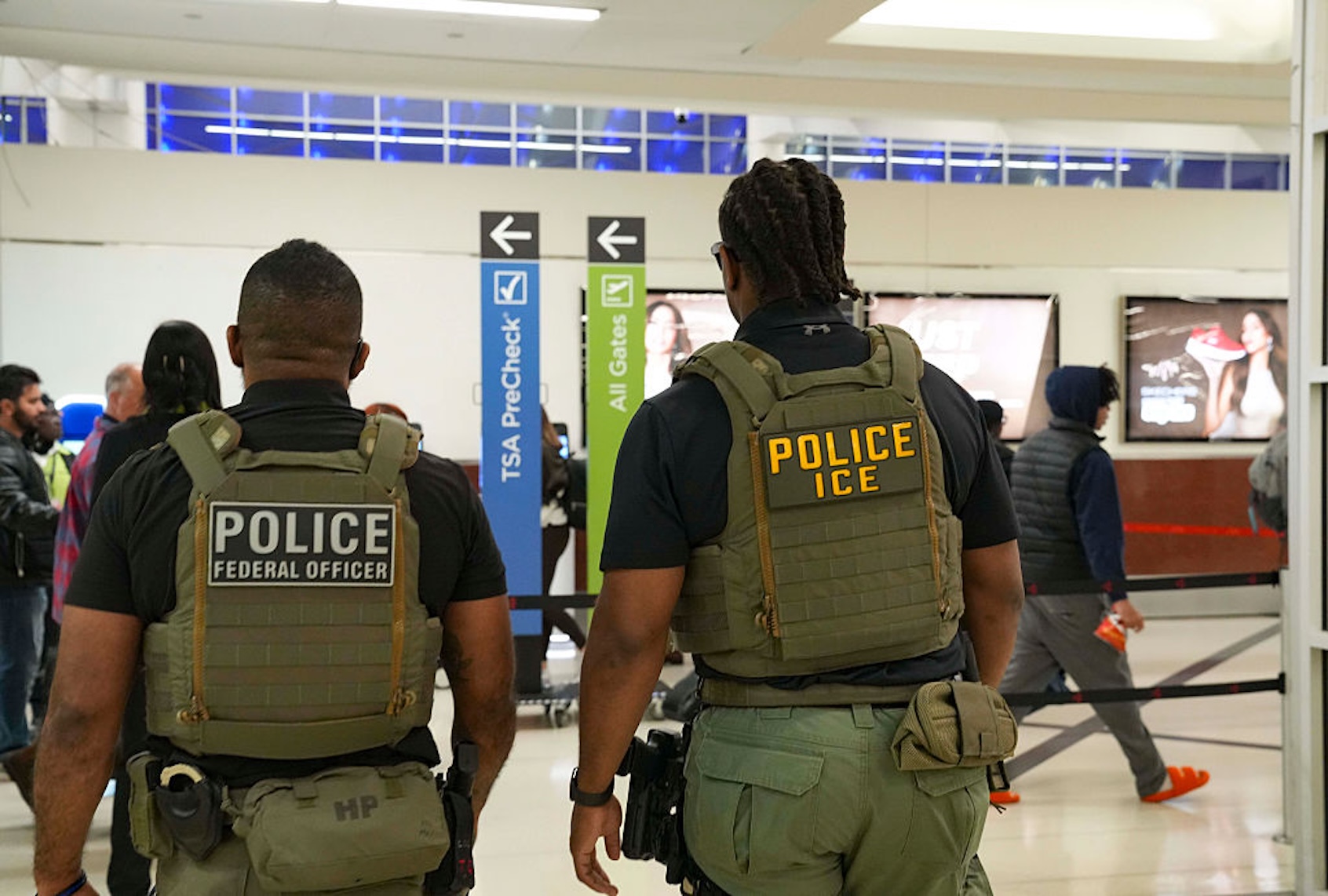
The Trump administration has deported more than 356,000 people so far this fiscal year, according to figures drawn from Immigration and Customs Enforcement’s own enforcement workbook, a pace that could push the government toward its highest annual removal total in more than a decade.
The exact figure is 356,389 removals since the fiscal year began Oct. 1, ABC News reported, citing the ICE data.
That already exceeds the 319,980 deportations carried out in all of the prior year and puts the government on course to approach the 438,421 removals logged in fiscal 2013, the modern-era record set under President Barack Obama.
Mike Howell of the Trump-aligned Oversight Project, which is suing for more detailed removal data, told ABC News the total is “larger than Obama in absolute terms,” while noting that the comparison shrinks when measured against a larger unauthorized population today. The count runs only through mid-July, the most recent window the agency has made public, and the final tally will not be locked in until after the fiscal year closes Sept. 30.

Behind the headline number is a more contested picture of who is actually being detained.
ICE reported holding 65,765 people and described roughly 60 percent of them as having “a criminal record” — a figure that combines 19,329 people with actual convictions and about 20,000 more whose charges have not been resolved in court. Set the unproven charges aside, as the Syracuse University research project TRAC does, and 70.6 percent of detainees, 46,436 people, have never been convicted of any crime, according to TRAC’s analysis of ICE data current to July 11, per The Latin Times reporting.
Reviewing the administration’s claim that about 70 percent of detainees had been convicted or charged, PolitiFact found it did not hold up even when pending charges were counted.
The administration casts the campaign as a matter of public safety. Homeland Security Secretary Markwayne Mullin — the former Oklahoma senator confirmed to the post in March, after President Trump fired his first secretary, Kristi Noem — has highlighted the deportation of alleged gang members and said the removals “made our country safer,” according to a department release. DHS says nearly 70 percent of the people ICE arrests have been convicted of or charged with a crime; as CNN reported, that count includes pending charges and describes those arrested rather than the population now in custody.
Most of the people being removed are from Mexico and Central America, which have long accounted for the bulk of U.S. deportations, with Mexico, Guatemala and Honduras at the top.
The surge’s human toll has drawn scrutiny across the country. Deaths in ICE custody have risen as the detained population has grown, CNN reported, and in July agents fatally shot two Latin American men — one in Maine, one in Texas — whom officials later acknowledged were not the people they had set out to arrest, according to The Associated Press.
For one community, the surge has taken on a particular and escalating shape. Haitians who once held Temporary Protected Status — the humanitarian designation that shielded roughly 350,000 people from deportation and allowed them to work legally — lost that protection after the U.S. Supreme Court cleared the way for the administration to end it in June, according to AP. In the weeks since the first removals resumed, deportation flights to Haiti have gone from about once a month to nearly every Thursday, a shift tracked by the ICE Flight Monitor run by the advocacy group Human Rights First and reported by AP.
Those flights are landing people in a country the U.S. government itself treats as too dangerous for ordinary travel.
Gangs control an estimated 70 percent of Port-au-Prince and are pushing into the countryside; nearly 1.5 million people have been driven from their homes, a record, and more than 3,050 were killed in the first six months of this year, according to U.N. figures cited by AP. More than half of Haiti’s roughly 12 million people need humanitarian aid. Because gunfire has closed the capital’s main airport to U.S. commercial carriers, the charters instead land in Cap-Haïtien, the northern city that has become Haiti’s gateway to the outside world. At least one recent flight carried U.S.-born children, the youngest a one-year-old, AP reported.

Human rights groups say returning people to those conditions is indefensible.
The administration is “knowingly sending people, including children, back into danger,” said Savi Arvey of Human Rights First, as reported by AP. More than 200 Haitians were flown back on two flights in late August, and a flight in early September carried 101 people, Nicolas Mardochée, a coordinator with Haiti’s foreign affairs ministry, told AP. From the airport, deportees must still cross gang-controlled roads to reach relatives, and a small cash stipend handed out on arrival does not cover even a one-way ticket to the capital, according to AP. In recent weeks, gunmen shot and burned residents inside their homes in the hillside town of Kenscoff and overran a section of Cité Soleil where elderly people who could not flee were killed, the Miami Herald reported.
Administration officials have at times floated far larger numbers — deportations nearing a million, with millions more said to have left on their own — but researchers at the Center for Migration Studies have said the largest of those self-deportation claims are not supported by evidence, and CTN is not reporting them as established fact. What is documented is the pace the government has now put on paper: more than 356,000 removals and counting, with three weeks still left in the fiscal year.
This article was originally written in English. Other language versions are produced using AI translation software, and errors are possible — the English version is authoritative. CTN also uses AI to convert text into audio.
https://ctninfo.com/ice-reports-over…ve-no-conviction/
https://www.facebook.com/CaribbeanNewsMedia