


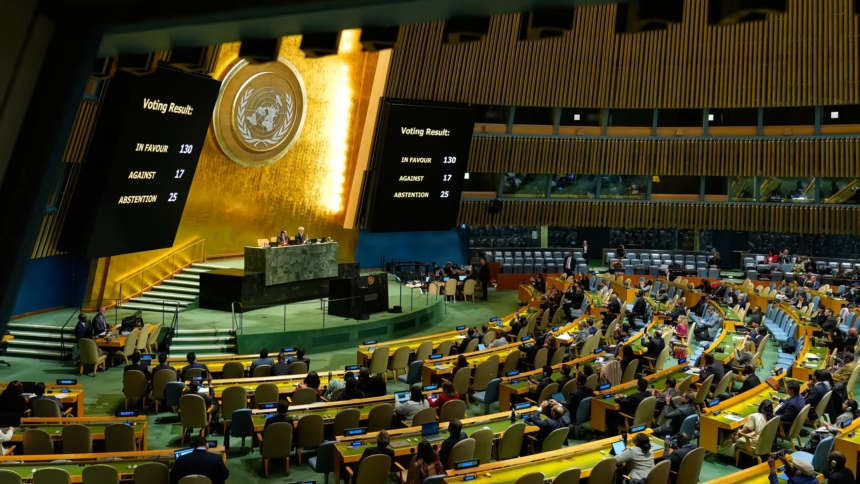
Antigua and Barbuda had planned to vote for a United Nations resolution calling on the United States to end its embargo against Cuba. But before the vote, the government reversed course after the State Department warned that supporting Cuba could jeopardize ongoing negotiations over U.S. visa restrictions on Antiguan citizens, Prime Minister Gaston Browne said.
Browne disclosed the decision on his weekly radio program, according to Antigua News, which reported his remarks Tuesday. The wire service UPI, in a report credited to Mar Puig, said his government had initially decided to support the resolution but reconsidered after a call from Washington.
“We had decided to support Cuba on a resolution recently and changed our position because we had a call from the State Department advising us that they’re making progress in the negotiations, and if we supported Cuba, that it would undermine the negotiations, so we changed our position,” Browne said, as quoted by Antigua News.
The prime minister said he had instructed Antigua’s ambassador to the UN to abstain after the warning from Washington. In the end, though, the country was recorded not as an abstention but as absent during the Oct. 28 vote. Browne said he did not know why the ambassador failed to take part.

The General Assembly adopted the resolution 130-17, with 25 abstentions, according to The Associated Press.
It was the 34th consecutive year the assembly has passed such a measure, but support fell sharply: in 2025 the resolution drew 165 votes in favor, seven against and 12 abstentions. This year’s tally was the lowest level of support since 1995, after a U.S. diplomatic campaign to weaken the vote.
Browne’s account comes as his government presses Washington to lift visa restrictions that have complicated travel for Antiguan citizens. In August, Antigua and Barbuda formally asked U.S. Secretary of State Marco Rubio to review the restrictions and the Visa Bond Program affecting its nationals. According to a government statement, Ambassador Ronald Sanders delivered a diplomatic note to Rubio after Browne had written directly to President Donald Trump to request a review.
The government said it had taken measures to address U.S. concerns about identity verification, document security, screening and compliance with immigration requirements.
Browne also suggested Washington’s stance could be tied to Antigua and Barbuda’s Citizenship by Investment Program, which lets qualifying foreign investors obtain citizenship through financial contributions. He said his government had told the European Union it was willing to suspend the program, while asking for an additional three and a half years to phase it out. He added that he was not certain the citizenship program was the only reason for the U.S. restrictions.
The human cost surfaced on the same broadcast. A woman told the prime minister she could not travel to the United States to visit her ailing mother because her visa had expired and a new one was difficult to obtain. Browne said his government was continuing to negotiate with Washington and questioned the justification for the restrictions, citing the two countries’ long diplomatic relationship.
The episode exposed divisions among Caribbean governments over Washington’s approach to Cuba. During the October vote, the Bahamas, Barbados, Belize, Grenada, St. Kitts and Nevis, St. Vincent and the Grenadines, and Suriname supported the resolution. Jamaica, Haiti and Guyana abstained, while Trinidad and Tobago voted against it. Along with Antigua and Barbuda, Dominica and St. Lucia were recorded as absent. Antigua and Barbuda had supported a similar resolution in 2025, according to the country’s voting record as cited by the Antigua Observer.

Browne said his government would continue its diplomatic efforts to resolve the visa restrictions affecting its citizens.
https://ctninfo.com/antigua-reversed…me-minister-says/
Source: UPI
AI Use Policy:
Some of CTN’s journalists are not native English speakers and draft their work in French or Haitian Creole. We then use AI-assisted translation software to produce the English versions, and traces of machine-generated phrasing may occasionally remain. Every article — in any language — is written, reviewed, and edited by CTN’s staff writers and editors, who remain responsible for its accuracy. CTN also uses AI to convert text into audio.