


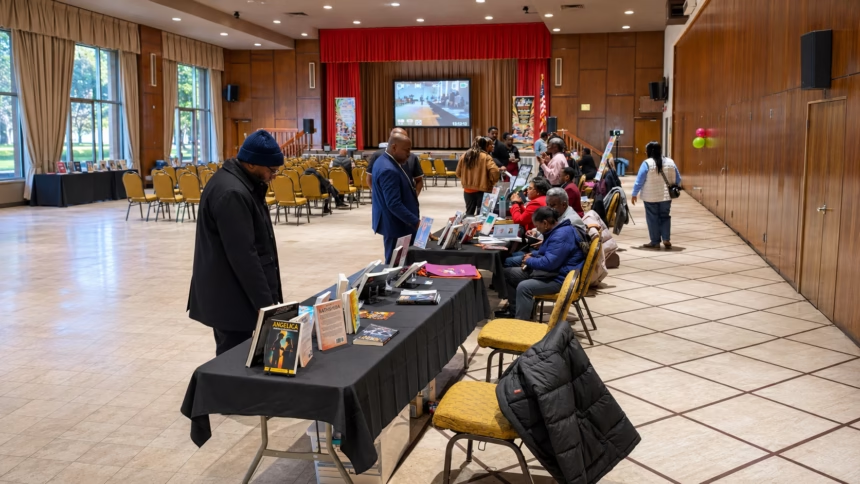
The Boston Haitian Book & Culture Festival hosted a major book fair at the Nouvelle Jérusalem Evangelical Baptist Church in Randolph, Massachusetts.
Coming from several U.S. states, more than thirty authors took part in signing sessions during this first edition of the festival. The event, held on November 14 at the Nouvelle Jérusalem Church, located at 871 North Main Street in Randolph, had been announced as a day devoted to books, ideas, culture, and exchange within the Haitian diaspora.
Through this initiative, Frantz Jean-Baptiste intends to contribute to the efforts to promote the book within the Haitian communities of the diaspora.
“For a very long time, within the Haitian diaspora, we have spoken almost not at all about the question of the book,” said the organizer, who also wishes to “give visibility to the authors who have made so many sacrifices to bring knowledge within everyone’s reach.”

Frantz Jean-Baptiste says he devoted more than six months to designing and preparing this first edition.
After defining the criteria and the rules for participation, he succeeded in selecting 33 authors, nearly all of whom, according to him, answered the call.
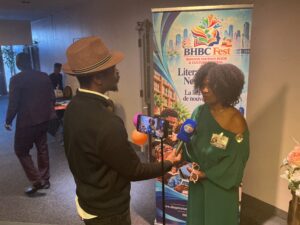
No sooner had the first edition ended than Frantz Jean-Baptiste was already thinking about the next. He is considering, in particular, the creation of a literary prize intended to reward several authors in different categories, he revealed to Robenson Sanon, who was conducting the interviews for CTN during the event.
The organizers’ stated ambition is to make the BHBC Fest a lasting space for encounter among authors, readers, educators, artists, entrepreneurs, students, and members of the Haitian diaspora. The public presentation of the event emphasized precisely this desire to create a platform centered on literature, identity, and the future of the diaspora.
Artificial intelligence and Haitian presence at the heart of the first discussions
The event began around noon with a panel bringing together, notably, Jodi Tatiana Charles— author, educator, and marketing specialist — along with the organizer, Frantz Jean-Baptiste.

The discussions were largely dominated by the rise of artificial intelligence, a technology that, according to Jodi-Tatiana Charles, remains still very poorly understood.
Charles has more than three decades of experience in marketing, communication, and brand development. She is also an author and has worked in several sectors, notably the media, public institutions, and business consulting.
In her presentation in Randolph, she emphasized above all the weak presence of Haiti and of Haitians in the major discussions surrounding the development of artificial intelligence.
According to her, Haitians do not participate sufficiently in producing the information used to feed artificial intelligence systems when it comes to Haiti.
She therefore invited members of the community to become more involved in the debates and in the production of content related to this technology.
Her message was clear: Haitians must also become producers of information about their own history, culture, realities, and communities, rather than leaving it exclusively to others to define the way Haiti is represented in the new digital tools.
Asked about the possibility that artificial intelligence might reduce or weaken human creativity, Jodi-Tatiana Charles acknowledged the limits and the fragilities of this technology. She argued above all for a responsible use of AI, which must remain a tool in the service of the human being rather than a substitute for reflection and creativity.
Jodi-Tatiana Charles was also presenting several of her works at this first edition of the festival. Her work as an author includes, notably, books intended for children and focused on culture, identity, and transmission. Her recent book Going to the Festival addresses, in particular, art, community, friendship, and participation in cultural life.
Carole Démesmin: from music to transmission through the book
She is known above all for a musical career that has crossed borders and spanned several generations. But this time, Carole Démesmin was not present for a musical performance.
The legendary Haitian artist took part in the festival to present her work Les Quatre Souffles de Quisqueya, also published under the titles Four Breaths of Kiskeya and Kat Souf Kiskeya.
Through this work, Carole Démesmin seeks to contribute to a better transmission of Haitian history and culture to the new generations.
Published in three languages — French, English, and Haitian Creole — the book delves into the history and memory of the Taínos, the Indigenous peoples of Kiskeya before the arrival of the Spanish, notably through the figure of Anacaona. The project combines oral tradition, ancestral memory, and cultural research.
Carole Démesmin, a native of Léogâne, has for several decades pursued a career that combines music, storytelling, visual arts, and the promotion of Haitian cultural heritage. Her artistic career spans more than four decades, and her work has been particularly devoted to traditional music, rara, memory, and Haitian identity.
Like many of the authors present at the festival, she has devoted time, energy, and financial resources to the publication of her work.
But for her, the potential economic returns remain secondary. What matters above all is the possibility of making this work available to the public and of contributing to the transmission of Haitian cultural memory.
Edna Chéry also turns to writing
Alongside Carole Démesmin, other well-known figures of the Haitian community took part in this first edition.
Such is the case, notably, of Edna Chéry.
After contributing to the promotion of Haitian culture across several disciplines — notably painting, haute couture, and film — Edna Chéry is now exploring more fully the world of writing.
For her first participation in the festival, she was presenting Aida, a work devoted to the story of a marginalized child in Haiti who is nonetheless endowed with many talents.
Intended for children, the book is offered in Haitian Creole, English, Spanish, and Portuguese.
Edna Chéry is already working on another book that should be published soon, according to the information she shared during the event.
L’Enfant perdu also moves from screen to book
The director and author Pierre Roberson-Roland Neptune was also among the participants.
His work L’Enfant perdu, already adapted for film, is now available in book form. Bookstore catalogs list a French edition of the work published in November 2026 under his name.
Through this work, Roland Neptune addresses, notably, sensitive family questions and certain subjects considered taboo.
The director, who also describes himself as passionate about questions related to family and marriage, says he wanted to use fiction to prompt reflection on these realities.
L’Enfant perdu is his third book.
Milady Auguste continues her path in literature
The young writer Milady Auguste was also present at the first edition of the BHBC Fest.
There, she was presenting her second novel, Sur les traces de Man Bonne.
With two published works already, Milady Auguste is gradually beginning to carve out a place for herself in the literary world. She acknowledges, however, that she still has more work to do to achieve greater visibility, and she intends to continue her efforts in order to establish herself more firmly in the field.
Sur les traces de Man Bonne is indeed listed by C3 Éditions as a novel by Milady Auguste, published in June 2023 and running to 320 pages.
Her works are notably available through C3 Éditions in Haiti and on online sales platforms.
Immigration explained through experience
Milida Domerçant was also on hand, with two works.
Drawing on more than 15 years of experience in the field of immigration, she seeks to place her knowledge at the service of the public, notably through a lexicon devoted to immigration.
She aims to make an often complex vocabulary more accessible to those who must navigate the American immigration system.
In a community where questions related to asylum, TPS, work permits, permanent-residence procedures, and deportations occupy an important place, this type of work meets a need for information and for making the subject accessible.
Pierre d’Haiti: transforming trauma into a message of perseverance
Coming from the neighboring state of Connecticut, Pierre F. d’Haïti had also answered the call.
He was presenting, notably, his work Left in the Garden, a book that addresses trauma, personal hardship, the feeling of abandonment, and the ability to persevere in the face of adversity.
The work, published in English, has been listed since 2020. Its official description evokes, notably, difficult childhood experiences, abuse, loneliness, isolation, depression, and discouragement, while emphasizing the need to keep looking toward the future.
Through this book, Pierre d’Haïti thus seeks to convey advice and a message of resilience to those confronted with trauma and the trials of life.
His career also includes several years of community and educational engagement in Connecticut. Left in the Garden is among his publications devoted to his personal experience and to reflection on life’s trials.
Several figures honored
During this first edition of the Haitian Book Festival in Boston, several figures were also honored for their contribution to Haitian culture.
Such is the case, notably, of Carole Démesmin, whose decades-long career has brought Haitian music, traditions, and heritage to prominence on many international stages.
Beyond sales and signing sessions, the festival thus sought to recognize the work of those who devote a significant part of their lives to preserving, documenting, and transmitting Haitian culture.
This dimension constitutes one of the major stakes of a literary event organized within the diaspora: enabling established or emerging authors to meet the public directly, while creating a space where several generations can exchange around Haitian history, literature, and identity.
Public turnout below expectations
Despite the efforts devoted to promoting the event, the public did not turn out as massively as the organizers had hoped.
For a first edition, this lower-than-expected turnout nonetheless represents more a challenge than a reason for discouragement for Frantz Jean-Baptiste.
The organizer is already thinking about the next edition of the Boston Haitian Book & Culture Festival and about the means of strengthening its reach.
His plan to create a literary prize, to increase the visibility of authors, and to continue promoting the book within the diaspora shows that he intends to establish the initiative over the long term.
The first edition will at least have made it possible to bring together, in a single space, writers, artists, educators, and members of the community around a widely shared observation: the book must occupy a far more important place in the transmission of history, culture, and knowledge within the Haitian diaspora.
AI Use Policy:
Some of CTN’s journalists are not native English speakers and draft their work in French or Haitian Creole. We then use AI-assisted translation software to produce the English versions, and traces of machine-generated phrasing may occasionally remain. Every article — in any language — is written, reviewed, and edited by CTN’s staff writers and editors, who remain responsible for its accuracy. CTN also uses AI to convert text into audio.
https://ctninfo.com/in-randolph-the-…s-and-literature/