

Two of the country’s largest institutions in air travel and banking stumbled within hours of each other on Monday, adding to a string of technology failures that has left many Americans uneasy about the systems they rely on each day.
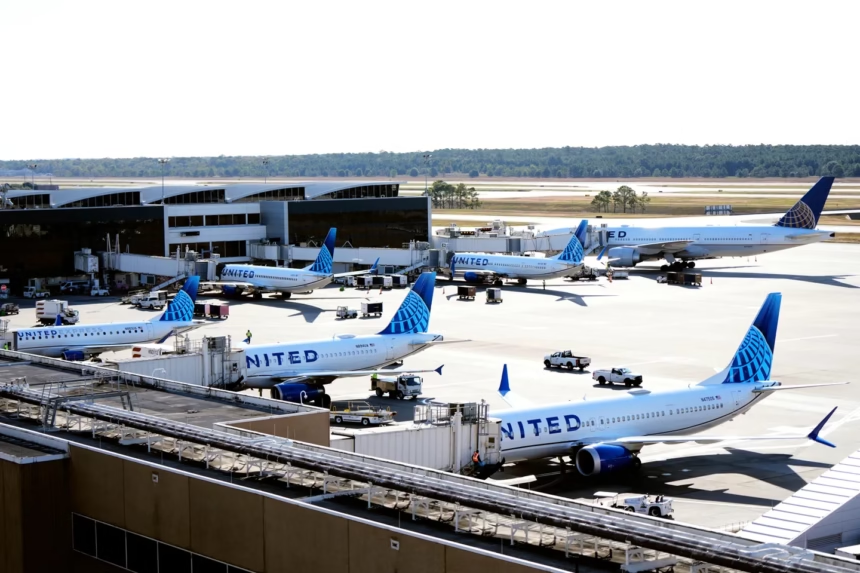
United Airlines was hit by what it called a “widespread system outage” that grounded flights on Monday afternoon before the problem was resolved after about an hour, according to The New York Times. The airline said that “while some flights were delayed, there was no impact on flights in progress, or on United Express flights,” referring to the regional carriers that fly shorter routes on its behalf.
In an earlier statement, reported just before 5 p.m. Eastern time, United said it was “troubleshooting a technology issue affecting departing flights.” The company did not offer further detail about what went wrong, The Times reported.
The timing was difficult. As The Times noted, the disruption came just days before millions of Americans are expected to fly for the Thanksgiving holiday — many of them already on edge after a nationwide ground stop late last week threw air traffic into disarray.
Travelers left guessing on the tarmac
The accounts gathered by The New York Times describe confusion that spread from gate to gate. Craig Gruen, 43, was sitting on the tarmac in Charleston, South Carolina, when the captain of his Denver-bound flight told passengers the crew could not verify the plane’s weight through United’s management system, the newspaper reported. The captain later said over the intercom that United was connecting its narrow-body planes to an older system to confirm weight information so the flight could be cleared for takeoff. “When technology continuously fails, I’m losing trust in the systems,” Mr. Gruen told The Times.
Brandon Chandler, 35, had boarded a flight from Newark Liberty International Airport to Austin, Texas, around 5:20 p.m. when the captain announced that an outage had disrupted the airline’s system for calculating weight and balance, according to The Times. The crew, Mr. Chandler said, was “reverting to an old-school way of calculating numbers for a safe flight.” The captain gave the all-clear just after 7 p.m. The run of outages, Mr. Chandler told the newspaper, had left him with a “bottomless pit feeling in my stomach.”

At LaGuardia Airport in New York, Jonathan Kim, 29, told The Times that passengers often knew more than the staff. “We were able to find news stories about the outage before the agents knew what was going on,” he said, describing travelers who began pricing rental cars and seats on other airlines, worried the delay might rival Friday’s ground stop. David Goss, 67, of Chicago, whose flight was held in Mexico City for about an hour, put it more bluntly in a text message to The Times once he was airborne: “Someone better get to work and address these issues.”
The Times noted that airlines sometimes experience brief technical disruptions and can recover quickly when a problem is caught early, but that a lengthy outage can become destabilizing as pilots and flight attendants reach their legal working limits and delays ripple across a carrier’s network.
A ‘software bug’ at the nation’s largest bank
Hours earlier, JPMorgan Chase — the country’s largest bank — reported trouble processing transactions, and said the problem might have reached customers of other banks as well, The New York Times reported. In a statement cited by the newspaper, the bank said it had “experienced a temporary issue related to a software bug in on-premise hardware systems” and that there was no evidence the trouble was “cyber-related.” By Monday evening, a spokeswoman said Chase had resumed normal operations.
The bank sought to limit alarm. “This is not a systemic issue,” it said in an earlier statement reported by The Times, adding that “other banks may have been impacted by slowness in transactions only to the extent that they were a party to a transaction with us.” Chase, which serves more than 86 million customers at 5,000 branches, said account holders “still have access to their accounts and funds.”
Even so, The Times reported that some Chase customers said on social media that they could not use their A.T.M. cards or complete transactions at branches, and that customers at Wells Fargo, U.S. Bank and Bank of America reported problems as well, according to the outage-tracking site Downdetector. Users also flagged issues with the payment platform Zelle. As the newspaper explained, banking networks are deeply interconnected, so trouble at one institution can cascade — and Chase’s size magnifies the effect, since it is a co-owner of the Clearing House, which runs core payments infrastructure, and of Early Warning Services, which operates Zelle. U.S. Bank said its systems were not “directly impacted,” though Zelle transfers to other institutions might be delayed; Zelle said it was “not down”; and Bank of America said its systems were “operating normally.” Wells Fargo did not immediately respond to the newspaper’s request for comment.
A week that strained public confidence
Monday’s problems followed two earlier disruptions that The Times tied to the same unsettled mood. A global Microsoft outage that began Thursday and was resolved Saturday knocked out widely used products including the Outlook email service, the Teams messaging app and the Copilot assistant; Microsoft attributed it to a “technical issue” rather than a cyberattack. On Friday, the Federal Aviation Administration issued a rare nationwide ground stop after outdated air traffic communications equipment became overloaded, which officials traced to a routine router upgrade at a radio facility in El Dorado, Arkansas, along with a second, unspecified problem at a radar facility in Amarillo, Texas.
The New York Times reported that there was no indication the disruptions shared a common cause. But the accumulation drew notice from specialists. “Our country has seen three very serious technology incidents over the past week,” Mike Chapple, a professor of information technology, analytics and operations at the University of Notre Dame, said in a statement quoted by The Times. “When we dig into the details, each one has an explanation that makes sense on its own, but they all point to a common theme: the complexity and fragility of the systems that we depend on every day.”
Rumors of power trouble — and why preparation still makes sense
As the outages piled up, speculation spread across social media about what might come next, including unverified rumors of possible power disruptions in the days ahead. As of the time of this publication, no federal agency has issued any such warning, and nothing in the incidents reported by The New York Times points to a coming power failure. The breakdowns described this week involved airline software, a bank’s hardware, a Microsoft service and aging aviation equipment — not the electrical grid. Readers should treat claims of an imminent blackout with caution and rely on official sources, such as local utilities and emergency-management agencies, rather than anonymous online posts.
That said, a measure of readiness is sensible at any time of year, and especially heading into a holiday week when stores and services are busy. Keeping a few days of basic, non-perishable food and drinking water on hand costs little and spares a last-minute scramble. Charging phones, laptops, and any backup battery packs in advance, and keeping a car reasonably fueled, leaves a cushion if service is interrupted for any reason. And having an alternative way to stay in touch — a charged backup phone, a battery or hand-crank radio, and a short list of important numbers written down — is a reasonable precaution should a network go down. None of this is a response to a confirmed threat; it is ordinary preparation that holds up whether the week ahead is calm or bumpy.
For travelers, the practical advice that emerges from The Times’ reporting is to build in extra time, check flight status directly with the airline before leaving for the airport, and keep an eye on the news.
https://ctninfo.com/united-flights-a…-tech-breakdowns/
Source: New York Times

AI Use Policy:
CTN uses artificial intelligence tools to support research, drafting, and editing. All content is reviewed and verified by a human editor before publication. The reporting on the United Airlines and JPMorgan Chase outages, the earlier Microsoft and Federal Aviation Administration disruptions, and all quotations herein is drawn from The New York Times. The note on online rumors and general preparedness is CTN’s own and does not reflect any official warning.