

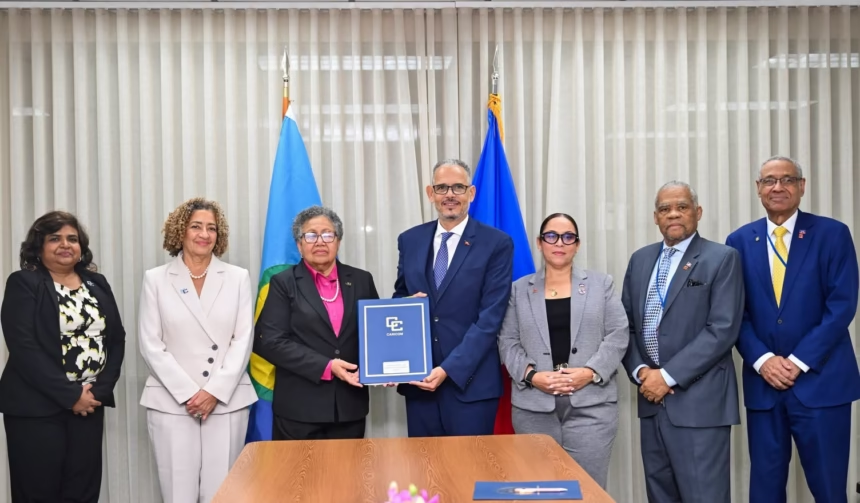
New York — On September 21, 2026, Haitian Prime Minister Alix Didier Fils-Aimé and the Secretary General of the Caribbean Community (CARICOM), Dr. Carla Barnett, signed the Multilateral Air Services Agreement (MASA). The ceremony, held on the sidelines of the 81st United Nations General Assembly, is presented by the Haitian government as a decisive step toward deeper integration of Haiti into the Caribbean space.
According to a statement from the Prime Minister’s Office, the MASA will open new prospects for air connectivity, regional mobility, and cooperation. It is intended to facilitate new connections with Caribbean states, promote the movement of people and goods, support tourism and trade, and improve the competitiveness of air transport.
The Prime Minister emphasized that “opening up Haiti constitutes a strategic priority,” particularly to stimulate economic activity, create new opportunities for businesses, and strengthen ties between the Haitian people and other Caribbean peoples. The signing also reflects the government’s desire to strengthen aviation security and safety by better harmonizing with international standards and sharing regional expertise.
Yet the gap between stated ambition and reality on the ground remains considerable. Haiti is going through an unprecedented security, political, and humanitarian crisis, and the question of whether an air agreement can truly produce tangible effects in a country where the state controls barely a fraction of its territory remains open.

The MASA is CARICOM’s central legal instrument for establishing a single air transport market within the Community. Its objectives are clear: to establish a single market for air services within the Community, promote the adoption of uniform recommended standards and practices, ensure consistency in licenses and certifications of aeronautical personnel, and ensure that international air transport services are provided by financially viable and technically qualified carriers.
To date, twelve member states have signed the MASA, eleven of which have ratified it: Antigua and Barbuda, Barbados, Belize, Dominica, Grenada, Guyana, Jamaica, Saint Kitts and Nevis, Saint Lucia, Saint Vincent and the Grenadines, Suriname, and Trinidad and Tobago. Haiti’s accession further expands this list.
Haiti and CARICOM: A Complex and Winding Integration Path
Haiti joined CARICOM in 2002, becoming the organization’s fifteenth member state. Yet more than two decades later, the country’s role within the Community remains ambivalent: on one hand, it is the most populous French-speaking country in the Caribbean, with a singular cultural identity; on the other, its chronic political, economic, and security crises have long kept it on the periphery of the regional integration process.
The early attempts at trade integration are revealing. As a CARICOM member, Haiti applies the Common External Tariff (CET). A World Bank trade brief indicates that in 2007, Haiti’s simple most-favored-nation average tariff was only 2.8%, and its weighted average tariff was 2.9% — the lowest among CARICOM member states — with the maximum rate reaching only 15%. However, the effective import tariff burden rose significantly due to a 4% inspection fee, a 2% surcharge, a 10% turnover tax, and excise duties, bringing the effective burden to approximately 6.9%.
More paradoxically still, Haitian exports faced the highest regional tariff barriers in CARICOM.
In 2006, the weighted average tariff on its exports was 10.5%, and non-agricultural exports—mainly clothing—faced an average tariff of 12.4%. In other words, Haiti went further in opening its market than its neighbors, but its products encountered higher obstacles when entering regional markets. This asymmetry partly explains Haiti’s caution regarding its community commitments.

The region’s political and security engagement offers a different picture. In February 2026, Prime Minister Fils-Aimé attended the 50th regular CARICOM meeting in Saint Kitts and Nevis, where he discussed Haiti’s security situation with Secretary General Barnett, focusing on capacity building for the Haitian Armed Forces and the National Police, support for the deployment of the Gang Suppression Force (FRG), and regional assistance for the electoral process.
In July 2026, CARICOM governments issued a statement following their 51st conference in Saint Lucia, reaffirming “their unwavering solidarity with the Haitian people,” welcoming the Haitian government’s efforts to restore security and advance the electoral process, and calling for the “full deployment and extension of the mandate of the Gang Suppression Force (GSF).” The statement emphasized that “Haiti’s security is inseparable from the security and stability of the wider Caribbean region.”
However, the statement published by CARICOM’s Eminent Persons Group (EPG) after its visit to Haiti from September 2 to 9, 2026, reveals the regional organization’s deep concerns. The EPG noted that the electoral process “has not met expectations,” that voter registration was “hampered by the presence, on the territory, of areas beyond state control,” and that many stakeholders expressed reservations about the heavy documentary requirements of the revised electoral decree — with some parties even calling for a postponement of the December 13 date.
The security situation was described as “particularly worrying.” The EPG noted “the spread and explosion of deadly violence and kidnappings,” as well as the challenges posed by the slow deployment of the GSF. All stakeholders insisted on the need to “ensure a safe environment allowing voter registration throughout the country, political campaigns, freedom of movement, and safe citizen voting.”
In this context, the signing of the MASA takes on particular significance. Haiti’s air connectivity has been severely tested in recent years.
American Airlines, which had served Haiti for more than fifty years, indefinitely suspended its flights to Port-au-Prince in December 2024. Previously, the U.S. Federal Aviation Administration (FAA) had banned U.S. commercial flights from flying over Haiti at low altitude, after several incidents in which gangs fired on aircraft. In March 2026, the FAA extended this ban until September 3, citing “the persistent inability of Haitian security forces to prevent attacks on aircraft in and around Port-au-Prince.”
Currently, Sunrise Airways is the only airline providing regular passenger service between Port-au-Prince and the United States. Haitians wishing to travel to the United States must pay high sums, often transiting through the Turks and Caicos Islands or the Bahamas.
A turning point came in June 2026, when American Airlines announced it would resume flights to Haiti on November 1, but to Cap-Haïtien in the north of the country rather than Port-au-Prince, which is plagued by gang violence. The airline will use Boeing 737s for a daily flight, noting that Haiti is “the Caribbean market with the highest demand not served by U.S. airlines.”
The signing of the MASA offers, in theory, an institutional framework allowing Haitian carriers — such as Sunrise Airways — to expand their routes in the CARICOM region.
The agreement allows community carriers free access to member states’ markets, which could open more regional traffic rights to Haitian carriers without bilateral negotiations. For a country geographically close but long isolated in terms of transport, this institutional dividend is not negligible.
The signing of the MASA is a clear signal sent by Haiti to the outside world: despite the crisis, the country remains committed to regional integration. The Prime Minister’s Office statement insists on Haiti’s desire to “better leverage its position at the heart of the Caribbean” and to “contribute fully to building a more integrated, more accessible, and more dynamic regional space.”
Yet a considerable gap separates institutional commitments from their effective implementation.
The signing of the MASA constitutes an undeniable institutional progress. But for a country unable to guarantee the safe operation of its capital’s airport and with an electoral process bogged down, the opportunities offered by air liberalization can only fully materialize once the more fundamental questions of security and political stability are resolved.
https://ctninfo.com/haiti-signs-the-masa-regional-integration-ambitions-and-harsh-realities/
https://www.facebook.com/CaribbeanNewsMedia