


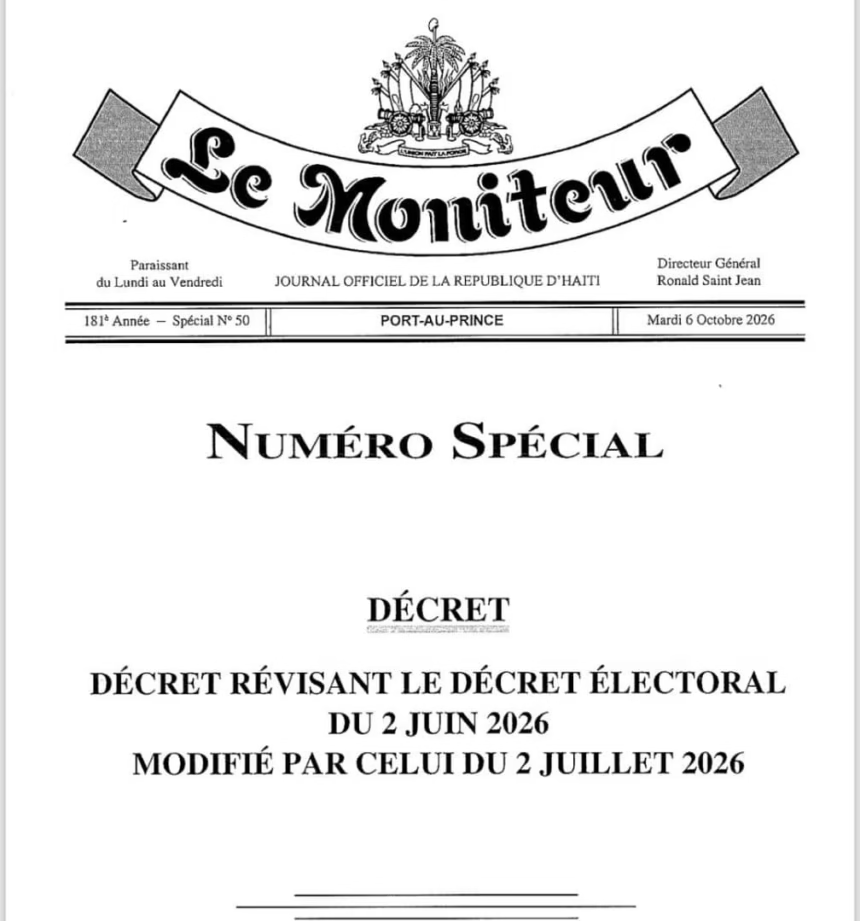
Port-au-Prince — The new electoral decree was published on Tuesday, October 6, 2026, in a special issue of the official journal of the Republic of Haiti, “Le Moniteur.” This electoral decree revises that of June 2, 2026, itself amended by that of July 2, 2026. Validated the day before, on October 5, in the Council of Ministers and signed by Prime Minister Alix Didier Fils-Aimé as well as by all members of the government, this 392-article text now constitutes the legal reference framework for the organization of the presidential election, legislative elections, elections of territorial collectivities and indirect elections, as well as for the popular ratification of a limited number of changes to the Constitution. It also enshrines, from its very first articles, the principles of integrity, transparency, impartiality and inclusion, and reaffirms the universal and secret nature of suffrage.
Among the most sensitive provisions of the new decree is the retention of the popular ratification mechanism. In accordance with the National Pact for Stability and the Organization of Elections of February 21, 2026, published in Special “Le Moniteur” No. 7 of February 23, 2026, the text provides that the proposed changes to the Constitution be submitted directly to the Electoral Assembly. Article 73.1 specifies that this ratification takes place by single-round majority vote and is held at the same time as the first round of the presidential election and the legislative elections. The ballot provided for this purpose, described in Article 220.1, bears the title “REPUBLIC OF HAITI: PROPOSAL FOR CHANGES TO THE CONSTITUTION” and contains two boxes: one green bearing the words “Yes / Wi,” the other white bearing the words “No.” The Executive, according to Article 195, is responsible for informing the population and explaining the content of the document, while Article 194 requires the publication of the proposed changes in the Official Journal within a timeframe allowing for wide dissemination throughout the territory before the date of the vote. Notably, Article 196.1 expressly prohibits any agent of the national Public Administration from participating in advocacy for or against the proposed changes, and Article 197 obliges public media to reserve equal space for supporters of “YES/WI” and those of “NO.”
One of the major innovations of this new legal framework lies in the regime of exclusions affecting potential candidates. The decree gives free rein to political or economic figures suspected of involvement in shady activities and targeted by sanctions from the United States, Canada or the European Union. Only those subject to sanctions from the United Nations Security Council remain excluded from the electoral process. This provision, found systematically in the lists of eligibility conditions — whether for the candidate for the Presidency (Article 76, paragraph 8), the candidate for the Senate (Article 84, paragraph 8), the candidate for the Chamber of Deputies (Article 95, paragraph 8), the candidate for the Municipal Council (Article 107, paragraph 9), the candidate for the Administrative Council of the Communal Section (Article 113, paragraph 9) or the candidate for the Assembly of the Communal Section (Article 119, paragraph 12) — de facto opens the way to candidacies that, under other skies, would provoke fierce controversy. It marks a break with previous versions of the decree, which referred more broadly to international sanctions, and could profoundly alter the composition of Haiti’s next political leadership.
Title XI, devoted to transitional provisions, sets precise temporal requirements for public officials wishing to seek elective office. Under Article 387, members of the Government and Senior Officials who wish to run in the next elections must resign from their positions within one month of the signing of the National Pact for Stability and the Organization of Elections of February 21, 2026, failing which their candidacy shall be inadmissible. Article 388 requires Interim Executive Agents who wish to become candidates to resign no later than seven (7) days after the publication of the decree in the Official Journal, failing which their candidacy is considered inadmissible. Government Commissioners, for their part, must provide proof of resignation from their posts at least two (2) months before the candidate registration period, in accordance with the requirements set out in Article 153, paragraph 13, which requires a certified notarized copy of the resignation letter with acknowledgment of receipt and a response letter from the head of the institution within this timeframe. Furthermore, members of the CEP may only run for elective office if they resign at least three (3) years before the date of the elections (Article 389), while the Director General, Directors, members of the BEDs and BECs as well as any other CEP staff member are subject to a one (1) year deadline (Article 390). Any electoral staff member who registers as a candidate in violation of this provision would be immediately dismissed from their duties and their candidacy rejected, without prejudice to criminal penalties.

Still No Date for the First Round
Despite the publication of this new decree, the dates of the elections remain unknown. The first round, which had been set for December 13, 2026, has still not been reconfirmed by the Provisional Electoral Council. This silence fuels uncertainty about the effective holding of the vote within the initially envisaged timeframes, even though the decree provides, in Article 75, that voters are convened by an Order adopted in the Council of Ministers setting the purpose, places and date of the convocation, at the request of the CEP. The electoral calendar, which Article 134 recalls determines the deadline to be granted to political parties to comply with the requirements of the list of members, therefore remains the determining element that is slow to be made public. This uncertainty comes in a context already marked by considerable logistical challenges, including the updating of the electoral register, the installation of Registration and Voting Centers (CIV) throughout the territory, the publication of electoral lists thirty (30) days before the vote and the posting of the list of members of Voting Bureaus twenty-two (22) days before the vote.
The new decree also innovates in the area of electoral disputes. It creates three levels of jurisdiction: the Communal Electoral Disputes Bureau (BCEC), the Departmental Electoral Disputes Bureau (BCED) and the National Electoral Disputes Bureau (BCEN), sitting in panels of Electoral Judges assisted by Clerks. These bodies, which are not permanent courts, are created for the occasion of electoral competitions. Decisions of the BCEC may be appealed before the BCED, whose rulings may only be challenged before the BCEN for incompetence, misinterpretation or misapplication of electoral legislation, while BCEN rulings are not subject to any appeal. Title IX of the decree also establishes a detailed repressive regime, distinguishing between contraventions, misdemeanors and electoral crimes, with prison sentences and fines that may reach, for crimes, forced labor for life, particularly in cases of manufacturing false national identification cards or fraudulent manipulation of ballot boxes.
Title VI sets rigorous ceilings for campaign financing. Donations from a natural or legal person may not exceed twenty million gourdes for a political party, twelve million for a presidential candidate, five million for a Senate candidate, three million for a Chamber of Deputies candidate, one million five hundred thousand for a municipal cartel and one million for other elective positions. Spending ceilings are set at two billion gourdes for a presidential candidate, two hundred million for a senator, forty million for a deputy, twenty million for a cartel for the position of Mayor, four million for a CASEC cartel and two million for an ASEC cartel. Direct or indirect financing from a state authority or a person of foreign nationality is prohibited, as is any financing from illicit or criminal activities.
While the country still awaits the convening of the people to the polls, this new 392-article electoral decree lays the legal foundations of a process whose outcome remains, more than ever, dependent on political, security and logistical factors that go beyond the normative framework alone.