


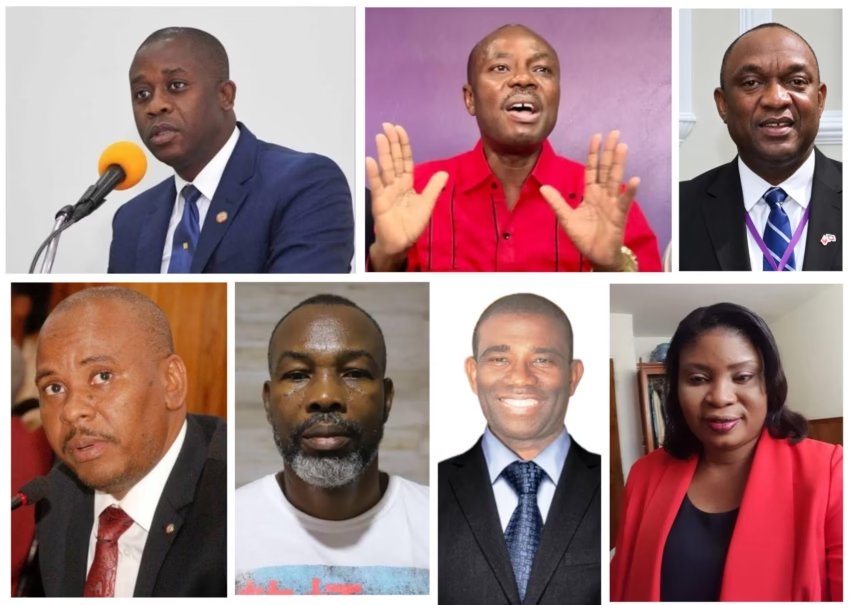
In its final report submitted pursuant to resolution 2794 (2025), the Panel of Experts on Haiti established by Security Council resolution 2653 (2022) paints an alarming picture of collusion between gangs, political actors, businesspeople, and state agents. The document, covering the period from October 2025 to July 2026, names several individuals and gang leaders, details the acts they are accused of, and recommends their addition to the sanctions list or the strengthening of existing measures.
The report’s central finding is unambiguous: gangs are not autonomous entities. They rely on “a network of actors with an interest in maintaining their activities,” including “political figures, economic actors, and members of the security sector.” The Panel of Experts warns that “efforts to neutralize gang leaders are unlikely to produce lasting results unless accompanied by measures targeting the networks that support them.”
The UN sanctions regime, which currently includes nine individuals and two entities, can only produce its full effects if it also targets these backers. Yet the report notes that “the vast majority of individuals who assist gangs and contribute to the destabilization of the country are not yet on the sanctions list.”
Alfredo Junior Antoine: The former deputy of Kenscoff

The Panel of Experts devotes a detailed section to Alfredo Junior Antoine, a former deputy elected in the Kenscoff constituency from 2016 to 2020. According to the report, since at least 2016, he “has armed and supported groups of young people in the region, using them as a political tool.” These groups later evolved into gangs or joined them.
He is presented as “one of the main sponsors of the attack perpetrated on January 27, 2025, in Kenscoff,” which resulted in more than 100 murders, accompanied by numerous rapes, including of minors, armed robberies, and the burning of homes. He also planned attacks with gangs in several neighborhoods of Kenscoff and communicated frequently with Dady Paul, alias “Didy,” one of the main gang leaders in the area, as well as with Magalie Habitant, described as “the main intermediary between political officials, businesspeople, and gangs.”
The report also presents him as “one of the suppliers of firearms, ammunition, and financial resources to Viv Ansann,” and indicates that several illegally held firearms were discovered at his home. Arrested on April 4, 2025, for conspiracy against state security, financing criminal organizations, complicity in murder, and criminal association, he was released on May 9, 2025. The Panel of Experts contacted him; Mr. Antoine denied any links to gangs by email, but the Panel maintains its conclusions.
Nenel Cassy: The former senator of Nippes
Nenel Cassy, former senator of the Nippes department (2006-2012 and 2016-2020), is also singled out. The report states that he “provided support to various armed actors in order to promote his political agenda and serve his interests.”

He controls the criminal group “BLTS,” operating in Chalon, in the commune of Miragoâne, specializing in illegal possession of firearms, murders, attempted murders, kidnappings for ransom, gang rapes, vehicle theft, and armed robbery. He contributed to the creation of Fantome 509, a violent group composed of armed individuals, including police officers, which participated in public disorder, arson, and murders of police officers.
The report also accuses him of having committed “an attempted kidnapping followed by the assassination of a Haitian diplomat, in February 2021,” and of having sought to “sow chaos in Haiti by planning armed attacks against airport infrastructure in Port-au-Prince, Les Cayes, and Cap-Haïtien.” He allegedly organized numerous meetings that led to attacks aimed at destabilizing Kenscoff, in collusion with Viv Ansann. He also allegedly distributed weapons to gangs in Gressier in 2018 and supported the G-Pèp coalition as well as the Kraze Baryè gang of Vitelhomme Innocent.
Arrested on August 2, 2025, for conspiracy against state security, financing criminal groups, attempted murder, and criminal association, he was released on August 19, 2025. The Panel of Experts sent him a letter, which went unanswered. He is already subject to sanctions from Canada (March 2023) and the United States (December 2023).
Rosemila Petit Frère: The former mayor of Arcahaie
Rosemila Petit Frère, a businesswoman and former mayor of the commune of Arcahaie from 2016 to 2020, is at the heart of an investigation into illicit financial activities linked to gang financing. The report states that she “maintained long-standing relationships with the leaders of the Viv Ansann gang” and “provided them with both financial and logistical support.”
She played “a decisive role in maintaining links between gangs and criminal, political, economic, and security sector circles, notably by facilitating communications and financial transactions.” Message exchanges revealed that she supported several Viv Ansann leaders, including Renel Destina, alias “Ti Lapli,” leader of the Grand Ravine gang.
The report specifies that during the five months preceding the launch of Viv Ansann in September 2023, she multiplied calls with Jean Gardy, alias “Pece Pim Pim,” and Ti Lapli, and transmitted to the latter three times “confidential operational information concerning imminent operations of the Haitian National Police.” Thanks to her contacts within the police, she “often received confidential investigation reports from corrupt officers,” notably concerning Prophane Victor and Magalie Habitant.
Her corrupt relationships enabled her to obtain public contracts for supplying uniforms to the police without competitive bidding. She also facilitated the appointment of individuals to strategic positions to divert funds for her own benefit, notably at the Social Assistance Fund. She laundered these funds through three commercial entities she owned: Centre Commercial, Groupe Radio Mono 96.3 FM, and Excel Travel. Arrested in August 2025 while transiting through the Dominican Republic from Canada, she contested the Panel of Experts’ conclusions, which it maintains.
Guy Philippe, Youri Latortue, Prophane Victor, and Jean Charles Moise also singled out
Other political figures are also cited in this report. Guy Philippe, a former senior police official turned political actor, is accused of supporting Viv Ansanm. The experts mention several meetings with Jean Misnord, alias “Fado,” number three of the Simon Pelé gang, in the context of attempts to expand gangs toward southern Grand’Anse.
In Artibonite, the experts also recall what they describe as the historical use of armed groups by Youri Latortue and Prophane Victor. Prophane Victor is not merely a peripheral name in the UN framework; he is among those already on the UN sanctions list.
Jean-Charles Moïse, a businessman from the Nord department, secretary-general of the Pitit Dessalines party, former presidential candidate, and former senator of the North, is identified as the principal actor in the glass eel sector, “one of the most lucrative natural resources in Haiti.” A kilogram sells for between $3,000 and $5,000 on the international market, while local fishermen sell it for only $0.34 to $1.70.
The report states that “Mr. Moïse’s network decides who is assigned to the office responsible for issuing glass eel export permits” and that he “exercises political and economic influence over the sector,” controlling the entire supply chain. He pressures certain customs agents to yield to his tax fraud demands; those who refuse are transferred. He heads a network of illicit exporters linked to a broader regional network operating in Caribbean waters, and mobilized his smuggling network in the North to move glass eels out of Haiti when legal exports were blocked.
Gang leaders already sanctioned
The report recalls that nine individuals are on the sanctions list. Jimmy Chérizier (HTi.001), alias “Barbecue,” leader of the Delmas 6 gang; Johnson André (HTi.002), alias “Izo,” leader of the 5 Segond gang; Renel Destina (HTi.003), alias “Ti Lapli,” leader of the Grand Ravine gang; Wilson Joseph (HTi.004), alias “Lannò San Jou,” leader of the 400 Mawozo gang; Vitelhomme Innocent (HTi.005), leader of the Kraze Baryè gang; Prophane Victor (HTi.006), former deputy; Luckson Elan (HTi.007), leader of the Gran Grif gang; Dimitri Hérard (HTi.008), former head of the General Security Unit of the National Palace, designated for his support to gangs; and Kempes Sanon (HTi.009), leader of the Les Argentins gang.
The Panel of Experts notes that several of these leaders continue to recruit minors, notably Izo and Ti Lapli, and that children are used as human shields against drone attacks. Gangs continue to collect ransoms, extort businesses, and levy illegal taxes. Kidnappings have increased, mainly attributable to Izo’s 5 Segond gang, Wilson Joseph’s 400 Mawozo, and Vitelhomme Innocent’s Kraze Baryè.
A sanctions regime weakened by its implementation
The report reveals that asset freezing remains largely ineffective. The Bank of the Republic of Haiti confirmed that only the accounts of Kempes Sanon (383,520.99 gourdes, or about $2,910) and Prophane Victor (55,486.81 gourdes, or about $421) have been frozen. The Panel of Experts is concerned about “the absence of a coordinated national process to locate and freeze the assets of these individuals.”
No real estate has been identified or frozen. Commercial banks were slow to react after the designation of the individuals concerned, allowing them to transfer their assets or conceal them under third parties’ names. The Panel of Experts also noted persistent fraud in the issuance of Haitian passports, some being issued to foreign nationals or under false names, which increases the risk that sanctioned individuals travel under false identities.
Targeted recommendations
The Panel of Experts recommends that the Sanctions Committee “continue to review the statements of case” and “update the list of designated individuals.” It invites the representative of the Haitian Government responsible for implementing the sanctions regime to report on progress and difficulties. It encourages Member States to support the disarmament, demobilization, and reintegration strategy, to strengthen the capacities of the PNH and the Haitian Armed Forces, and to ensure that contingents of the Gang Suppression Force strictly respect international human rights law.
The report finally recommends that the Haitian Government adopt a decree regulating the exploitation and trade of glass eels, pending its accession to the Convention on International Trade in Endangered Species of Wild Fauna and Flora.
The period covered by the report was marked by 3,165 people killed and 1,551 wounded in armed violence between October 2025 and April 2026, with 65% of victims during security operations. The Panel of Experts emphasizes that “gang violence has hampered access to humanitarian aid and basic services” and that internal displacement has reached approximately 1.5 million people, or 12% of the Haitian population.

