


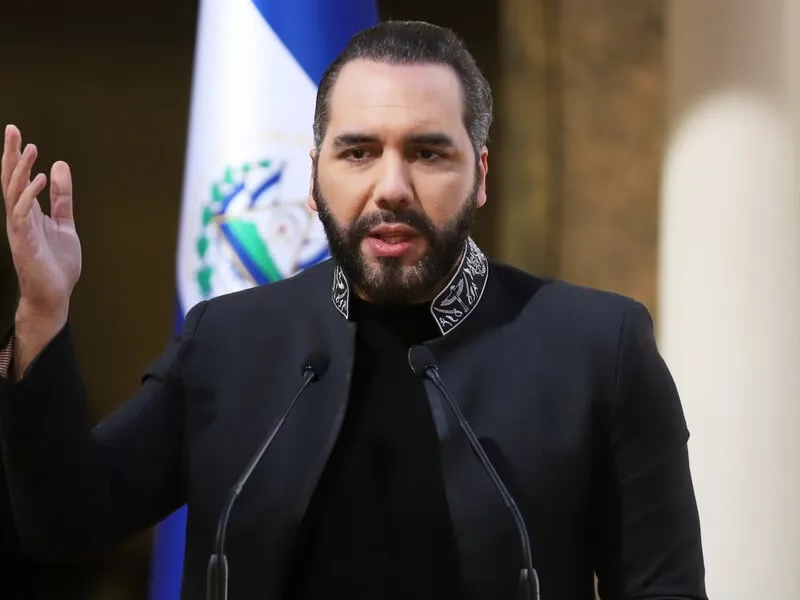
El Salvador’s president, Nayib Bukele, said he has launched a military operation to rescue four Salvadoran air force personnel who have been missing in Haiti since Sunday, and issued a direct threat to the armed gangs he blames for holding them, the BBC reported.
In remarks relayed by the broadcaster, Bukele said Wednesday’s action was “nothing” compared with what would happen if the four men — whom he described as non-combatants — were not returned alive.
Bukele framed the mission narrowly and the stakes starkly. In posts on X cited by the BBC, he said the group was made up of pilots and technical personnel whose job was “to carry out medical evacuations and save lives, not to wage war,” and that the operation’s single objective was to bring the four home alive. If they were returned unharmed, he said, “everything will go back to how it was before the kidnapping.” He said the men had been seized “in a cowardly manner” as they returned from buying food at a market.
The four were attacked on Sunday, October 18, in Croix-des-Bouquets, a gang-controlled community on the edge of Port-au-Prince, according to the Associated Press, whose correspondent Dánica Coto reported that the men were aviation technicians heading back to their camp. Their armored vehicle was struck with explosives and set ablaze, and they fled the burning vehicle; Salvadoran helicopters sent to help came under fire, the AP reported. El Salvador’s armed forces, in a statement on Sunday, said the group had been ambushed while traveling back to its camp in an armored vehicle that caught fire after being hit by explosives.
U.S. Ambassador Mike Waltz said the vehicle had been hit by “hundreds of bullets and explosives,” and that “we believe the four men survived, but they do remain unaccounted for,” according to the AP. No gang has claimed responsibility for the attack.
On Wednesday, before Bukele announced the rescue operation, the Gang Suppression Force said it was still searching for the men and that it had “engaged armed gang elements, with helicopter support,” with early reports indicating that several gang members had been killed, the BBC reported.

The four men are part of the Gang Suppression Force (GSF), the international operation the United Nations Security Council authorized in September 2025 with a mandate of up to 5,550 personnel to help Haiti’s police confront the gangs. The force replaced an earlier Kenya-led mission that had struggled with chronic shortages of funding and equipment. More than 2,000 troops have deployed so far, drawn from countries including Chad, Jamaica, Guatemala and El Salvador, the AP reported.
The ambush is the first major attack on the force since it began operating, and it has exposed the risks its personnel face. The GSF’s special representative, Jack Christofides, told the United Nations that “gangs are testing the gang suppression force,” that attacks on it have increased, and that “we cannot be everywhere at once,” according to the AP; the force has urged residents of the area to stay indoors. Earlier in the week, the United Nations warned that Haiti’s gangs were adapting to the heightened security push, “stepping up reprisals against civilians and extending their reach into rural areas,” as the BBC noted.
The attack unfolds in a country where the state has lost command of most of its capital.
Armed gangs control the vast majority of Port-au-Prince — estimates range from about 70 percent, cited by the AP, to 85 percent, cited by the BBC. UN figures place the number of people displaced by the violence at nearly 1.5 million, a record. The BBC reported that more than 5,500 people were killed in gang-related violence in Haiti in 2024; the AP reported that more than 5,700 people were killed or injured and more than 230 kidnapped between January and mid-September of this year.
Haiti’s political institutions have offered little counterweight. The country has not held elections since 2016, and about two weeks ago it postponed presidential and legislative elections — which had been scheduled for December 13 — indefinitely, according to the BBC. Haiti has been gripped by a political vacuum, economic collapse and worsening gang warfare since the assassination of its president in 2021.

https://ctninfo.com/?p=45051&preview=true

Source: BBC
AI Use Policy: Some of CTN’s journalists are not native English speakers and draft their work in French or Haitian Creole. We then use AI-assisted translation software to produce the English versions, and traces of machine-generated phrasing may occasionally remain. Every article — in any language — is written, reviewed, and edited by CTN’s staff writers and editors, who remain responsible for its accuracy. CTN also uses AI to convert text into audio.

