


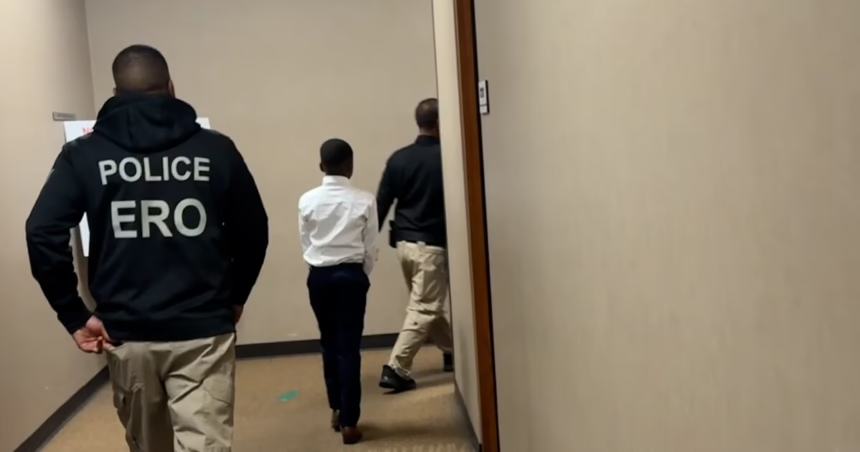
An 8-year-old Haitian boy in San Diego was taken into federal custody this week after his uncle brought him to an immigration appointment the family had been summoned to attend. The uncle, who had raised the child since the boy’s father was deported more than a year ago, went to the meeting because he did not want to break the law. He left without his nephew.
The case was reported by USA TODAY, whose correspondent María Luisa Paúl detailed how the third-grader — not identified by name — was separated from his uncle, from his classroom at Fay Elementary in San Diego’s City Heights neighborhood, and from classmates so shaken that the district sent crisis counselors to the school.
According to the San Diego Unified School District, no one in the federal government has told them where the boy is.
“While immigration policy decisions are often framed as matters of law and enforcement, their real-world consequences are increasingly being experienced by children whose lives, education and emotional well-being are disrupted through no fault of their own,” district officials wrote to the secretaries of Homeland Security and Health and Human Services in a Nov. 6 letter, as quoted by USA TODAY.
The Department of Homeland Security defended the decision.
In a statement to USA TODAY, a DHS spokesperson said U.S. Immigration and Customs Enforcement found the uncle “was not part of either family unit he had been living with” and “could not establish legal guardianship of the minor,” and therefore classified the boy as an unaccompanied minor. “Out of an abundance of caution and to ensure the child’s safety, ICE determined it was best to remove the child from the household and place him in the care of the Office of Refugee Resettlement,” the spokesperson said, adding that the boy’s father had been deported to Mexico by Customs and Border Protection.

While DHS said ICE removed the boy from the household “to ensure the child’s safety,” videos circulating on social media show the 8-year-old being handcuffed as he was taken into custody — footage NBC 7 San Diego confirmed in a report on its Facebook page.
The boy, the district said, had previously held Temporary Protected Status — the humanitarian designation that shielded Haitians from deportation for more than a decade.
First granted after Haiti’s catastrophic 2010 earthquake and repeatedly renewed as the country’s crises deepened, the protection ended this year. The Supreme Court cleared the way on June 25, 2026, ruling in Mullin v. Doe that the administration could proceed, and DHS terminated the Haiti designation effective July 27, 2026, ending protections for hundreds of thousands of people.
In their letter, San Diego Unified officials and the local leaders and unions who joined them asked the administration to hold children as close as possible to their home schools, to consult districts before relocating students, to place children with approved relatives or foster families nearby, and to track how those children fare in school publicly. “Every child deserves stability, dignity, and access to education,” they wrote.
For now, a third-grader who was in his San Diego classroom days ago is somewhere in the federal shelter system, and the adults who know him best say they cannot find out where. His father is in Mexico. His uncle is in San Diego. And the country his family fled remains one the State Department warns Americans not to visit, with armed groups controlling much of Port-au-Prince since the 2021 assassination of President Jovenel Moïse.
What makes the boy’s case notable is that he wasn’t found alone at the border.
He was living with a relative when enforcement reached him — the pattern that child-welfare advocates say is pulling a growing number of children who have family here into a shelter system built for those who arrive with no one.
Under a 2008 anti-trafficking law, children deemed unaccompanied are generally transferred within 72 hours to the Office of Refugee Resettlement, a child-welfare arm of HHS, which is supposed to place them with a vetted parent or relative.
USA TODAY reported, citing the Deportation Data Project, that more than 8,000 children were arrested and detained by immigration authorities between January 2025 and July 2026, and that 1,620 children were in HHS custody as unaccompanied minors as of Nov. 5.
The outlet reported that the average time children spend in those shelters has lengthened sharply — from 35 days in October 2024 to 185 days in November 2025, according to figures the nonprofit Kids in Need of Defense drew from ORR data — as the government tightened sponsor requirements and began sharing sponsors’ information with immigration enforcement.
The end of TPS has reverberated across Haitian communities nationwide. USA TODAY reported that in Miami’s Little Haiti, the largest Haitian enclave in the country, business owners say they have lost workers and customers; and that in Springfield, Ohio — home to as many as 15,000 Haitians — ICE has detained dozens and ordered hundreds more to wear GPS ankle monitors.
https://ctninfo.com/a-haitian-boy-8-…-an-ice-check-in/
Source: USA Today.
AI Use Policy:
Some of CTN’s journalists are not native English speakers and draft their work in French or Haitian Creole. We then use AI-assisted translation software to produce the English versions, and traces of machine-generated phrasing may occasionally remain. Every article — in any language — is written, reviewed, and edited by CTN’s staff writers and editors, who remain responsible for its accuracy. CTN also uses AI to convert text into audio.