


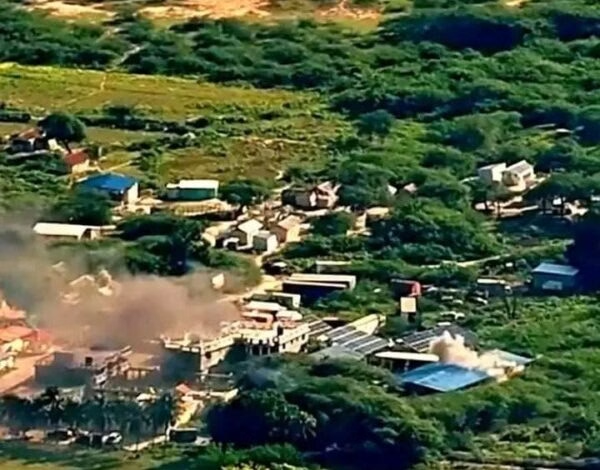
Salvadoran President Nayib Bukele published a video on Tuesday showing the demolition of a residence attributed to Wilson Joseph, known as “Lanmò San Jou,” the leader of the 400 Mawozo gang. The operation was carried out during the night of November 7-8, 2026, in the Croix-des-Bouquets area.
Specialized units of the Haitian National Police (PNH), backed by the Gang Suppression Force (FRG), the Task Force, and Salvadoran soldiers, reportedly took part in the assault. Air assets and explosive drones were also reportedly deployed to reach the targeted residence. Before the intervention, Nayib Bukele himself had solicited information on social media to locate the building. An episode that illustrates both the intensity of security cooperation between Haiti and El Salvador and the limits of a strategy based on force.
A Country on the Brink of Collapse
To grasp the significance of this operation, one must recall the scale of the crisis that has been ravaging Haiti for several years. Since the assassination of President Jovenel Moïse in July 2021, the political vacuum has been filled by armed gangs, which have extended their grip on the capital and beyond. According to data verified by the United Nations Human Rights Office, at least 5,519 people were killed and 2,608 injured between March 2025 and January 2026. The “Viv Ansanm” coalition, led by Jimmy “Barbecue” Chérizier, has expanded its control from Port-au-Prince to the Artibonite and Centre regions, seizing strategic roads and maritime crossings.

In a report submitted to Congress in 2026, the U.S. State Department described the power of the gangs as a “direct threat to the existence of the Haitian state.” Approximately 12,000 gang members are identified, including 3,000 who are well-equipped and experienced. Facing them, the Haitian National Police nominally fields some 13,000 officers, but only about 6,000 are actually operational. It is in this context that the UN Security Council adopted Resolution 2793 in September 2025, transforming the multinational mission into a “Gang Suppression Force” (FRG/GSF), authorized to deploy up to 5,500 military and police personnel.
The Salvadoran Escalation
El Salvador’s presence within the FRG was initially modest. Before October 2026, San Salvador’s contingent numbered around 120 military personnel, primarily Air Force pilots and aeronautical technicians responsible for helicopter medical evacuations. The turning point came on October 18, 2026: four Salvadoran technicians fell into a gang ambush in Croix-des-Bouquets and disappeared. In response, Nayib Bukele’s government deployed more than 2,000 soldiers to Haiti, including special forces—an unprecedented troop level for a single country within this mission. Bukele insists: this is not an “invasion,” but a search and rescue operation. Yet the scale of the deployment suggests a lasting involvement. Washington gave its green light to the initiative. Donald Trump personally praised the “firmness” of his Salvadoran counterpart. The United States provided support in strategic air transport and supplies, while Colombia facilitated the transit of troops and equipment. But Marco Rubio was clear: there would be no question of committing American soldiers on the ground.
A Strike with Symbolic as Much as Military Significance
The destroyed residence belonged to Wilson Joseph, leader of the 400 Mawozo gang, designated as a foreign terrorist organization by Washington. The gang gained notoriety in 2021 with the kidnapping of 17 American and Canadian missionaries. It operates mainly in Croix-des-Bouquets and eastern Port-au-Prince, where it engages in extortion, kidnapping, and territorial control. According to several sources, the operation during the night of November 7-8 mobilized specialized PNH units, the FRG, the Task Force, and Salvadoran soldiers, with air support and explosive drones. Bukele’s approach—publicly soliciting information on social media to locate the target—amounts to an assumed form of psychological warfare.

But Wilson Joseph was not captured. He was absent during the assault. According to information confirmed by multiple sources, he had taken refuge in another suburb in southern the capital, along with other gang leaders. The destruction of a building does not mean the collapse of a network. The 400 Mawozo, a member of the Viv Ansanm coalition, has an organizational resilience that does not depend on a single man. For Haitians who have lived under the terror of gangs for years, images of demolition may provoke symbolic relief. But the real criterion for success remains their ability to return home, to move freely, to send their children to school without fear of kidnapping.
A Standoff Between Washington and San Salvador?
The operation comes at a time when relations between the United States and El Salvador are strained over the conduct of operations in Haiti. According to information published Tuesday, November 10, by the American media outlet Axios, U.S. concerns stem in particular from an attack perpetrated on October 31 against a Salvadoran convoy of five armored vehicles near the U.S. embassy. Shots reportedly also hit American diplomatic facilities. The following day, the U.S. chargé d’affaires in Haiti, David Howell, reportedly expressed his concerns to Prime Minister Alix Didier Fils-Aimé, citing a lack of coordination between Salvadoran units and other components of the international force, as well as risks related to the conduct of operations. On November 5, the U.S. embassy in El Salvador transmitted a diplomatic note to San Salvador authorities, citing coordination problems and concerns about the security of its facilities and personnel. American officials also mentioned three wounded Salvadoran soldiers.
In its response on November 9, the Salvadoran government contested these claims. Regarding the reported impacts on the U.S. embassy, San Salvador maintains that its soldiers were positioned with their backs to the building and were directing their fire in another direction, rejecting any responsibility for the reported damage. Salvadoran authorities also defended their intervention in an incident involving Chadian FRG soldiers. According to their version, their air assets were mobilized to repel a gang attack against the Chadian soldiers, without firing toward their positions. The government further asserts that coordination of its air assets with the FRG and Haitian authorities had begun as early as October 26. It also contests American reports of three wounded soldiers.
For San Salvador, American criticism does not call into question the objective of the intervention. The government asserts it has taken the necessary measures to coordinate its assets and defends the manner in which its soldiers responded to the reported attacks.
For Haiti, Salvadoran assistance raises high expectations among a population exhausted by years of violence.
