

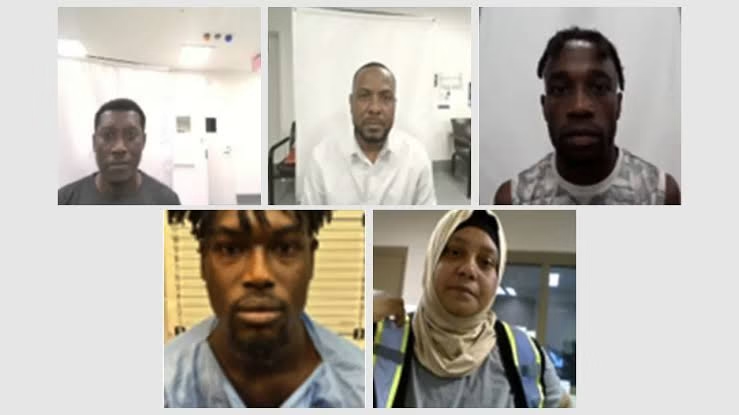
U.S. Immigration and Customs Enforcement (ICE) arrested five people: four Haitian nationals and one Cuban in a nationwide operation over alleged fraud in the federal food-stamp program, the Department of Homeland Security said, describing the arrests as the start of a sustained enforcement campaign.
DHS announced the arrests on October 21, a day after Fox News first reported the operation with the department’s confirmation. The four Haitian nationals DHS named were Rubstony Junior Theodore, Wilbert Jean Baptiste, Louis Jean and Jhensly Charles. The fifth person was a Cuban national, Elizabeth Povea Rodriguez. The agency alleged that all five had entered the United States unlawfully and received benefits they were not entitled to under the Supplemental Nutrition Assistance Program, known as SNAP or food stamps. CTN does not describe people as “illegal” in its own reporting; the account of how the five entered the country is the agency’s.
Homeland Security Secretary Markwayne Mullin framed the operation in sweeping terms, saying that federal assistance is “for Americans only.” DHS said the arrests were the beginning of a broader effort to investigate suspected SNAP fraud.
In its announcement, the department named the five people but did not release individual SNAP application records or charging documents showing how each had allegedly obtained benefits improperly. The cases had not been detailed publicly as of the department’s statement.

Federal law does allow some noncitizens to receive SNAP.
After the One Big Beautiful Bill Act, signed July 4, 2025, narrowed eligibility for many immigrant groups, the categories that remain eligible include U.S. citizens, certain lawful permanent residents, Cuban and Haitian entrants, and citizens of the Compact of Free Association nations, according to U.S. Department of Agriculture guidance. “Cuban and Haitian entrant” is a legal designation under the Refugee Education Assistance Act of 1980 and does not apply to everyone from those two countries; DHS did not state the immigration classification of any of the five people it arrested.
The designation is not the same as nationality, and that distinction matters for the four men DHS named. Being Haitian does not automatically make someone a “Haitian entrant,” and it does not automatically make someone ineligible either. Under Section 501(e) of the 1980 law, the category covers certain Haitian and Cuban nationals who were paroled into the United States, who have pending asylum applications, or who are in removal proceedings, subject to conditions — for some, that no final, nonappealable removal order has been entered.
That definition cuts against the agency’s framing in a specific way. DHS alleges the five “entered unlawfully,” but manner of entry does not, on its own, settle SNAP eligibility: a Haitian who crossed without inspection and then filed for asylum, or who is in removal proceedings, may fall within the very “Haitian entrant” category the law permits to receive benefits. Whether any of the four men — Theodore, Jean Baptiste, Jean or Charles — actually qualified would turn on his individual immigration classification and benefit records, none of which the department released.

https://ctninfo.com/?p=45046&preview=true
https://www.facebook.com/CaribbeanNewsMedia
AI Use Policy:
Some of CTN’s journalists are not native English speakers and draft their work in French or Haitian Creole. We then use AI-assisted translation software to produce the English versions, and traces of machine-generated phrasing may occasionally remain. Every article — in any language — is written, reviewed, and edited by CTN’s staff writers and editors, who remain responsible for its accuracy. CTN also uses AI to convert text into audio.