


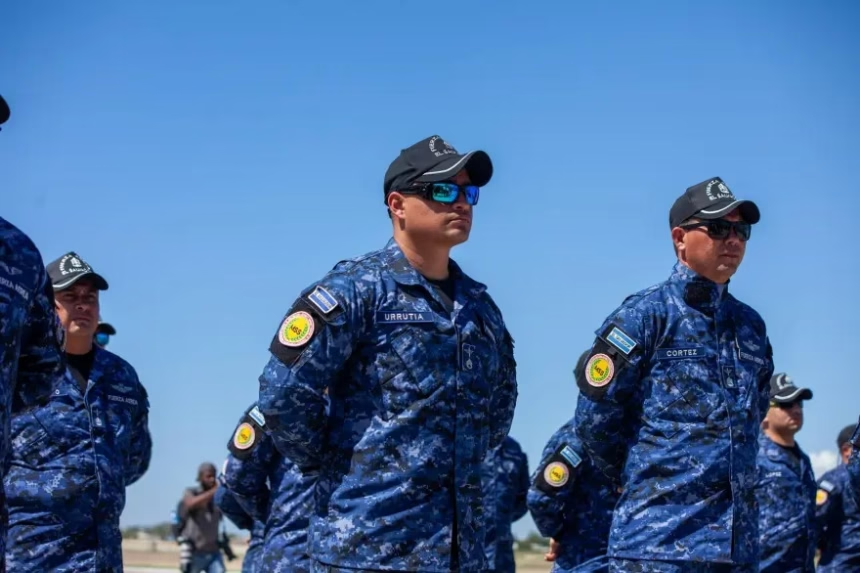
At least four Salvadoran soldiers from the FRG have been missing since Sunday, October 18, 2026, in Santo 17, a neighborhood in the Plaine du Cul-de-Sac, north of the Haitian capital. According to initial information available, their vehicle was reportedly caught in an ambush before being set on fire by gang members operating in the area. The exact circumstances of the attack remain unclear, as does the precise number of soldiers involved: authorities are currently referring to “at least four” missing, suggesting that the toll could change. The incident once again illustrates the seriousness of the security situation in this part of Port-au-Prince and other areas of the country, where armed groups are multiplying attacks against law enforcement and convoys.
In a statement, the FRG confirmed the disappearance of several of its soldiers in Santo 17. It indicated that it had activated its emergency procedures and affirmed that it was in contact with Haitian authorities in order to locate the soldiers. It called for calm and caution, while assuring that all available means would be mobilized to find the missing. The statement did not, however, specify the exact conditions of the attack or the soldiers’ state of health. For its part, the Salvadoran army also issued a communication confirming that it was aware of the situation. It expressed solidarity with the soldiers’ families and indicated that it was following the progress of the search in coordination with partners present on the ground. The Salvadoran authorities have not, for the time being, announced a final human toll.
Since the disappearance was announced, a large-scale mobilization of law enforcement has been undertaken in the area. Helicopters flew over Santo 17 and its surroundings for almost the entire night, while persistent gunfire continued to be heard. On Monday morning, according to residents forced to stay holed up in their homes, detonations and drops of kamikaze drones were still perceptible. These accounts, which could not be independently confirmed immediately, testify to the intensity of the clashes and the difficulty of the search operations. Law enforcement is trying to secure access routes, identify the perpetrators of the attack, and find the missing soldiers. But in a densely populated urban environment, where gangs control several passages and use increasingly sophisticated methods, every advance carries high risks.
This attack comes as the FRG still does not have its full complement. The force faces persistent financial and logistical constraints that limit its deployment capacity, equipment, and responsiveness. These difficulties are regularly highlighted by observers, who believe they weaken the effectiveness of security missions and further expose the personnel involved. The disappearance of several soldiers in Santo 17 risks reviving debates on the funding, preparation, and coordination of forces deployed in Haiti. It also raises the question of the protection of foreign soldiers engaged in operations alongside local authorities.

The coming hours will be decisive in determining the fate of the missing soldiers and in assessing the authorities’ response. Further details are expected on the ongoing operation. In the meantime, the incident is a reminder of the volatility of Haiti’s security context and the need for a coordinated response capable of protecting civilian populations while searching for the missing soldiers.