


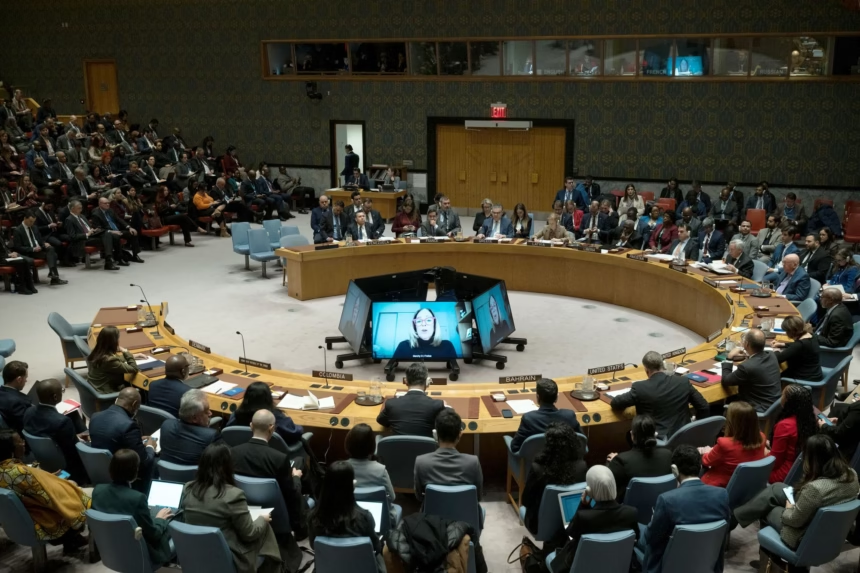
The United Nations Security Council renewed its sanctions on Haiti for another year on October 14. It directed its sanctions committee to expand the list of people targeted, including anyone who violates the arms embargo that has failed to stop weapons from flowing to the country’s gangs.
The measure, adopted as Resolution 2831 (2026) at the Council’s 10,241st meeting, extends the travel ban, asset freeze and arms embargo first imposed in 2022 for one year from the date of adoption.
The resolution does not itself name any new individuals. Instead, it directs the committee that administers the sanctions “to consider expeditiously the update of the list of individuals and entities expeditiously,” taking into account the reports of the Panel of Experts — the independent body that investigates who finances and arms Haiti’s gangs — and “including adding to the list individuals and entities that act in violation of the arms embargo.” In other words, the Council has renewed the framework and instructed its committee to add new names; the designations themselves come next.
What the resolution does
Acting under Chapter VII of the UN Charter, which allows the Council to impose binding measures to address threats to international peace, the resolution renews the travel ban, asset freeze and arms embargo established under Resolution 2653 (2022) and most recently extended in 2025. It extends the Panel of Experts’ mandate for 13 months and keeps the sanctions committee’s authority in place.
The resolution also widens the grounds on which a person can be listed. It affirms that individuals who destabilize Haiti “through the illicit exploitation or trade of natural resources” may be subject to the travel and financial measures — a reference that tracks the Panel’s findings on the smuggling of elvers, the juvenile eels that are among Haiti’s most valuable and illicitly traded natural resources. It separately expresses concern about “misappropriation, embezzlement and diversion of public resources,” and states that those who support armed groups and criminal networks, directly or indirectly, may be listed.

On weapons, the text reaffirms that member states must prevent the trafficking and diversion of arms into Haiti, including by strengthening border controls, and calls on states that sell or donate firearms to Haitian authorities to tighten stockpile management and post-delivery controls so the weapons are not diverted to gangs. It assigns the Gang Suppression Force — the international force authorized in 2025 to help Haitian police confront the gangs — a role in recording and disposing of seized arms. It requires it to report any weapons lost, stolen or diverted to the Panel of Experts.
While Resolution 2831 names no one, it builds on an existing list and a Panel report that recommended expanding it.
The sanctions regime currently designates nine individuals and two entities, according to the Panel of Experts’ most recent report. Those already sanctioned are gang leaders, among them Jimmy Chérizier, known as “Barbecue,” the head of the Delmas 6 gang and a figure in the Viv Ansanm coalition; Johnson André, known as “Izo,” of the 5 Segond gang; Renel Destina, known as “Ti Lapli,” of Grand Ravine; and Vitelhomme Innocent, of Kraze Baryè.
The Panel’s final report, reported publicly earlier in October, went further than the existing list. It named politicians, former officials and business figures it accuses of financing and arming the gangs, and recommended that they be added. Among them were the former congressman Alfrédo Junior Antoine, the former senators Nenel Cassy and Youri Latortue, the former congressman Prophane Victor, the former mayor of Arcahaie Rosemila Petit Frère, the former National Palace security chief Dimitri Hérard, and the party leader and former senator Jean-Charles Moïse, whom the Panel tied to the illicit glass-eel trade.
Those named have denied or disputed the Panel’s conclusions, and the report notes a response. Resolution 2831’s instruction to update the list “taking into account the reports submitted by the Panel of Experts” is the mechanism through which such names could now be considered for designation.
The resolution ties any future easing of the measures to measurable results. It sets three benchmarks the Council will watch: whether Haitian authorities build the judicial and rule-of-law capacity to confront armed groups; a progressive reduction in violence, measured by the annual number of intentional homicides, kidnappings and incidents of sexual violence; and a progressive decline in arms trafficking, including by increasing the number and volume of weapons seized. It asks the Secretary-General, working with the Panel, to assess progress on those benchmarks by September 1, 2027.
The Panel of Experts is directed to submit an interim report by March 28, 2027, and a final report by September 1, 2027, with periodic updates in between. Member states are asked to report the concrete steps they take to implement the measures, and Haitian authorities are asked to brief the sanctions committee annually on their enforcement progress, including legislative and regulatory action.
The resolution also encourages support for Haiti’s National Commission for Disarmament, Dismantlement and Reintegration and its 2026 strategy, for the UN Haiti Peace Dividends Fund, and for building the capacity of the Haitian National Police and the Armed Forces of Haiti.
The stakes behind the paperwork are the conditions the Council described in the text itself: “extremely high levels of gang violence,” including kidnappings, trafficking in persons, homicides, and sexual violence, and “the killing, maiming, abduction, sexual violence and the recruitment of children by gangs,” alongside “ongoing impunity for perpetrators, enablers, and financiers.” The arms embargo has existed since 2022, yet the Panel has repeatedly found that weapons keep reaching the gangs and that the assets frozen under the sanctions remain minimal. Whether the renewed measures and the instruction to add new names change that will be judged, by the Council’s own terms, against next year’s figures on killings, kidnappings and weapons seizures.
https://ctninfo.com/un-renews-haiti-sanctions-for-a-year-and-orders-its-committee-to-add-new-names/
https://www.facebook.com/CaribbeanNewsMedia

AI Use Policy:
Some of CTN’s journalists are not native English speakers and draft their work in French or Haitian Creole. We then use AI-assisted translation software to produce the English versions, and traces of machine-generated phrasing may occasionally remain. Every article — in any language — is written, reviewed, and edited by CTN’s staff writers and editors, who remain responsible for its accuracy. CTN also uses AI to convert text into audio.