


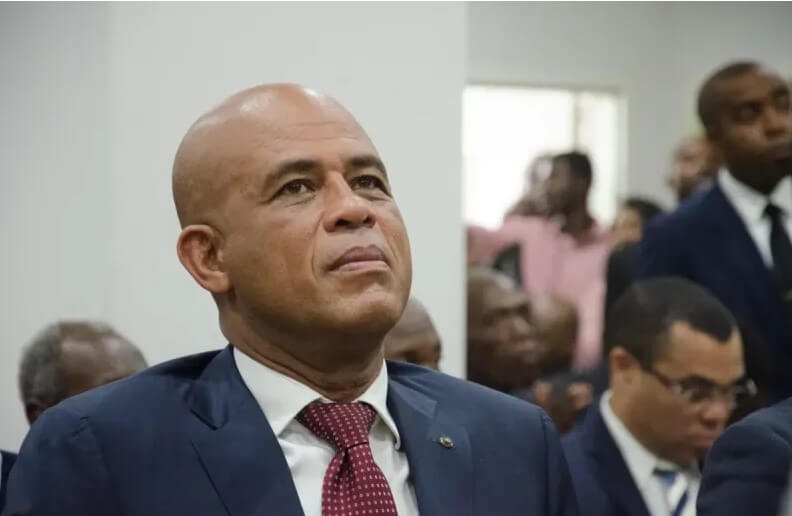
Former President Michel Joseph Martelly has officially registered as a candidate for the presidency of the Republic on the online platform of the Provisional Electoral Council (CEP). As of October 16, 2026, he is the 16th contender for the supreme magistracy of the Haitian state. This registration, carried out under the banner of the political grouping Debloke, marks a new stage in an electoral process that is already highly contested and closely watched. However, it does not yet constitute definitive validation: the electoral body will have to verify the conformity of the file, the candidate’s eligibility, and any legal objections. In a country where every candidacy is scrutinized, Michel Martelly’s could crystallize tensions and revive debates about his record, the controversies surrounding him, and the international sanctions he faces.
Michel Martelly’s time in power, between 2011 and 2015, remains one of the most contested aspects of his candidacy. His detractors recall that his mandate was marked by a deterioration of the economic situation, worsening poverty, institutional instability, and rising social tensions. According to these critics, the Haitian state weakened under his regime, while armed networks and gang-related practices began to expand. Weak institutions, impunity, and the fragmentation of power gradually opened the way to more visible organized violence in several parts of the country. These elements are often cited to argue that his return to the supreme magistracy would represent a risk for stability and for the trust of international partners.
The Petrocaribe affair is also a central issue in assessing his legacy. Funds from the Venezuelan oil agreement, intended to finance social programs and infrastructure, were at the heart of suspicions of embezzlement, mismanagement, and corruption. The reports and citizen mobilizations that followed have left a deep mark on collective memory. Although Michel Martelly has not been convicted in this case, his administration is often associated with a lack of transparency and the presumed squandering of public resources. This affair weighs heavily on his image and fuels the controversies surrounding his candidacy.
The controversies do not stop there. Michel Martelly is sanctioned by the United States, Canada, and the European Union. These sanctions, which may take different forms depending on the jurisdiction, reflect persistent distrust on the part of several international partners toward him. They also raise the question of the compatibility between a presidential candidacy and restrictive measures adopted by foreign actors. His supporters may argue that these sanctions are a form of political pressure, but his opponents see them as a warning sign about governance and the candidate’s credibility.

Furthermore, Michel Martelly is flagged in a report by the Anti-Corruption Unit (ULCC). This report, which is part of efforts to monitor public funds, fuels criticism of the management of the state under his administration. He has also been heard by the Haitian justice system as part of the investigation into the assassination of former President Jovenel Moïse. This hearing does not, in itself, mean that he is guilty, but it places his name at the heart of a highly sensitive judicial proceeding. It strengthens the media and political attention around him and raises questions about transparency, justice, and the accountability of former leaders.
In the face of this situation, national and international public opinion is closely following the evolution of the case. Observers are waiting to see whether the CEP will approve or reject Michel Martelly’s candidacy. The electoral body’s decision will be decisive not only for the former president’s political future but also for the credibility of the electoral process. In any case, Michel Martelly’s candidacy under the Debloke banner illustrates the complexity of Haiti’s transition: it combines memory of the past, demands for justice, international sanctions, and the expectations of a long-suffering population. The CEP is now placed before a historic responsibility.