


More than $7 million in Haitian public funds set aside to arm the country’s outgunned national police cannot be accounted for, according to a Miami Herald investigation into a Tennessee-founded security company with ties to the late Dolly Parton. The case makes Fencebridge Strategic Risk the latest U.S.-linked private security firm to draw scrutiny over its work in Haiti.
Fencebridge agreed roughly a year ago to supply the Haiti National Police (PNH) with semi-automatic rifles and ammunition, Herald reporters Shirsho Dasgupta and Jacqueline Charles reported Saturday. Only part of the order has arrived. Batches of 9mm, 5.56mm and 7.62mm rounds reached Haiti in late September, while the bulk of the government’s payment passed through the hands of a Texas businesswoman who does not work for the company.
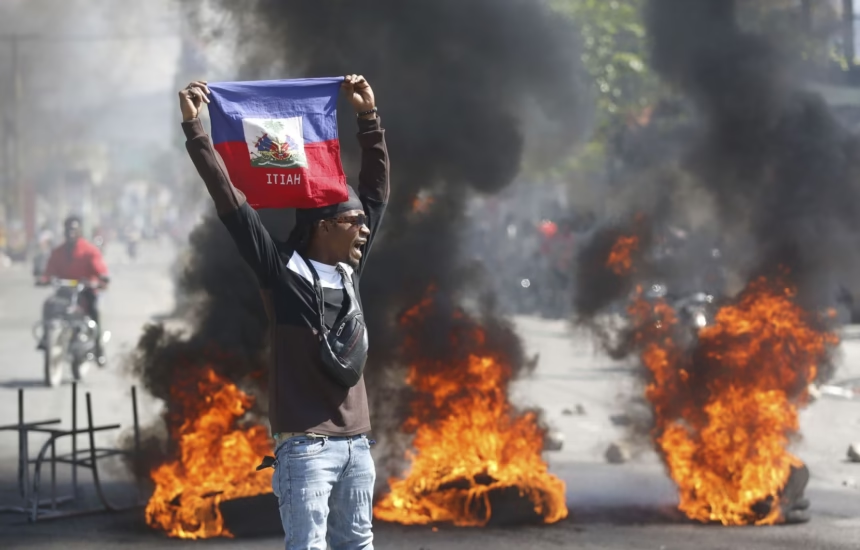
The delays have landed on a police force that has repeatedly run short of bullets while armed gangs carry out deadly attacks. Gang violence has killed more than 25,000 Haitians since 2021, according to the Herald’s reporting.
A $15 million wire to a third party
The money trail begins on Jan. 27, 2026. Documents that Haitian sources shared with the Herald show the government of Haiti wiring two payments, one of $8,241,955 and another of $7,082,589.29, one minute apart, to a Citibank account tied to Ellie Soto. Soto, a Costa Rican-born U.S. citizen living in the Houston suburb of Sugar Land, acknowledged in one document receiving a cumulative deposit of roughly $15.35 million from Haiti.
Under the arrangement, Soto was to hold the funds in escrow and release payments to Fencebridge as the weapons were procured. Fencebridge Chief Operating Officer Andrew Day, who lives in Key West, told the Herald that Soto supplied her own attorney to handle the transfers and that she is still holding more than $7 million the company was owed.
The escrow ran through a client trust account, known as an IOLTA, held by Orange County, California, attorney Anthony Madu. Day said Madu refused Fencebridge access to the money. “He only took orders from Ellie, who isn’t even a part of our company,” Day told Dasgupta and Charles of the Miami Herald, adding that Madu later said he had sent the entire balance to Soto.
Madu told the Miami Herald’s reporters that he “disposed the money according to the instructions,” but cited attorney-client privilege and declined to say more. Repeated attempts by the Herald to reach Soto through her Houston-based company, Tranmex LLC, were unsuccessful.
Who in the Haitian government decided to route public funds through Soto remains unknown.
Fencebridge entered the Haiti arms trade without the U.S. permits it needed. Haiti is under a State Department arms embargo, and exports to its police are subject to export controls.
Enter former Rep. Mark E. Green, a Tennessee Republican and former chair of the House Homeland Security Committee who resigned from Congress in July 2025. Green traveled to Haiti about two months later while pursuing a cement deal; Soto, who had flown to Port-au-Prince from Miami on Sept. 14, was pitching the government on fuel. Green said the group had met in Fort Lauderdale before the trip.
When Green learned the police wanted new weapons and that the police chief wanted to drop a longtime supplier, he offered his help. “I said I could help you with that,” Green told the Miami Herald’s Dasgupta and Charles. He said he offered his network of Washington contacts, telling the Herald reporters, “I have lobbyists buddies in D.C.”
Green said he billed Soto $1,000,080 and has been paid $600,000. He denied any role in structuring the contract and said Soto no longer returns his calls. “That $7 million isn’t with Fencebridge, and it isn’t with Green,” he told the Miami Herald.
Accounts of Green’s role conflict. Day told the Herald’s reporters that Green, working under Soto’s direction, lobbied for “support in the U.S.” Green rejected that description. A Haitian source familiar with the deal, who spoke to the Herald on condition of anonymity, blamed Green for the delays and said Green and Soto are “holding the money.” Green has denied holding any of it.
Tennessee business records reviewed by the Herald show that Danny Nozell, Parton’s longtime manager and now the controller of her estate, incorporated Fencebridge in November 2015. Bryan Seaver, Parton’s nephew and former head of security, became chief executive about four months later. Tennessee dissolved the company in 2020 for failing to file an annual report. It is now incorporated in Grand Cayman, a British overseas territory.
Day told the Herald that Fencebridge has worked in Haiti for four years, though he gave few details. Sources told the newspaper the police contract is the company’s first with the PNH.
The deal became public through a family and business feud. After Parton died on Aug. 25, 2026, at 80, Nozell’s company fired Seaver and obtained a temporary restraining order against him, CBS News has reported; Seaver has argued in court that his messages were private venting between frustrated, grieving friends. One of those texts, cited in court records, bragged about the Haiti contract. “I’m literally an international arms dealer and mercenary,” Seaver wrote, according to the Miami Herald’s reporting.
The value of the contract is disputed. The Herald reported that Seaver’s message put it at $29 million; other outlets covering the estate litigation have described his claim as $27 million. Fencebridge now says the figure was wrong and that the contract is worth about $24 million, $13 million for ammunition and $11 million for guns. Seaver declined to comment to the Herald.
Parton’s knowledge of the firm is unclear. Nozell first wrote to the Herald that “Dolly never had anything to do with the company.” Estate attorneys later asked the newspaper not to use that statement; the Herald published it because no off-the-record agreement existed when Nozell sent it.
Haiti’s justice minister, Patrick Pélissier, whose ministry oversees the national police, signed off on two deals with Fencebridge and did not respond to the Herald’s request for comment. Other officials did not say whether the contract was reviewed by the Cour Supérieure des Comptes et du Contentieux Administratif (CSC/CA), the independent court that audits public spending.
That court has shown it will intervene. Two government officials told the Herald it blocked a separate weapons purchase for Haiti’s armed forces after the vendor failed its vetting.
Fencebridge defends its conduct. Day told the Herald the company aims to help Haitian authorities “regain control from the armed gangs,” calling it a “registered and licensed arms broker.” He said he had never seen U.S. approvals take so long in a career spent exporting weapons to conflict zones. The State Department told the Herald it would not discuss specific licensing activity.

A pattern of private contracts
Fencebridge is not the only U.S.-linked firm whose Haiti work has raised accountability questions. Vectus Global, the company led by Blackwater founder Erik Prince, has supported a Haitian government task force using armed drones against gangs since March 2025. Human Rights Watch counted 1,243 people killed in 141 drone operations between March 2025 and January 2026, including 43 civilian adults and 17 children, Reuters reported in July.
Reuters also reported that Americans working for Vectus as contractors to a foreign government were not required to disclose their activities, and that Washington exercised no oversight of the firm’s operations. Prince has declined to say what Haiti pays Vectus, and Rep. Joaquin Castro, D-Texas, has pledged congressional scrutiny of the arrangement.
In both cases, Haitian public money has gone to private, U.S.-connected companies under terms the public has not seen. For Fencebridge, the unanswered questions are specific: who authorized sending more than $15 million to an individual outside the company, whether the CSC/CA reviewed the contract, and when the PNH will receive the rest of the ammunition Haiti has already paid for.
Sources: This article is based on reporting by Shirsho Dasgupta and Jacqueline Charles of the Miami Herald (“Dolly Parton’s nephew, former lawmaker struck arms deal in Haiti. Millions are missing,” Oct. 17, 2026).

AI Use Policy:
Some of CTN’s journalists are not native English speakers and draft their work in French or Haitian Creole. We then use AI-assisted translation software to produce the English versions, and traces of machine-generated phrasing may occasionally remain. Every article — in any language — is written, reviewed, and edited by CTN’s staff writers and editors, who remain responsible for its accuracy. CTN also uses AI to convert text into audio.