

Between March 6 and July 31, 2026, the Cul-de-Sac Plain area and the commune of Cité Soleil witnessed a resurgence of armed violence of rare intensity. According to a report published in August 2026 by the United Nations Integrated Office in Haiti (BINUH), at least 613 people were killed and 375 others wounded during this period. This already horrific toll is very likely below the reality, as many bodies have not been counted.
Among the victims, 64% were associated with gangs, but nearly one-third — 214 people — were civilians not involved in criminal activities. Men, women, and children were cut down by stray bullets or deliberately executed on suspicion of collaborating with rival gangs. 90% of documented cases resulted from violence perpetrated by the gangs themselves, 9% during security force operations, and 1% following acts of popular violence.
Added to these figures are systemic sexual violence: at least 176 women and girls, aged 10 to 71, were victims of rape, including gang rape, perpetrated by gang members. These acts are often used as weapons of war or as “punishment” inflicted on populations living in areas controlled by rival gangs. Due to fear of reprisals, stigma, and limited access to support services, these figures are very likely underestimated.
The Origins of the Conflict: Reshuffling Alliances and Pressure on Gangs
The recent clashes take place against a backdrop of criminal alliance reshuffling and increased pressure from security forces on certain gangs in the capital. Since the end of 2025, operations conducted by the PNH, sometimes backed by a private military company, have forced several armed groups to abandon their bases in neighborhoods such as Delmas 6, La Saline, or Tokyo. These gangs then sought refuge in Cité Soleil and Croix-des-Bouquets, creating tensions with groups already established in these areas.

The trigger for the clashes in the Cul-de-Sac Plain was the arrival, in early February 2026, of the Tokyo gang in the Village de la Renaissance locality. This gang, driven from its Bas-Delmas base by security operations, quickly set up an illegal checkpoint on Route 9 to extort money from cargo trucks. This installation sparked opposition from the Chen Mechan, Pierre VI, and Terre Noire gangs, which were already collecting illegal taxes on National Road 1. However, it was supported by the 400 Mawozo and Canaan gangs, which sought to expand their influence in the area.
Four Phases of Deadly Violence
The clashes unfolded in several distinct waves, each marked by its share of atrocities.
First Phase (March 6 – April 18): The first battles broke out on March 6, pitting two alliances against each other: on one side, the 400 Mawozo, Canaan, and Tokyo gangs; on the other, the Chen Mechan, Pierre VI, and Terre Noire gangs. In six days, at least 74 people were killed and 76 others wounded. Civilians were executed for refusing to join gang ranks or on suspicion of collaboration. On March 11, 20 men were violently beaten in Duvivier after refusing to help erect barricades; two of them died from their injuries. A lull, negotiated by local businesses anxious to protect their operations, followed. During this first phase, 111 women and girls were raped, often inside their own homes, in the presence of their children.
Second Phase (April 19 – May 9): The Tokyo gang’s determination to maintain its presence triggered a new escalation. In barely three days, from April 19 to 22, at least 117 people were killed and 125 others wounded. On April 20, a patrol of the Temporary Anti-Gang Unit (UTAG) intercepted a minibus carrying members of the 400 Mawozo gang in Sarthe, killing 12 of them. Despite this intervention, targeted violence against civilians continued. A nine-year-old girl was shot because she came from a neighborhood under the control of a rival gang. An additional 46 women were victims of gang rape during this period.

Third Phase (May 10 – June 3): A new outbreak of violence caused at least 147 deaths and 75 injuries between May 10 and 13. On May 11, 17 boys aged 15 to 17 were executed on the orders of the Pierre VI gang leader, after one of them was caught in a phone conversation with someone linked to the Canaan gang. These teenagers were hunted down in their homes, forcibly removed, and shot in an informal dump. Police operations conducted between May 13 and 20 killed 11 gang members but also caused six civilian deaths, hit by stray bullets. A “truce” was mentioned around May 20, but it did not resolve the main issue — the withdrawal of the Tokyo gang — and six new cases of gang rape were documented.
Fourth Phase (June 4 – July 31): The climax of this wave of violence came on June 13. A “rara” procession of more than 300 people celebrating the World Cup match between Haiti and Scotland was attacked by the Belekou gang. The leader of this gang, mistakenly believing the parade was a diversion orchestrated by the rival Brooklyn gang, ordered a deadly assault. At least 61 people were killed and 20 others wounded, including seven children. The youngest was barely seven years old. Survivors were taken captive, and thirteen women and girls were raped by their captors.
A cycle of reprisals ensued between the Belekou and Wharf Jérémie gangs, with kidnappings, executions, and clashes that spread to the Varreux oil terminal, disrupting the capital’s fuel supply. Between June 29 and July 31, an additional 44 people were killed, most in targeted attacks against civilians suspected of supporting rival gangs or accused of breaking rules imposed by the criminals.
Troubling Links Between Police and Gangs
The BINUH report also raises a troubling issue: the alleged links between certain members of the Haitian National Police and criminal gangs. In February 2026, a criminal network of 17 people, including five police officers accused of supporting the Tokyo gang, was dismantled by the Central Directorate of the Judicial Police. These officers allegedly served as escorts for gang members or supplied them with weapons and ammunition. They were also employed by Haitian private security companies.
This blurring of lines between police and organized crime undermines efforts to restore order and fuels public distrust of institutions. Residents of Cité Soleil even reported seeing police officers ask certain gangs, such as Pierre VI and Terre Noire, to stay out of the clashes to allow security forces to face the 400 Mawozo, Canaan, and Chen Mechan gangs. These allegations, if confirmed, would reveal unacceptable collusion between state agents and criminals.
The Economic Stakes of the Cul-de-Sac Plain
The Cul-de-Sac Plain is not just a playground for gangs; it is also a major economic stake for the country. This area, straddling the communes of Cité Soleil, Croix-des-Bouquets, and Tabarre, is home to strategic businesses: the Barbancourt Rum distillery, the La Couronne and Séjourné breweries, the Compagnie des Tabacs Comme Il Faut, Flamengo Import-Export, BPH Industries, and the National Equipment Center.
Two vital roads cross this plain: National Road 1, which allows trucks from the container port and the Varreux oil terminal to reach the north of the country, and Route 9, an alternative route. Each gang seeks to control these axes to set up illegal checkpoints and levy taxes on cargo trucks. The Chen Mechan gang operates in Marin, Pierre VI and Terre Noire in Sarthe and Duvivier, and the Tokyo gang in Village de la Renaissance. These criminal activities generate colossal revenues, enabling the gangs to arm themselves and recruit.
In May 2026, business leaders in the area issued several statements to alert about the risks that persistent violence posed to their operations. They met with the special representative of the Gang Suppression Force (FRG) to share their findings on the deteriorating security situation and the lack of a coordinated response from the authorities.
The Situation in Kenscoff: An Extension of Violence
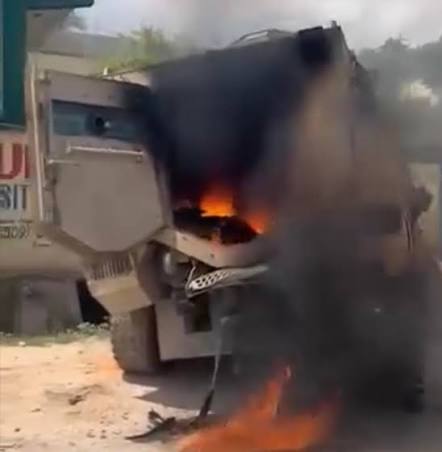
While attention was focused on the Cul-de-Sac Plain, another attack came as a reminder that violence knows no borders. This Friday, August 7, 2026, the commune of Kenscoff, located on the heights of Port-au-Prince, was the scene of a new deadly ambush. An armored vehicle of the Haitian National Police fell into a trap set by members of the “Viv ansanm” criminal coalition in the Viard locality. The bandits had dug a deep hole in the road to immobilize the vehicle before opening fire on the police officers. Three officers were wounded, and the armored vehicle was completely torched by the assailants.
This attack is part of a context of chronic insecurity that has plagued Kenscoff for more than eighteen months. Once considered a haven of peace and a prosperous agricultural area, this commune of approximately 65,000 inhabitants has become a hunting ground for armed gangs. The mayor of Kenscoff, Jean Massillon, has repeatedly alerted authorities to the deteriorating situation. He denounces repeated attacks that have forced hundreds of families to flee their homes, with vehicles burned and dwellings set on fire. “The bandits have killed many people. They have burned numerous cars, set several houses on fire, and forced families to flee,” he said.
Security forces are paying a heavy price in this strategic commune. In August 2025, a similar ambush had already claimed the lives of two officers from the Departmental Intervention and Operations Brigade (BOID) and left three others wounded. Gangs are seeking to extend their grip on this mountainous area overlooking the capital, offering both a strategic position to monitor security force movements and a escape route to rural areas.
Widespread Insecurity Spreading Across the Country
Beyond Kenscoff and the Cul-de-Sac Plain, Haiti’s overall security situation remains extremely critical. Gangs now control approximately 90% of the Port-au-Prince metropolitan area, where the resurgence of kidnappings terrorizes the population on a daily basis. Ransom kidnappings, which had seen a slight decline, are now experiencing an alarming uptick.
The threat is no longer limited to the capital. The Artibonite department, the country’s agricultural breadbasket, is also affected by gang violence. Kidnapping cases have been reported there in recent days, confirming the geographical expansion of criminal activities. According to the UN report, intentional homicides in the Artibonite and Centre departments increased by 210% between January and August 2025 compared to the same period in 2024. This surge demonstrates the gangs’ ability to extend their influence far beyond the capital’s limits.
The FRG: A Robust Force Slow to Act
In response to this escalation of violence, the international community established the Gang Suppression Force (FRG), a robust operation authorized by United Nations Security Council Resolution 2793 in September 2025. With an authorized strength of 5,500 personnel, the FRG has an expanded mandate to conduct counter-gang operations, either independently or in support of the PNH and the Haitian Armed Forces.
The mission is equipped with enhanced logistical capabilities, including armored troop transport vehicles provided by the United States. The FRG claims to be conducting joint patrols in several sensitive areas, including Kenscoff and its surroundings.
However, despite these announcements, the force has not yet truly engaged in large-scale operations in the most active gang strongholds. The BINUH report highlights that the FRG, “not yet fully deployed, has conducted regular patrols in certain areas of Cité Soleil, but has not participated in operations against gangs.” Questions persist regarding its deployment and its actual effectiveness on the ground. When questioned about the delays, the mission cites a “progressive and structured” installation to ensure the effectiveness of future interventions.
This sluggishness is perceived as a failure by local authorities and the population, who are demanding urgent action to dislodge the armed groups. Haitian police officers, on the front lines, are paying a bloody toll in a war that exceeds their capacities, while the population of Kenscoff, abandoned, lives in terror. The appeals from Mayor Jean Massillon to authorities for greater logistical resources remain unanswered for now.
Security Operations with Sometimes Tragic Consequences
Since the start of the clashes on March 6, at least 20 security force operations have been documented in the Cul-de-Sac Plain and Cité Soleil. These operations, conducted by various PNH units (BIM, BOID, BRI, UDMO, UTAG, SWAT), resulted in the deaths of 55 people (44 gang members and 11 civilians) and wounded 41 others (22 gang members and 19 civilians). Most civilians were hit by stray bullets inside their own homes.
The BINUH report reminds that any use of lethal force by security forces must comply with international human rights law and respect the principles of legality, necessity, proportionality, non-discrimination, precaution, and accountability. To date, no information indicates that authorities have opened investigations to establish the circumstances of deaths caused during these operations, including when children were affected.
On March 28, a private military company launched four explosive drones at a house in Canaan housing the local gang leader, killing nine of his guards. The use of such means by private actors raises complex legal questions. According to the UN Working Group on the use of mercenaries, states are responsible for the actions of private security companies to which they grant the power to exercise governmental prerogatives.
BINUH Recommendations
In the face of this disastrous situation, BINUH makes several recommendations:
To the international community: accelerate the full deployment of the FRG in Haiti to strengthen support for Haitian security forces in the fight against gangs, in compliance with international human rights law.
To Haitian authorities: accelerate the operationalization of the two specialized judicial hubs, one of which will be tasked with investigating mass crimes, including murders and sexual violence committed by gangs.
To Haitian authorities: ensure that all victims of abuses committed by armed gangs, particularly survivors of sexual violence, have effective access to assistance tailored to their needs, while ensuring their protection against threats, intimidation, and reprisals.
To Haitian authorities: implement the 2021 national disarmament, demobilization, and reintegration strategy, particularly its provisions concerning voluntary returns or weapons buyback programs.
To Haitian authorities: deploy social protection and promotion programs in marginalized areas to reduce gang membership, often perceived as the only option for access to economic resources.
To Haitian authorities: ensure that security force operations comply with international standards and ensure accountability by investigating any human rights violations that may arise from security operations.
To regional states: strengthen and increase inspections of shipments destined for Haiti on their territory, including in seaports and airports, in accordance with UN Security Council resolutions imposing an arms embargo.
Friday’s attack in Kenscoff is yet another wake-up call in a country sinking a little deeper into chaos every day. The gangs, in full restructuring, are exploiting the state’s weaknesses and the slowness of international deployment to consolidate their grip on strategic areas. The 613 deaths in five months in the Cul-de-Sac Plain alone reflect an unprecedented human tragedy.
Without coordinated military action, backed by adequate logistical resources and a comprehensive strategy to combat poverty, corruption, and impunity, Haiti risks sinking definitively into the abyss. Time is running out, and every passing day sees new lives shattered by gang barbarism.