



Mayor Michelle Wu says her administration will file public records requests to identify property owners willing to lease parking to U.S. Immigration and Customs Enforcement, part of an effort to discourage anyone in Boston from helping the agency expand its presence in the city. Wu acknowledged she has no power to stop private owners from renting to ICE, but said the city intends to contact those who come forward and press its case against the idea.
The push follows a federal procurement notice ICE posted in July on a government contracting website.
The agency said it was conducting market research to find surface or structured parking near existing or planned ICE facilities in more than a dozen cities. Boston was on the list, with the agency seeking 249 contiguous spaces in the city’s central business district under a lease of three to five years. According to the Boston Globe, the Boston request was the second largest among the 14 cities named, behind only Englewood, Colorado, and the only one in New England. Federal officials described the notice as market research and information-gathering, not a decision to move ahead. If it does proceed, local outlets have reported, ICE vehicles could begin using the spaces as early as the start of next year.
Speaking Sunday on WCVB’s “On the Record,” Wu called the solicitation an early sign of expanded enforcement. She said the city had not heard from ICE directly about the parking search, and that getting information from the agency has been consistently hard. “This is not a surprise because even when we’ve asked for specific information it’s been difficult or impossible to get it,” she said.
Wu said the records requests are meant to let the city reach owners who respond to the ICE notice and tell them where Boston stands. “We can’t block private property owners,” she said, but the city can make clear its view that leasing to the agency “is not a way to make the community safer.”
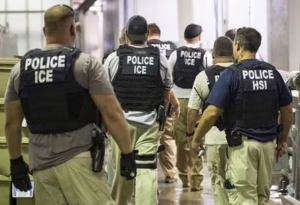

She framed her opposition around recent killings during immigration operations elsewhere, saying ICE enforcement can carry “life and death consequences.”
Wu pointed to fatal shootings in Minnesota and Maine. In January, ICE agents killed two U.S. citizens, Renée Good and Alex Pretti, during a large enforcement surge in the Minneapolis area, deaths that drew national protests. In July, an ICE agent in Biddeford, Maine, fatally shot a 26-year-old Colombian man whom advocates said was authorized to work in the United States. “We oppose any, any mechanism to allow them to do that here,” according to the Boston Herald.
The parking dispute is the latest step Boston has taken to distance itself from federal immigration enforcement. In February, Wu signed an executive order barring ICE from operating on city property, parks or municipal lots without a court order or warrant. Under the Boston Trust Act, city police do not honor ICE civil immigration detainers, which are requests to hold people the agency suspects of immigration violations; the Herald reported that the department declined all 57 such requests it received last year. Several city councilors, including Council President Ruthzee Louijeune, have urged landlords not to rent to ICE, and Governor Maura Healey signed the PROTECT Act this month, which further limits where the agency can stage and operate in Massachusetts.
ICE and the Department of Homeland Security have defended the parking search and declined to confirm any locations.
A spokesperson said the agency would not discuss office or parking sites, citing operational security and what it described as a steep rise in threats and assaults against officers. Officials also tied the need for space to a rapidly growing workforce, saying recent federal funding has added thousands of ICE personnel nationwide.
Not everyone accepts Wu’s premise that a larger ICE presence makes the city less safe. Jessica M. Vaughan, director of policy studies at the Center for Immigration Studies, a Washington think tank that favors stricter immigration enforcement, argued that policies like Boston’s are precisely what push ICE to make arrests in public. If local police and sheriffs honored detainers, she said, agents could take custody of people already held in jails and prisons rather than pursuing them on the street. “They have no choice,” Vaughan said of ICE. “They have to go out to the streets to find them.” She said local leaders should give police more discretion over which detainers to follow, and noted that Boston’s approach differed under former mayors Thomas Menino and Marty Walsh, per the Boston Herald.
For now, the process remains in its early stages. ICE must still weigh any responses, decide whether to issue a formal request for lease proposals and negotiate terms, a sequence that could stretch over months. In the meantime, Wu’s records requests would give the city a list of who, if anyone, is willing to do business with the agency in a city whose immigrant neighborhoods, including large Haitian and Caribbean communities, would feel the effects of any expanded operations most directly.


https://ctninfo.com/?p=44207&preview=true
Source:
Wu plans FOIA to ID property owners interested in leasing to ICE

