



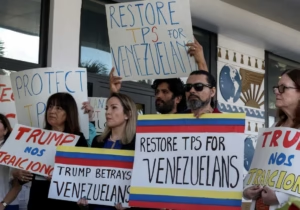
More than 627,000 Venezuelan immigrants could regain their legal status in the United States as soon as November 6, after a federal appeals court refused to keep their deportation protections suspended; a reprieve that now hinges on whether the Supreme Court steps in first.
A three-judge panel of the Ninth U.S. Circuit Court of Appeals unanimously rejected the Trump administration’s bid to keep Venezuela’s Temporary Protected Status on hold, according to Latin
The decision represents another development in a prolonged legal dispute over the federal government’s authority to terminate humanitarian immigration protections. However, it does not guarantee that Venezuelan TPS holders will regain their status on November 6.
The U.S. Supreme Court could still intervene before that date, when an earlier order temporarily blocking the restoration of the program is scheduled to expire.
According to the National TPS Alliance and the American Civil Liberties Union (ACLU) of Northern California, the appellate court’s decision could allow protections to resume while the underlying lawsuit continues.
The dispute centers on actions taken by former Department of Homeland Security Secretary Kristi Noem, who canceled an extension of Venezuela’s 2023 TPS designation and subsequently moved to terminate the program.
On September 5, 2025, a federal district court in California determined that Noem had exceeded her statutory authority by reversing the previous extension and terminating Venezuela’s designation.
The federal government challenged that decision, and the Supreme Court temporarily suspended its enforcement on October 3, 2025, allowing the administration’s termination measures to remain in effect during the litigation.
The case returned to the Ninth Circuit after the Supreme Court, on October 5, 2026, vacated an earlier appellate decision and directed the court to reconsider the dispute in light of a separate Supreme Court ruling concerning judicial review of TPS termination decisions.
Following that development, the Trump administration requested another suspension that would take effect when the Supreme Court’s existing order expires on November 6.
The administration also requested an additional administrative suspension of at least 21 days if its principal motion was rejected.
The three judges denied both requests on October 30.
The appellate court’s order does not constitute a final resolution of the legal challenge. The judges indicated that they would establish an expedited schedule for further arguments on the merits of the case.
The dispute concerns Venezuela’s 2023 TPS designation, which covered hundreds of thousands of Venezuelan nationals who had received temporary immigration protections in the United States.
The Latin Times reported that approximately 627,750 Venezuelans could be affected by the potential restoration, although the exact number of current beneficiaries eligible for reinstatement has not been independently confirmed.
TPS is a humanitarian immigration program that allows eligible nationals of designated countries to remain temporarily in the United States when armed conflict, natural disasters, or other extraordinary conditions make their return unsafe.
Beneficiaries who meet the program’s requirements are generally protected from deportation and may obtain employment authorization.
The cancellation of Venezuela’s designation left affected beneficiaries facing uncertainty about their immigration status and eligibility to continue working legally.
In court filings highlighted by the National TPS Alliance, several Venezuelan immigrants described the consequences of losing their protections.
One beneficiary, Carlos Sanchez Villa, was deported to Liberia in August 2026 despite having no previous connection to the West African country, according to a sworn declaration cited by the organization.
The National TPS Alliance presented such accounts as evidence of the consequences of the administration’s termination policy.
Although the October 30 decision specifically concerns the potential restoration of protections for Venezuelans, the broader legal proceedings also involve Haitian TPS beneficiaries.
The National TPS Alliance lawsuit originally challenged the Trump administration’s actions against Venezuela’s TPS designation. In March 2025, the plaintiffs expanded their legal challenge to include the administration’s decision to shorten an extension of TPS for approximately 500,000 Haitians.
Four Haitian TPS holders subsequently joined the litigation, according to the ACLU of Northern California.
However, the October 30 order does not independently restore TPS protections for Haitian nationals. The legal consequences of the ruling must be distinguished from the separate court orders and Supreme Court decisions affecting Haiti’s designation.
The proceedings nevertheless concern a legal question relevant to several TPS disputes: whether the Department of Homeland Security can reverse an existing TPS extension and whether federal courts have authority to review such actions.
Representatives of organizations challenging the administration’s decision welcomed the Ninth Circuit’s refusal to grant another suspension.
Jose Palma, coordinator of the National TPS Alliance, said the decision strengthened the organization’s efforts to protect immigrants’ ability to live and work in the United States.
He described the ruling as a victory for beneficiaries who have faced prolonged uncertainty about their immigration status.
Jessica Bansal, an attorney with the National Day Laborer Organizing Network who represents the plaintiffs, criticized the original TPS termination and its consequences for Venezuelan families.
According to Bansal, the Ninth Circuit’s order could allow Venezuela’s TPS protections to resume on November 6, provided the Supreme Court does not issue another order preventing reinstatement.
The plaintiffs maintain that federal courts have authority to determine whether the Homeland Security secretary acted beyond the powers established by Congress. The administration has challenged the courts’ jurisdiction to consider those claims.
The Ninth Circuit’s latest order rejected the government’s request for a suspension but did not provide a final determination of all the legal questions involved.
The immediate future of Venezuela’s TPS designation now depends on whether the Supreme Court issues another order before the existing suspension expires.
If no further judicial intervention occurs, the September 2025 district court injunction is expected to take effect on November 6, allowing affected Venezuelan beneficiaries to regain their TPS protections while the litigation proceeds.
However, the restoration of employment authorization and documentation could require additional administrative guidance from U.S. Citizenship and Immigration Services (USCIS).

As of November 2, the October 30 appellate decision should not be interpreted as confirmation that TPS protections have already been restored.
Affected immigrants will need to monitor official court decisions and USCIS announcements to determine when and how any reinstated protections can be documented.
The October 30 order leaves the underlying litigation unresolved, with the Ninth Circuit preparing to consider additional arguments concerning the administration’s authority to cancel previously approved TPS protections.
For hundreds of thousands of Venezuelans, November 6 remains the next significant date in a legal dispute that will determine whether their temporary immigration protections can resume while the courts continue reviewing the government’s actions.
https://ctninfo.com/?p=45142&preview=true
Source: The Latin Times
Some of CTN’s journalists are not native English speakers and draft their work in French or Haitian Creole. We then use AI-assisted translation software to produce the English versions, and traces of machine-generated phrasing may occasionally remain. Every article — in any language — is written, reviewed, and edited by CTN’s staff writers and editors, who remain responsible for its accuracy. CTN also uses AI to convert text into audio.

