

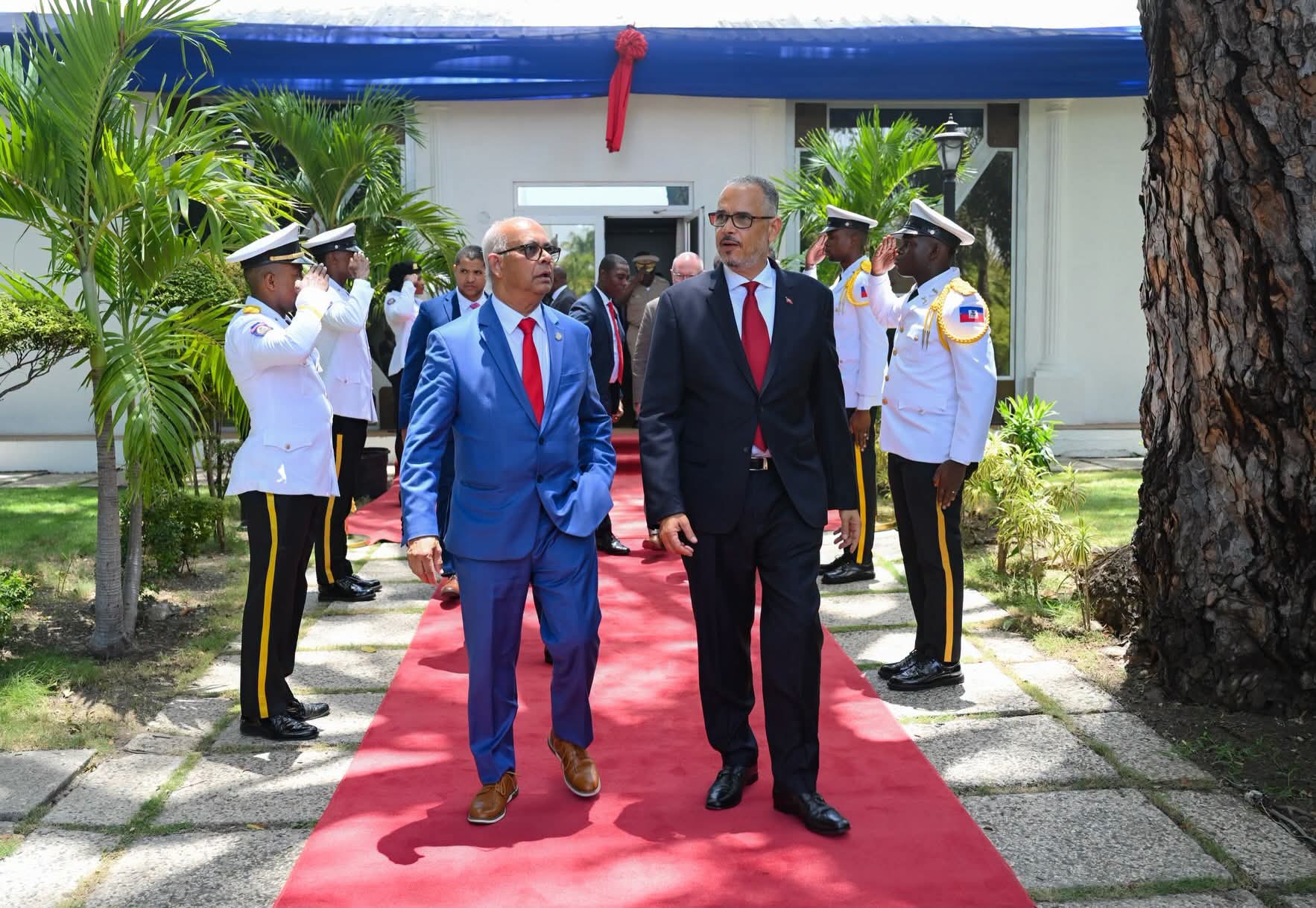
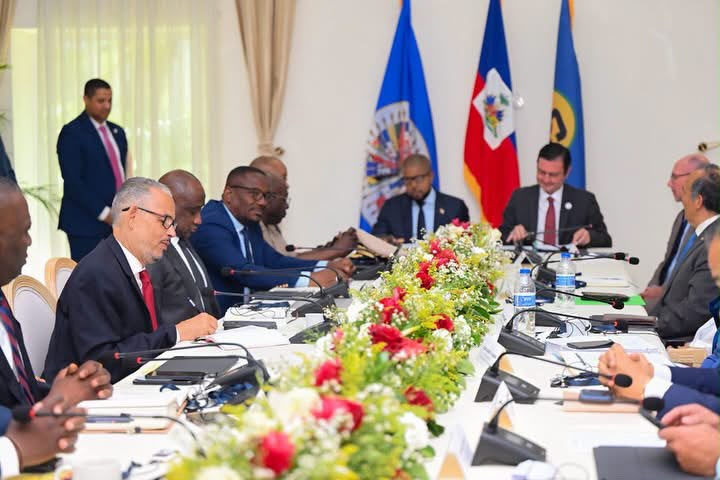
Port-au-Prince, August 17, 2026 – A major diplomatic dynamic unfolded this Monday at the National Palace, where Prime Minister Alix Didier Fils-Aimé received a high-level Inter-American delegation led by the Secretary-General of the Organization of American States (OAS), Albert Ramdin, and the Secretary-General of CARICOM, Carla Barnett. The meeting marks a decisive step in the institutional rapprochement between Haiti and its regional partners.
The delegation, which is in Haiti from August 16 to 19 as part of a support mission, focused its discussions on the two major challenges identified by the Haitian government: the restoration of security and the organization of credible and inclusive elections. The talks allowed for an assessment of progress made in strengthening the capacities of the Haitian National Police (HNP), a component deemed essential by international partners for the country’s long-term stabilization.
In his message posted on platform X, Secretary-General Ramdin commended “the ongoing efforts to increase the capacities of the Haitian National Police,” describing this progress as a major contribution to long-term stability. He also reaffirmed the OAS’s readiness to accompany Haiti in electoral preparations, with the goal of ensuring “safe, inclusive, and credible” elections.
Haiti’s Integration into CAF: An Economic Turning Point
Alongside security and political challenges, this day was marked by a significant institutional advancement on the economic front. The Haitian government formalized its integration into the Development Bank of Latin America and the Caribbean (CAF), a decision already approved in December 2025 by the institution’s board of directors.

Minister of Foreign Affairs Raina Forbin signed an agreement regarding the immunities, exemptions, and privileges of the CAF in Haiti, while Minister of Economy and Finance Serge Gabriel Collin initialed the formal instrument of the country’s accession. This integration paves the way for privileged access to financing, technical assistance, and the bank’s knowledge programs, which are particularly well-suited to states vulnerable to climate change.
The simultaneous presence of the OAS and CARICOM alongside Haitian authorities reflects the collective commitment of the Inter-American community. The mission, which continues through August 19, aims to consolidate a coordinated response to the multidimensional challenges facing Haiti: insecurity, humanitarian crisis, institutional fragility, and economic recovery.
Prime Minister Fils-Aimé expressed his gratitude to regional partners for their “constant support,” reiterating his government’s determination to “create the security conditions necessary for the holding of upcoming elections.” A firm stance that contrasts with the chronic instability that has hampered previous electoral processes.
As the Inter-American delegation continues its work, this diplomatic sequence points to a shared willingness to transform principled commitments into concrete actions. Integration into the CAF, combined with reinforced support from the OAS and CARICOM, could offer Haiti the institutional and financial levers needed for a sustainable exit from the crisis. The challenge now lies in translating these diplomatic advances into tangible benefits for a population awaiting stability and prospects.