


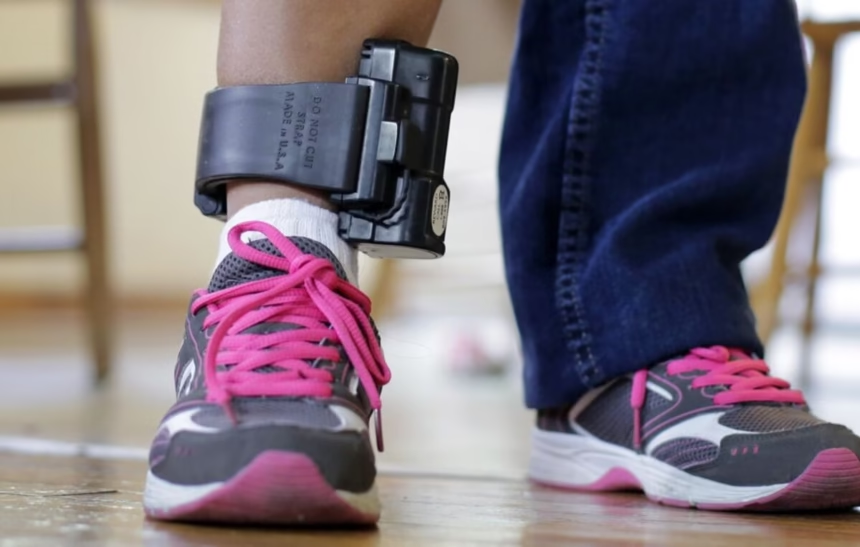
Immigration and Customs Enforcement (ICE) has removed electronic ankle monitors from several Haitian immigrants in Springfield, Ohio, and replaced them with a smartphone check-in application, according to people directly affected.
The change lifts a visible and stigmatizing burden, but it does not loosen the conditions those immigrants live under.
One of them, Ronald, a Haitian immigrant in Springfield whose monitor was removed last week, told CTN that he had gone to ICE to report problems he was having with the device, and that officers removed it during that visit. Since then, he said, he must check in every day through the app and is not permitted to leave the state of Ohio. Others in the community describe the same arrangement: the bracelet is gone, but the daily reporting and the travel restriction remain in place.
An important caveat applies. The Department of Homeland Security has not indicated that the policy of placing ankle monitors on immigrants has ended or been declared invalid.
Other immigrants in Springfield and elsewhere may still be wearing the devices. For these individuals, what has changed is the tool used to monitor them—not their legal situation.
The application replacing the monitors is part of ICE’s Alternatives to Detention program, which supervises immigrants with pending cases outside of detention. The program relies heavily on a phone app known as SmartLINK, which verifies a person’s identity and location at check-in. As of mid-2025, about 183,000 adults were enrolled in the program, the large majority checking in through SmartLINK, while roughly 24,000, about 13 percent, wore ankle monitors, according to a July 2025 report by Elaine Mallon of The National News Desk, the Sinclair-owned wire service. A June 2025 ICE memo, first obtained by The Washington Post, directed officers to escalate supervision to “GPS ankle monitors whenever possible” for immigrants not being arrested at the time of reporting, and to increase reporting requirements. The agency has signaled it wants more immigrants, not fewer, fitted with the devices. The swap now seen in Springfield is consistent with ICE’s broad reliance on the SmartLINK app in individual cases, but it is not a published reversal of the monitoring policy.
In Springfield, the ankle monitor is bound up with the death of Pierre Damas Bel, a 20-year-old Haitian-born honors student at Wright State University who died by suicide on August 31, 2026, according to OSV News. ICE had fitted Bel with a monitor on July 29 as part of an alternatives-to-detention program while his immigration case continued; his asylum hearing was set for October.
Bel’s father, Pierre Ronal Bel, said in interviews that “everything changed” after the monitor was placed on his son, and that the young man was bullied and called a criminal by classmates; in a social-media post the day after the device was fitted, Bel wrote that he felt he was being treated like a criminal, OSV News reported. Archbishop Thomas G. Wenski of Miami described the death as a “death of despair” and urged the government to reconsider ending deportation protections for Haitians.

A DHS spokesperson, who described Bel as a Haitian national without legal status, said, “No one is required to stay in the United States illegally and wear a monitor.”
Bel’s death drew national attention to the use of ankle monitors on immigrants with no criminal record who are complying with the terms of their cases.
For some Haitians in Springfield who now have those monitors removed, the relief is real but partial. The device that became a symbol of criminalization is gone for some, but the obligations it enforced—daily check-ins, a ban on leaving the state—continue.
If you or someone you know is struggling or in crisis, help is available. Call or text 988 to reach the 988 Suicide and Crisis Lifeline, free and confidential, 24 hours a day.
https://www.facebook.com/CaribbeanNewsMedia
https://ctninfo.com/?p=44949&preview=true
AI Use Policy: Some of CTN’s journalists are not native English speakers and draft their work in French or Haitian Creole. We then use AI-assisted translation software to produce the English versions, and traces of machine-generated phrasing may occasionally remain. Every article — in any language — is written, reviewed, and edited by CTN’s staff writers and editors, who remain responsible for its accuracy. CTN also uses AI to convert text into audio.