


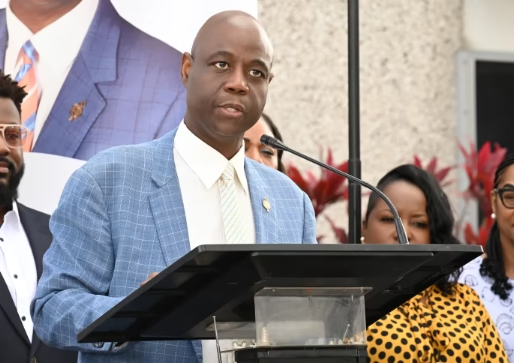
A court challenge that could remove North Miami’s Haitian-American mayor, Alix Desulme, from the November 3 ballot opened before a Miami-Dade judge on Wednesday, October 14, but did not conclude, and is set to resume on Monday, October 19 — reported to be the first day of early voting. The dispute centers on the type of checks Desulme used to pay his qualifying fees, and at the first hearing his attorneys turned the same kind of scrutiny back on the challenger.
The case matters well beyond a paperwork question.
North Miami is one of the centers of Haitian-American political power in the United States, and Desulme — who was appointed mayor in 2022 after the resignation of Philippe Bien-Aimé and won a full term in a December 2024 runoff with about 68 percent of the vote, according to WLRN — is the city’s current Haitian-American mayor. A disqualification would reshape the mayoral race in a city where Haitian representation has been built over decades.
A firsthand account of the October 14 proceeding came from Carolina Matamoros, who said she attended and posted a summary on the Instagram account @voteforcarolina, which supports District 3 candidate Carolina Matamoros. According to her account, Mayor Desulme was not present for the proceedings. Morgan’s legal team raised questions about the cashier’s checks Desulme used during qualifying, she wrote, and Desulme’s attorneys responded by challenging Morgan’s own qualifying documents — arguing, she said, that Morgan’s election-assessment payment was “80 cents short” and that the payment “allegedly came from an account not clearly identified as belonging to his campaign.”
“Regardless of the outcome, matters involving our city’s leadership deserve the public’s attention,” Matamoros wrote, adding that residents have “a responsibility to stay informed, ask questions, and remain engaged,” and that she would continue following the proceedings and sharing updates. She reported that the hearing is scheduled to resume at 11:30 a.m. on Monday, October 19, at the Osvaldo N. Soto Miami-Dade Justice Center, 20 NW 1st Avenue.
CTN has not independently verified this account of what was argued in court. The @voteforcarolina account supports a candidate in the same election, and the statements about Morgan’s paperwork are characterizations of arguments made by the mayor’s lawyers in court, not findings by the judge. What is clear from the account, and consistent with the case schedule, is that the matter was not resolved on October 14 and will continue on October 19.
Mayoral candidate George E. Duell Morgan brought the challenge, which Local 10 described as a competitor seeking the mayor’s removal from the ballot. Morgan asked the court to disqualify Desulme, arguing that two TD Bank checks the mayor submitted during qualifying did not comply with Florida’s election requirements.
Desulme submitted two TD Bank instruments labeled “Official Check,” both dated August 10, 2026 and totaling $5,392.80, according to the Haitian-American outlet Le Floridien, which reviewed the records. One check, for $4,494, paid North Miami’s qualifying fee to the city; the other, for $898.80, paid the separate 1 percent state election assessment, payable to the Election Trust Fund, that Florida requires of municipal candidates. Morgan’s complaint argues that both were bank-issued checks signed by a bank representative, rather than checks drawn on the candidate’s own campaign account and signed by his campaign treasurer, as the challenge contends the law requires.

The dispute turns on how a candidate may pay.
Florida Statute 99.061(7)(a)1 generally requires a qualifying fee to be paid by a check drawn on the candidate’s designated campaign account, and a cashier’s check is permitted only in limited circumstances, Le Floridien reported.
The outlet noted that in a 2024 case, Spiritis v. Botel, a court upheld the disqualification of a Riviera Beach candidate who had used a cashier’s check. Separately, Florida Statute 106.11 requires checks written on a campaign account to be signed by the campaign treasurer or a deputy treasurer, and a 2013 Florida Division of Elections advisory opinion, DE 13-04, concluded that the 1 percent assessment must likewise be paid by a check drawn on the campaign account unless a local charter or ordinance provides otherwise.
These are the requirements Morgan’s lawsuit invokes — and, by Matamoros’s account, the same body of law Desulme’s attorneys are now citing against Morgan. Whether either candidate’s payments satisfied the requirements, and what effect any defect would have on their place on the ballot, is for the court to decide.
North Miami’s City Clerk initially accepted Desulme’s qualifying documents, and the city has listed him as a qualified candidate.
The challenge arrives weeks after a North Miami candidate was removed from the ballot on a related question. In September 2026, Circuit Judge Christopher Green upheld the disqualification of District 2 candidate Hector Medina, as reported by Hoodline and the Miami Times. Medina had paid with checks drawn on his campaign account — satisfying that requirement — but signed them himself instead of having his designated campaign treasurer sign them. The court found the qualifying requirements had not been met, even though the City Clerk’s office had initially accepted the checks.
That outcome is central to how both sides may argue the Desulme case. Medina was removed over a signature problem on a campaign-account check; Desulme is accused of a different defect — using bank-issued checks rather than campaign-account checks at all.
The website North Miami Speaks, which compiled the candidates’ qualifying records and urged residents to attend the hearing, frames the case around whether the rules have been applied evenly.
According to records it published, District 3 candidate Jobans Jules submitted a $779.10 Truist Bank cashier’s check for the same 1 percent state assessment, also signed by a bank representative rather than a campaign treasurer. Another District 3 candidate, Carolina Matamoros, instead used the hardship option in Florida Statute 99.093(2), submitting sworn documents seeking an exemption from the assessment.
CTN has not independently verified every one of those records, and two points should be clear. Jules is not a party to Morgan’s lawsuit, and no court has found that he failed to qualify. The question raised by North Miami Speaks — why bank-signed checks were accepted from some candidates while Medina was removed over a signature — is an argument advanced by the mayor’s critics, not a finding by any court. How the court interprets the requirement for the 1 percent assessment in Desulme’s case, however, could bear on how the same rule is read for other North Miami candidates who paid it the same way.

Desulme has not issued a public statement on the allegations. He was not present at the October 14 hearing, by Matamoros’s account, though his attorneys appeared and contested the challenge, including by questioning Morgan’s own qualifying documents.
The timing raises the stakes. The hearing is set to resume on October 19, the day early voting is reported to begin, with ballots for the November 3 election already in voters’ hands.
If the court ultimately agrees with Morgan, Desulme could be removed from the ballot; the mayor’s counsel, in turn, is now questioning whether Morgan himself properly qualified. The ruling will land in a city whose Haitian-American electorate has long followed North Miami’s elections closely. CTN will report the court’s decision as soon as it is confirmed.
https://ctninfo.com/north-miamis-hai…-november-ballot/
Sources:
https://northmiamispeaks.com/alix-desulme-election-lawsuit-qualifying-checks/
AI Use Policy:
Some of CTN’s journalists are not native English speakers and draft their work in French or Haitian Creole. We then use AI-assisted translation software to produce the English versions, and traces of machine-generated phrasing may occasionally remain. Every article — in any language — is written, reviewed, and edited by CTN’s staff writers and editors, who remain responsible for its accuracy. CTN also uses AI to convert text into audio.