



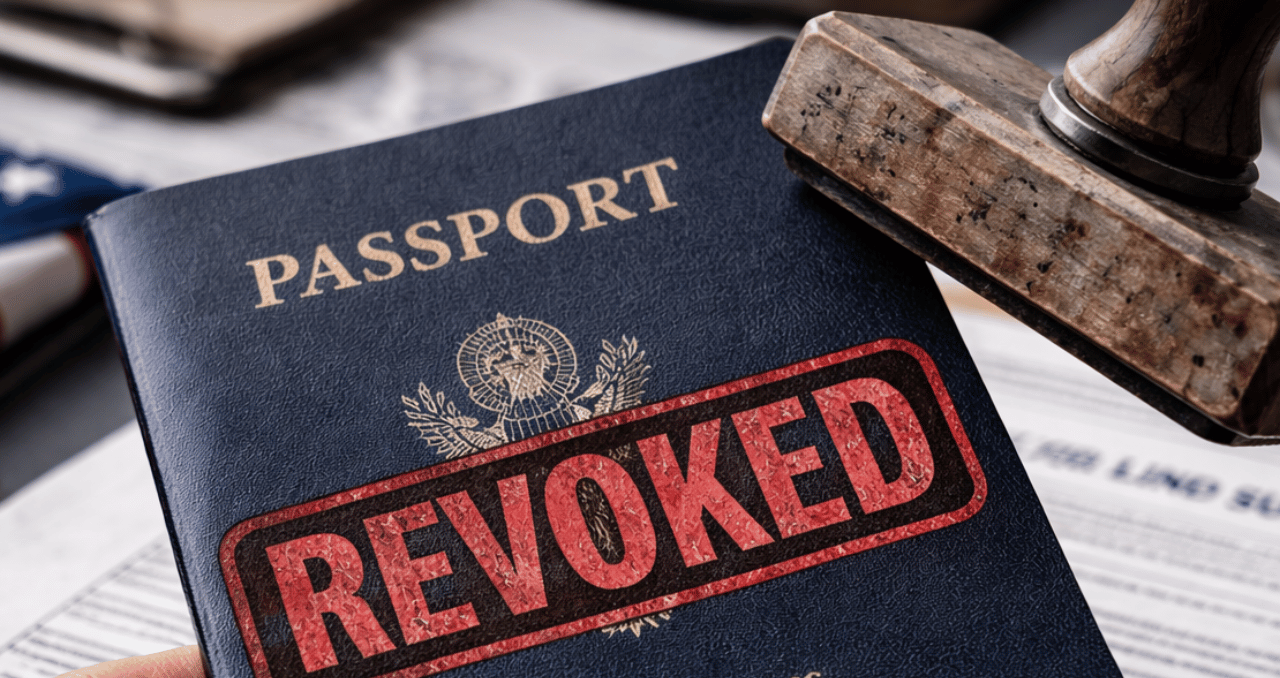
The U.S. State Department is set to begin revoking the passports of thousands of parents who have fallen significantly behind on child support payments, expanding what the agency describes as a long-standing but underused enforcement tool, according to reporting by the Associated Press.
The first wave of revocations is scheduled to take effect on Friday and will target parents whose unpaid child support debt totals at least $100,000, AP reported. Department officials told the news agency that approximately 2,700 American passport holders fall into that category, based on figures supplied to the State Department by the U.S. Department of Health and Human Services.
The action represents a significant escalation of an enforcement framework first established under a 1996 federal law that has remained largely unenforced for nearly three decades.

Under the original 1996 statute, the federal government has been authorized to deny or revoke U.S. passports for parents who owe more than $2,500 in past-due child support. In practice, however, the penalty has been applied narrowly — typically only when an affected individual filed an application to renew an expired passport, AP reported.
The new policy substantially expands the law’s reach.
According to AP, the State Department will now coordinate with HHS to identify all parents who exceed the $2,500 threshold and proactively revoke the passports of those who already hold valid travel documents — rather than waiting for them to seek renewal.
The department has not yet released a precise figure on how many passport holders currently fall into the broader category, AP reported, because HHS is still gathering data from state-level agencies that track child support arrears nationwide. Officials told the news service that the expanded enforcement could ultimately affect tens of thousands of additional Americans.
The expansion was first reported by AP in February.
State Department Frames Move as Effective Pressure Tool
In remarks shared with AP, Assistant Secretary of State for Consular Affairs Mora Namdar characterized the change as a strengthening of an enforcement strategy with a demonstrated track record.

“We are expanding a commonsense practice that has been proven effective at getting those who owe child support to pay their debt,” Namdar told the news agency. “Once these parents resolve their debts, they can once again enjoy the privilege of a U.S. passport.”
The State Department also told AP that the public disclosure of the policy expansion has already prompted some affected parents to settle outstanding balances. According to the department, hundreds of parents have moved to resolve arrears with state authorities since the AP first reported on the planned expansion in February.
“While we can’t confirm the causation in all of those cases, we are taking this action precisely to impel these parents to do the right thing by their children and by U.S. law,” the department said in a statement provided to AP.
Federal officials pointed to historical collection data to justify the expansion. According to figures the State Department provided to AP, the passport-denial program has facilitated the collection of roughly $657 million in past-due child support since enforcement began in earnest in 1998.
More than $156 million of that total has come from over 24,000 individual lump-sum payments made within the past five years alone, AP reported.
The State Department described the program as a “powerful tool” for compelling delinquent parents to meet their financial obligations.
What Affected Passport Holders Can Expect
According to AP, parents whose passports are revoked under the policy will receive formal notice from the State Department that their documents are no longer valid for international travel. To restore their travel privileges, they will need to satisfy their child support arrears and then submit a new passport application once payment is confirmed by the relevant state authorities.
The policy includes accommodations for individuals who may be overseas at the moment of revocation, AP reported. Affected travelers abroad will need to visit a U.S. embassy or consulate to request an emergency travel document, which will permit them to return to the United States but not to continue international travel until their child support debt is resolved.
The expansion arrives at a politically charged moment in U.S. immigration and border policy, with the State Department under heightened scrutiny over its travel-document policies more broadly. While the new enforcement focus on child support arrears is procedurally distinct from immigration enforcement, it shares a common feature: a willingness to leverage federal travel documents as a compliance mechanism.
Child support arrears in the United States represent a longstanding policy challenge. Federal and state authorities have used a range of tools over the years — including wage garnishment, tax refund seizures, professional license suspensions, and credit reporting — to compel payment. The expanded passport-revocation program adds another lever, one that supporters argue is particularly effective with high-earning delinquents who may travel internationally for business or personal reasons.
For parents within the affected community — including significant numbers in immigrant and diaspora populations who travel frequently between the U.S. and family abroad — the policy change could carry particular weight. Travel abroad to visit family, attend funerals, or conduct business will become contingent on resolving outstanding child support obligations.
The first wave of revocations is set to take effect on Friday.
https://ctninfo.com/?p=42622&preview=true
This article is based on reporting by the Associated Press.