


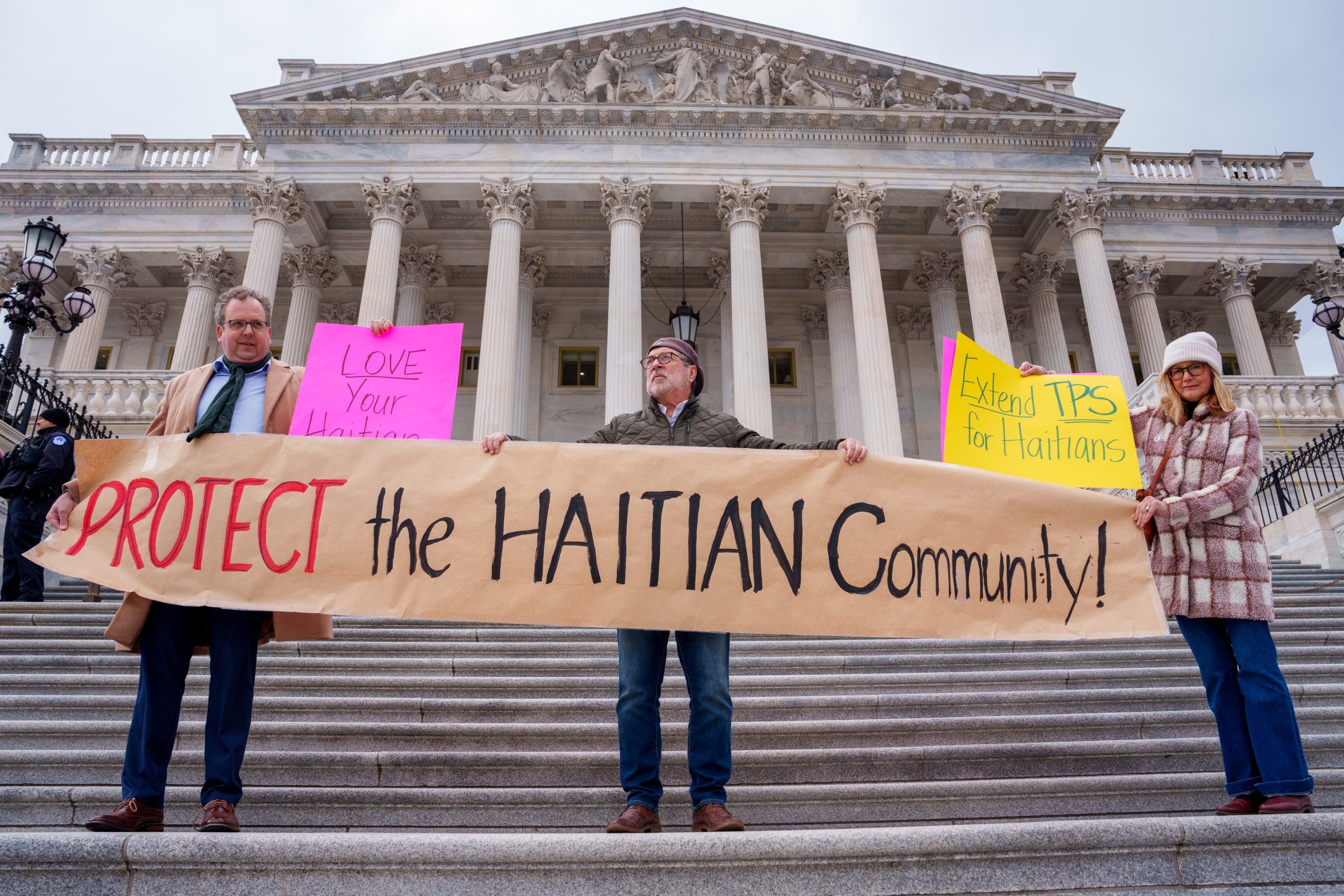
Attorneys representing Haitian recipients of Temporary Protected Status (TPS) are asking the U.S. Supreme Court to dismiss the case brought by the Trump administration, arguing that newly uncovered internal Department of Homeland Security documents raise serious questions about how the decision to terminate TPS for Haiti was made.
The development was first reported by NPR in an article by Nina Totenberg and Grady Martin.
According to NPR, lawyers for Haitian immigrants filed a motion Tuesday asking the justices to drop the administration’s case, which seeks to allow the government to end protections for more than 330,000 Haitians living legally in the United States under TPS.
In their motion, the attorneys argue that recently produced DHS documents strengthen their claim that the termination of TPS for Haiti was not the result of a neutral review of conditions in the country, but rather a predetermined decision. They also argue that because new evidence is still being uncovered, it would be premature for the Supreme Court to rule on the merits of the case.
TPS is a temporary immigration status created by Congress in 1990 to protect certain foreign nationals who cannot safely return to their home countries because of armed conflict, natural disasters, or other extraordinary conditions. Haiti was designated for TPS after the devastating January 2010 earthquake, which killed more than 200,000 people and severely weakened the country’s institutions.

Since then, protections for Haitians have been extended multiple times because of Haiti’s ongoing humanitarian, security, and political crises.
The country continues to face expanding gang violence, the collapse of key public institutions, mass displacement, and persistent public health and economic emergencies.
At the center of the legal battle is a major question: Can federal courts review the administration’s decision to terminate TPS for Haiti? The Trump administration argues that the law grants the executive branch broad authority in this area and sharply limits the courts’ role. Lawyers for TPS recipients argue that the government must still follow legally required procedures and cannot make a decision based on discriminatory motives.
The Supreme Court agreed to hear the case on an expedited basis, before a federal appeals court had completed its review. That unusual move gave the case national significance because its outcome could affect not only Haitians with TPS but also other immigrant communities protected under similar designations.
According to a motion filed by attorneys for Haitian TPS recipients, the new DHS documents show that career staff recommended extending TPS for Haiti. That recommendation was based in part on worsening violence and rapidly changing security conditions in the country. The attorneys argue, however, that a political appointee overruled that recommendation and that internal documents were later revised to support a decision to terminate the designation.
The motion also says some internal documents cited justifications that, according to the attorneys, were not sufficiently supported by evidence.
The lawyers argue that these details are directly connected to their claims that the decision to end TPS for Haiti was procedurally flawed and driven by hostility toward Haitians.

Those allegations are important because, during oral arguments before the Supreme Court, the administration argued that courts cannot review executive branch decisions on TPS. However, when questioned by Justice Amy Coney Barrett, Solicitor General John Sauer acknowledged that courts may review claims involving racial discrimination. The Haitian plaintiffs have raised precisely that kind of claim, arguing that the revocation of Haiti’s TPS designation was influenced by discrimination.
The attorneys are therefore asking the Supreme Court to dismiss the case as improvidently granted. Their argument is straightforward: until discovery is complete, the Court lacks a full factual record to properly evaluate the claims raised by Haitian TPS recipients.
For Haitian communities across the United States, this case is more than a legal dispute. It directly affects families, workers, small-business owners, students, and parents of U.S. citizen children. An unfavorable ruling could expose hundreds of thousands of people to the loss of legal status, work authorization, and, eventually, possible deportation to a country that many international organizations continue to describe as deeply unstable.
The government is expected to have an opportunity to respond to the motion. The Supreme Court could then decide to continue reviewing the case, dismiss it, or send it back to the lower courts for further development of the factual record.
For now, the future of TPS for Haiti remains in the hands of the Supreme Court. But the new evidence cited by attorneys adds another important dimension to the case: beyond the question of presidential authority, the justices are now being asked to consider how the government’s decision was actually made.
https://ctninfo.com/tps-lawyers-repr…evidence-emerges/
https://www.facebook.com/CaribbeanNewsMedia