


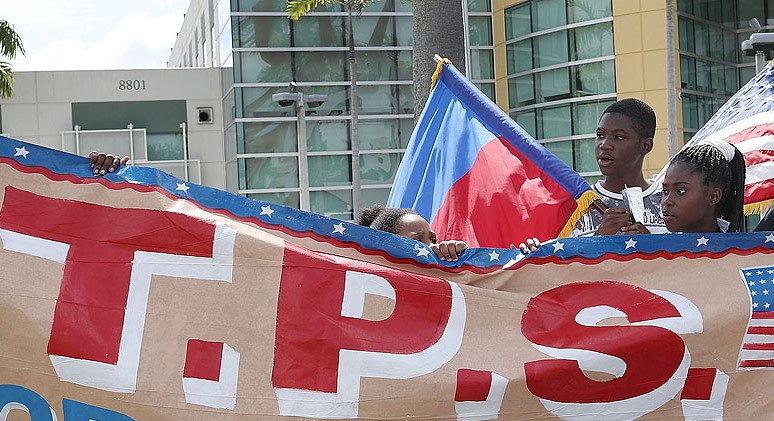
The NAACP (National Association for the Advancement of Colored People) forcefully condemned Thursday the U.S. Supreme Court’s 6-3 decision in Mullin v. Doe, which allows the Trump administration to terminate Temporary Protected Status (TPS) for more than 350,000 Haitian immigrants. This ruling exposes them to the potential loss of their work permits and immediate deportation to Haiti, a country still reeling from multiple crises.
The judicial decision, which upholds the executive branch’s position, was met with outrage by civil rights advocates, who view it as a discriminatory act with devastating human and economic consequences.
‘A Devastating Betrayal’ for Haitian Families
In a statement, Derrick Johnson, president and CEO of the NAACP – the oldest and largest civil rights organization in the United States – called the ruling a “devastating betrayal of Haitian families who have lived, worked, and contributed to this country for years.” He denounced a deportation driven by “racist prejudice against Black immigrants,” stating that the Supreme Court gave its “green light to the expulsion of more than 350,000 people, endangering their safety while ignoring the fundamental principles of equality before the law.”

NAACP Legal Counsel Kristen Clarke echoed these sentiments, asserting that the “racial motivation behind this administration’s callous decision to end TPS for Haitian nationals is simply undeniable.” She emphasized that the ruling “defies the 14th Amendment of the Constitution, which prohibits intentional acts of racial discrimination,” and condemned an administration that implements “policies driven by a toxic mix of racism and xenophobia aimed at dehumanizing, marginalizing, and erasing Black presence, political power, and voice.”
The Context of the Trump Administration’s Statements and Actions
This ruling comes against a backdrop in which advocacy groups and civil rights organizations have repeatedly called out the Trump administration’s statements and actions targeting Haitian immigrants. The Legal Defense Fund (LDF) and the NAACP had filed an amicus curiae brief before the Supreme Court, arguing for the maintenance of TPS. They highlighted that the decision to end the protections came after a series of “revealing” remarks by President Trump, including unfounded accusations that Haitian immigrants “eat people’s pets,” claims that they “probably have AIDS,” and characterizations of them as “poisoning the blood of America.”
The LDF and NAACP brief argued that the Constitution protects every person living in the United States, regardless of status, against racial discrimination under the Fifth Amendment. They also pointed to numerous comments by President Trump calling for a “permanent pause” on immigration from Haiti, while favoring immigration from “nice” European countries like those in Scandinavia.
A Considerable Economic and Social Impact

Beyond the legal and humanitarian dimensions, the Supreme Court’s decision carries major economic repercussions. Haitian TPS holders contribute nearly $6 billion to the U.S. economy annually and hold essential jobs in healthcare, agriculture, and industry. Their tax contributions are estimated at more than $1.5 billion.
The loss of their status would strip them of their legal right to work, potentially plunging an estimated 25,000 children of U.S. citizens into poverty. For civil rights organizations, this decision weakens the country and exposes entire families to separation and deportation to a nation where gang violence and political instability persist.
NAACP’s Call to Congress
In response to this ruling, the NAACP has no intention of backing down. The organization has called on Congress to act immediately to overturn the measure and establish a permanent pathway to citizenship for TPS beneficiaries. “We cannot allow our neighbors, our friends, and our families – people who have lived, worked, and built families here for years – to be torn from our communities,” Johnson declared.
Kristen Clarke, drawing on her experience as a former chief of the Justice Department’s Civil Rights Division, also called for Supreme Court reform, which she deemed essential to preserving democracy.