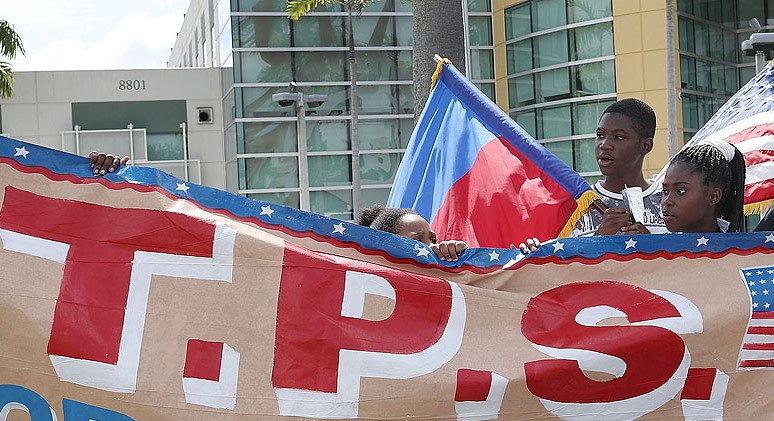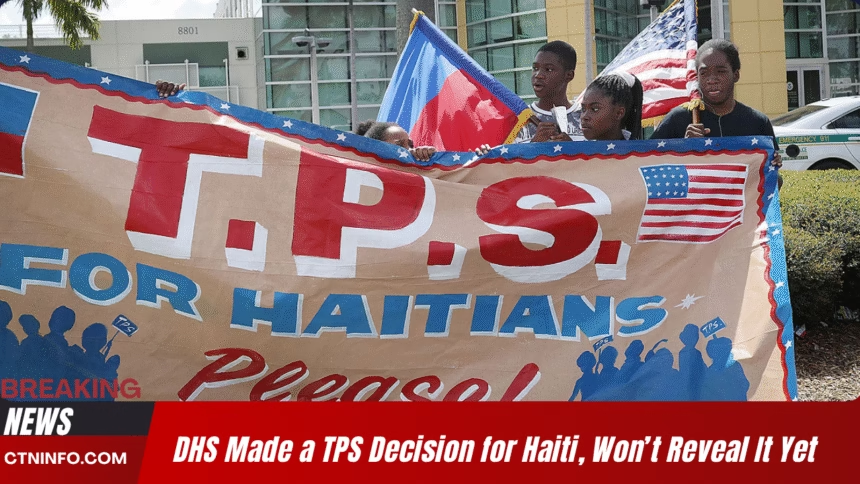
The U.S. Supreme Court has allowed the Trump administration to end Temporary Protected Status for Haiti, immediately threatening the legal status of an estimated 350,000 Haitians—including thousands in Massachusetts—who now face deportation to a country plagued by gang violence.
In a 6-3 decision on June 25, the Court ended the orders blocking TPS terminations, citing that the law gives the executive branch wide authority over TPS and limits most court challenges. This ruling also affects Syria and other countries facing termination of TPS.
For Haiti, the consequences are immediate and personal. The 2010 designation had shielded Haitians who fled the catastrophic earthquake of that year and the deepening instability that followed. According to advocates tracking the case, the terminations are scheduled to take effect approximately one month after the June 25 decision—around late July 2026—unless a lower court intervenes again. This means affected Haitians could begin losing work authorization and protection from removal within weeks of that date.
Massachusetts’ two U.S. senators, both Democrats, sharply condemned the decision.
Senator Edward J. Markey released his statement after appearing at a press conference outside the Supreme Court alongside Representatives Ayanna Pressley (MA-07), Democratic Whip Katherine Clark (MA-05), Maxwell Frost (FL-10), and Debbie Wasserman Schultz (FL-25).
Markey argued that “the lives of over a million TPS holders who cannot return home safely are now at grave risk due to the Supreme Court’s ruling on Trump’s unlawful, racist termination of the Temporary Protected Status program.”
He continued, stating that “the far-right extremist majority on the Court has severed a critical lifeline for people seeking safety and has worsened a humanitarian crisis.” Emphasizing the stakes, Markey said, “We have a moral duty to protect TPS holders and to provide this vulnerable group a permanent pathway to citizenship. We must continue the fight to protect our neighbors.”
Warren criticized the decision, saying, “Trump’s hand-picked Supreme Court just cleared the way for him to deport hard-working, legal immigrants into imminent danger in Haiti, Syria, and other war-torn and gang-controlled countries. It’s horrific and lawless.”
She added, “The Supreme Court is letting the president ignore the laws set by Congress and terminate protections for up to 1.3 million TPS workers and their families across the country. This decision is a disaster for the rule of law and a disaster for thousands of families in Massachusetts.”
The 1.3 million figure both senators referenced reflects the full population of TPS holders the administration’s policy could ultimately affect nationwide, across all designated countries—not just Haiti.
What the Court decided
The case reached the Supreme Court after district courts halted TPS terminations for Haiti and Syria. The government then asked the Court to review, and it agreed before a final judgment.
The majority ruled that a provision in the TPS law shields the Homeland Security secretary’s termination decisions from most judicial review, leaving only constitutional claims open to review. It also concluded that the Haitian plaintiffs’ race-discrimination claim was unlikely to succeed, noting that the administration’s terminations spanned a racially diverse set of countries and that no predominantly European nation’s designation had yet come up for review under the current administration.
The case bears the name of the current Homeland Security Secretary, Markwayne Mullin, who currently holds the office. The terminations at the center of the litigation were announced in 2025 by then-Secretary Kristi Noem, who asserted that conditions in parts of Haiti were suitable for return and that continued protection was contrary to the national interest — a rationale the plaintiffs argued was pretextual and, in Haiti’s case, tainted by racial bias.
In dissent, Justice Elena Kagan argued that the majority erred by foreclosing review of whether DHS complied with the procedures Congress mandated, and she rejected the majority’s conclusion that race played no role in the Haiti decision. She wrote that the references cited by the plaintiffs were “shot through with racial stereotypes and tropes.”
A long fight, centered in Massachusetts
For the Haitian community in Greater Boston — one of the largest in the country — the ruling lands as the latest blow in a year of legal whiplash. In February 2026, a federal district court paused the Haiti termination just before it was set to expire at the end of the month. In March 2026, the D.C. Circuit blocked the administration from immediately ending the designation. Each reprieve was temporary and is now swept aside by the Supreme Court’s June 25 decision.
Markey has been among the most active lawmakers on the issue. In April, he led 26 senators and 157 House members in filing an amicus brief urging the Supreme Court to uphold protections for Haiti and Syria, joined by Congresswoman Pressley, Senator Chris Van Hollen of Maryland, and Congresswoman Wasserman Schultz. In September 2025, he filed a bicameral amicus brief in the companion Haiti case at the district court level. And in January 2026, Markey and Pressley convened a field hearing at Jubilee Christian Church in Mattapan, where they heard directly from Haitian families, advocates, and community leaders about what the loss of TPS would mean.
Both senators signaled that the legislative fight is not over. Markey has previously introduced legislation to extend Haiti’s TPS designation and supports measures that would give long-term TPS holders a pathway to legal permanent residency — the kind of durable fix that, advocates note, only Congress can now deliver after the Court’s ruling foreclosed the courts as a check.
What comes next
The Court did not say Haiti or Syria is safe. The decision only defines the extent to which courts can review terminations. Once the terminations take effect, Haitians without other status risk losing protection and facing removal.
Immigration attorneys are urging affected Haitians to confirm the exact expiration date on their work permits, avoid acting on rumors, and seek a careful, individual case review to determine whether other relief — such as a family- or employment-based green card, asylum, or another status — may apply.
Editorial Disclaimer: This article was originally written in English. The French and Haitian Creole versions are produced using AI translation, and errors are possible — the English version is authoritative. CTN also uses AI to convert text into audio. Readers and listeners should rely on the English text where any discrepancy arises.