


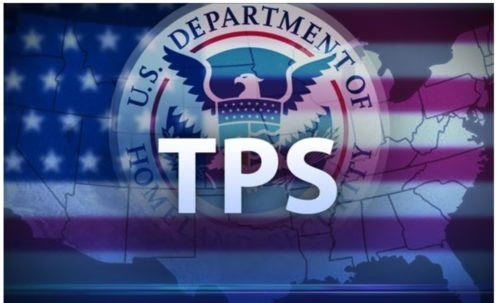
Hours after the U.S. Supreme Court cleared the way for the Trump administration to strip Temporary Protected Status from hundreds of thousands of Haitians, Governor Maura Healey faced a packed hall—clergy, labor leaders, doctors, attorneys, and Haitian community members—her voice rising with conviction as she delivered a message. She repeated it, unwavering, letting it echo until hope and defiance filled every corner of the room.
“In Massachusetts, we stand with our Haitian and Syrian communities and we always will,” Healey said.
The Thursday press conference was convened within hours of the June 25 ruling in Mullin v. Doe. It brought together an extraordinary cross-section of the Commonwealth’s leadership. Among them were Lieutenant Governor Kim Driscoll, Attorney General Andrea Campbell, Boston Mayor Michelle Wu, At-Large City Councilor Ruthzee Louijeune, and Dr. Geralde Gabeau of the Immigrant Family Services Institute. They united behind a single idea: Massachusetts would not turn its back on immigrants that its federal government had once invited in.
The decision they gathered to denounce was sweeping. In a 6-3 ruling written by Justice Samuel Alito, the Court held that the TPS statute bars federal judges from reviewing most challenges to a decision to end a country’s TPS designation. The ruling lifts the lower-court orders that had kept protections in place. For Haiti, the consequences are immediate and devastating: an estimated 350,000 Haitians nationwide — about 45,000 in Massachusetts — now face the fear of losing their work permits and protection from deportation. For many, this means the prospect of uprooting their lives, families, and futures. The ruling also ends protections for about 6,000 Syrians and places the livelihoods of TPS holders from over a dozen other countries in jeopardy.
“This decision makes no sense”
Healey did not soften her assessment of the policy or the Court that blessed it.
“This decision endangers our families, economy, communities, and country,” she said. “It lets President Trump heartlessly tear away protections from families and children—children who escaped horrifying earthquakes and violence. These children are here legally, seeking safety and hope.”
She underscored that the affected people had broken no rules. “They went to bed feeling secure, with legal status in the United States,” Healey said. “Overnight, that safety was ripped away. The Supreme Court and Donald Trump are not just attacking policy—they are tearing apart the lives of legal immigrants who’ve trusted this country for over a decade.”
Massachusetts has the third-largest Haitian population in the country, concentrated in Boston neighborhoods such as Mattapan and Hyde Park, as well as in cities like Brockton and Randolph. The Governor called the ruling a humanitarian and economic catastrophe, noting that many TPS holders are healthcare workers, caregivers, entrepreneurs, and small-business owners woven into the state’s economy.
“Massachusetts will not turn its back on families who built their lives here in our great state,” she said.
Healey pointed families to a state resource page on mass.gov and to the Massachusetts Access to Counsel initiative. This effort, launched with the Massachusetts Immigrant and Refugee Advocacy Coalition (MIRA), connects TPS holders to legal information and representation. She said her office would issue guidance for employers. Healey also announced a partnership with the United Way of Massachusetts Bay to raise emergency funds for impacted families.
“We are just getting started”
Attorney General Andrea Campbell called the ruling devastating and personal.
“I am deeply disappointed and devastated by today’s Supreme Court decision,” Campbell said, her voice heavy. “We see you. We value you—not just for your cultural contributions, not just for the work you do for our commonwealth, but for your humanity, your families, your hearts.”
She did not hedge on the state’s identity. “Massachusetts would not be the best state in the country without our immigrants. Period,” Campbell said, naming “our Haitian brothers and sisters, our Syrian brothers and sisters, and every other immigrant community who are here.”
Campbell offered some of the conference’s most concrete figures. She estimated that roughly 45,000 TPS holders live in Massachusetts. About 1,500 Haitian TPS holders work in the state’s nursing-care facilities, “a space where staffing shortages were already a major concern.” Nationally, she cited an estimated 350,000 Haitian and roughly 6,100 Syrian TPS holders. More precise numbers would require a “federal partner willing to share the data.”
The Attorney General urged anyone watching not to panic. “I want to assure TPS holders and their families that this decision today does not go into effect today. You remain protected today,” she said. The termination is expected to take effect upon the Court’s formal issuance of its judgment. That usually happens about 32 days from now, though the timeline remains uncertain.
Campbell placed the ruling in a broader historical context. She compared it, with visible frustration, to Supreme Court decisions that shattered the promise of Reconstruction after the Civil War. “We’ve seen this playbook before,” she declared, her voice tight with emotion. Campbell warned the Court had “disregarded clear racial animus” in a way that felt like an open wound. Her call to the room rang out: “If you have stood on the sidelines, you’ve stood on the sidelines for far too long. It is now time for you to step up.”
She urged every stakeholder — businesses, nonprofits, faith communities — to call the Department of Homeland Security and Congress to demand that TPS remain in place. “We are not powerless,” Campbell said. “If anything, we should be saying we’re just getting started.”
“Boston is the antidote”
Mayor Michelle Wu described a city that had spent months bracing for exactly this moment, even as it celebrated.
Wu said, “Boston is the antidote to what’s happening at the federal level.” She recounted how she got on the phone the moment the headline broke — with the Governor, Attorney General, City Councilor Louijeune, and Dr. Gabeau. Dr. Gabeau had already mobilized the legal-services community.
Wu was blunt about the Court. “Today, Donald Trump’s enablers on the Supreme Court handed down a decision that disregards established law, basic human dignity, and fundamental American values,” she said. Wu described Haitian neighbors who “have lived in Boston for decades and decades.” They “coach our kids, care for our elders, keep our streets safe” and “serve in our schools, our nonprofits, our public safety agencies.”
To those neighbors, she delivered a direct promise: “You belong here.”
Wu also offered practical reassurance, echoing the Attorney General. “This decision does not itself cancel your work permit. If you are authorized to work, you stay authorized,” she said. Wu urged employers to base any decisions only on employees’ current documents and to avoid preemptive action. Many Haitian and Syrian residents are authorized through other pathways, including pending asylum applications. Individual legal review remains essential.
The Mayor pointed to a relief fund set up earlier in the year through the Boston Foundation, which she said has mobilized more than $2.6 million since March to strengthen community organizations and prepare for this moment. “The city of Boston is a home for everyone,” she said. “We will never back down from protecting all of our neighbors.”
A daughter of Haiti speaks
City Councilor Ruthzee Louijeune — the first Haitian American elected to the Boston City Council and the daughter of Haitian immigrants — spoke with the weight of personal history.
“This is a sad day. This is a dangerous opinion,” she began. She highlighted a contradiction: “The State Department has issued a do-not-travel warning to Haiti. Yet they think it is safe to detain and deport 350,000 Haitians. Many have been here since the devastating 2010 earthquake. Make it make sense, because it does not.”
Louijeune warned of the human toll. “We are tearing families apart with this decision. We are tearing apart our workplaces and our economy,” she said. Many Haitian TPS holders have children who are U.S. citizens “who speak no other language than English.”
With Juneteenth fresh in memory, she invoked Haiti’s proud, painful history. “Haiti, the first Black nation to seize independence—and here, today, we slam our doors on those most in need,” she declared. “With Haiti leading the world in hunger, what are we doing? We are handing down a death sentence to people who thought this country could be their home.”
She pointed to the ongoing legislative fight. Louijeune credited Congresswoman Ayanna Pressley with securing “a bipartisan vote to extend TPS for three years” after a coalition pushed a discharge petition through the House. Senator Edward Markey and Senator Lisa Blunt Rochester are leading a companion effort in the Senate. “The fight is not over,” Louijeune said. “We are only continuing and pushing forward.”
“I dare you to go to sleep tonight”
The conference’s most piercing moment came from Dr. Geralde Gabeau, founder and executive director of the Immigrant Family Services Institute (IFSI) in Mattapan, a leading voice in Boston’s Haitian community.
Gabeau recounted an eight-year-old girl’s question to a teacher at IFSI’s Saturday music program: “Teacher, would you take me home with you?” The teacher, surprised, asked why. The girl, her voice trembling, explained her parents had told her to find someone to care for her: “In case I get to be deported, because I was born here, but my parents are here on TPS.”
That story framed Gabeau’s challenge to the justices. “What exactly am I going to say to those children who are born here and whose parents are on TPS and can be deported at any time?” she asked. In the scrum afterward, she estimated that more than 87,000 U.S.-born children currently have parents who hold Temporary Protected Status (TPS).
“Behind every single decision, every single policy, there is a life,” Gabeau said. “And we’re talking about people’s lives that you are destroying. I dare you to go to sleep tonight and sleep well when you know that more than 350,000 people are not going to be able to stay.”
A woman of deep faith, Gabeau closed with defiance and prayer. “What we do every day, we fight,” she said. “By God’s grace, we will win.” She noted that some Haitian TPS holders hold memos showing their status is valid only until July 1, and pressed that DHS Secretary Markwayne Mullin could act on his own authority, without Congress, to preserve protections — if he chose to act compassionately.
The World Cup that made the cruelty plain
Running through nearly every speech was an unlikely throughline: soccer.
Just weeks earlier, the same leaders had gathered in celebration. On May 26, Governor Healey proclaimed “Frantzdy Pierrot Day” in Massachusetts, honoring the Haitian national-team striker who grew up in Melrose, starred at Melrose High School, and played two seasons at Northeastern University before turning professional in Europe. Pierrot helped power Haiti to its first World Cup in 52 years, and on June 13, he led Les Grenadiers onto the field at Boston Stadium in Foxborough for the tournament’s opening night.
Healey returned to that pride at the press conference, recalling that Haiti’s players could not even train safely in their own country because of gang violence and kidnappings — the very conditions, she noted, that TPS was created to address. Wu remembered how the city “exploded with joy across every neighborhood” when Haiti scored its first World Cup goal in 52 years.
The contrast was the point. A nation too dangerous for its own team to play at home was, in the Court’s reasoning, safe enough to deport people to. “When we rooted for Haiti, we were rooting for our Haitian neighbors and our friends,” Healey said.
The human cost, and the road ahead
For families, the fear is already concrete. A community member named Angela described her household’s unraveling: her husband, a TPS holder and MBTA commercial driver, lost his job after he could no longer renew his commercial driver’s license. “I have a mortgage,” she said, her voice breaking. “We are hoping that TPS can continue so that he can find other employment opportunities.”
Officials cautioned that the legal fight is not finished, but it is steeply uphill. The case returns to the lower courts, but those courts can no longer hear the Administrative Procedure Act claims at the heart of the challenge, and the justices signaled the plaintiffs are unlikely to prevail on their remaining constitutional arguments. In the meantime, Campbell warned, there would be no protections for TPS holders — a gap the Court declined to fill.
Community leaders urged Haitian families to confirm the exact expiration dates on their work permits, avoid rumors, and seek help only from qualified immigration attorneys and federally accredited representatives, since many may qualify for relief through asylum, family- or employment-based petitions, or other pathways. The United Way of Massachusetts Bay’s federal response fund and the Boston Foundation are accepting donations to support affected families with housing, food, healthcare, and child care.
Healey closed the way she opened — with resolve, and with a reminder that the ruling is not the last word.
“Terrible, terrible Supreme Court decision,” she said.
https://ctninfo.com/massachusetts-st…e-court-guts-tps/
https://www.facebook.com/CaribbeanNewsMedia
https://ctninfo.com/massachusetts-st…e-court-guts-tps/
https://www.facebook.com/CaribbeanNewsMedia
Editorial Disclaimer:
This article was originally written in English. The French and Haitian Creole versions are produced using AI translation, and errors are possible — the English version is authoritative. CTN also uses AI to convert text into audio. Readers and listeners should rely on the English text where any discrepancy arises.