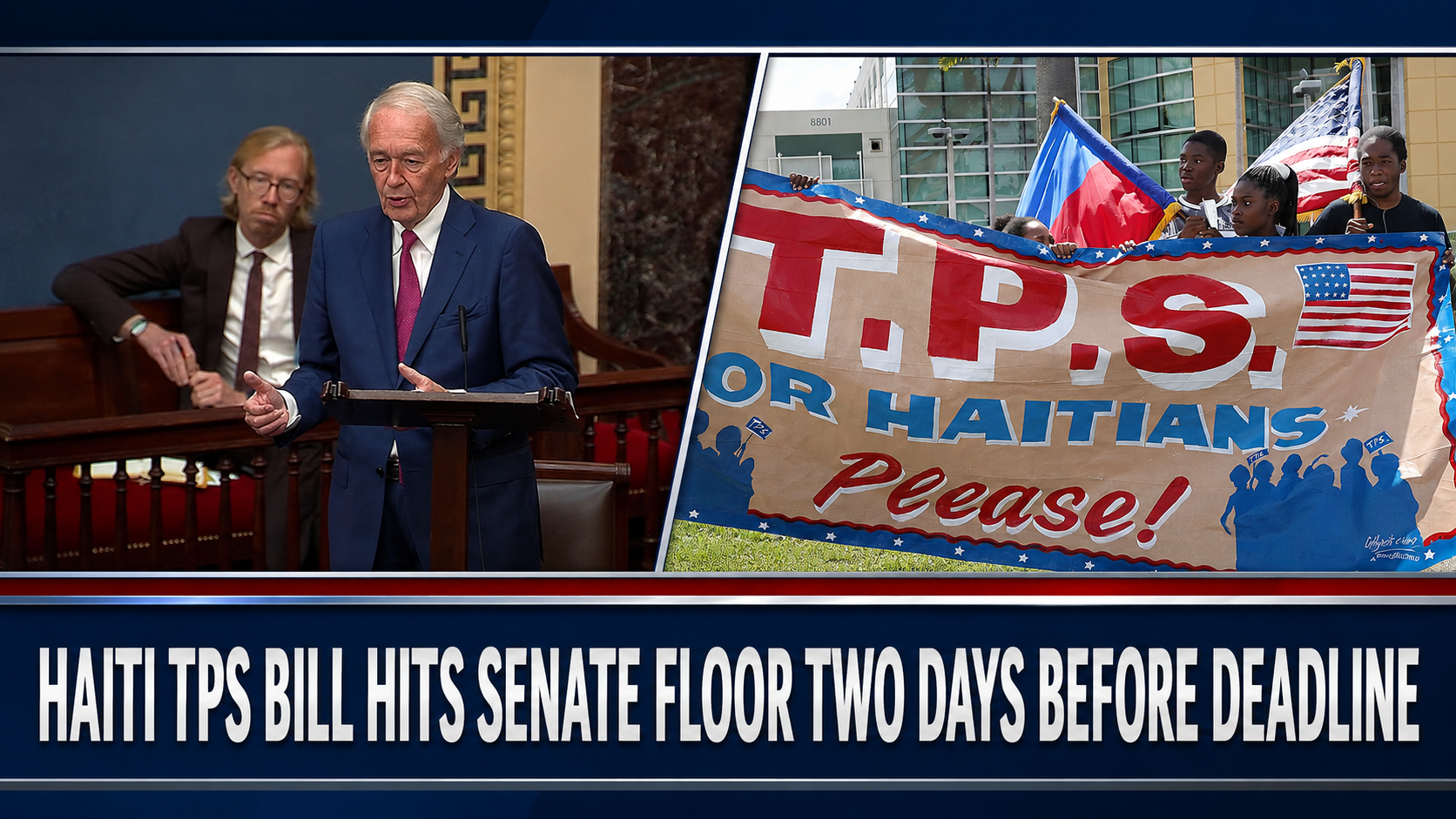



A senior State Department official told the House Foreign Affairs Committee on Tuesday that he did not believe his department was consulted before the Secretary of Homeland Security terminated Temporary Protected Status for Haiti — a step the statute requires — as Senator Edward J. Markey of Massachusetts prepares to ask the Senate to restore the designation by legislation.
The admission came from Michael Kozak, the State Department’s senior official in the Bureau of Western Hemisphere Affairs, who was asked twice during the hearing whether State had been consulted before then-Secretary Kristi Noem ended the designation. I don’t believe so, he said, according to Miami Herald reporter Jacqueline Charles, who covered the hearing.
The session was convened by Chairman Brian Mast, a Florida Republican, to examine the U.S. response to Haiti’s security crisis and the new United Nations-authorized Gang Suppression Force. Lawmakers repeatedly redirected it to termination.
Representative Gregory Meeks of New York, the committee’s ranking Democrat, framed the objection as a contradiction: the administration warns Americans not to travel to Haiti while treating the country as safe enough to return roughly 350,000 people. This is not just cruel; it’s contradictory, he said, warning it would worsen instability in Haiti.
Representative Bill Keating, a Massachusetts Democrat, pressed Kozak on the same point — that the danger justifying a Gang Suppression Force is the danger that justified the protection in the first place. It’s an obvious contradiction, he said.

Kozak said he did not see it that way. He suggested that many TPS beneficiaries have already adjusted to lawful permanent resident status and would not be returning, while acknowledging that he did not know the figures for Haiti, according to the Miami Herald.
That claim does not match how the program works. TPS, created by Congress in 1990, permits nationals of designated countries to live and work temporarily in the United States. It confers no path to permanent residency or citizenship. A Haitian TPS holder who has not obtained another status through a separate process has nothing to fall back on when the designation ends.
Kozak also argued that gang control is not nationwide, citing Prime Minister Alix Didier Fils-Aimé’s assessment that seven of Haiti’s ten departments could hold elections immediately. Of the rest, he said the problem areas are Artibonite and the West. UN officials have reported that armed groups control large parts of the West — which contains Port-au-Prince — and are expanding, with violence spreading into the southeast.
Representative Kweisi Mfume of Maryland disputed any suggestion that the termination’s impact would be limited, saying removing 350,000 people would require a massive effort.
What is before the Senate
The bill is H.R. 1689, introduced by Congresswoman Laura Gillen of New York with Republican Congressman Mike Lawler as an original cosponsor. Its operative language is a single sentence directing the Secretary of Homeland Security to designate Haiti for TPS until three months after January 20, 2029, or April 20, 2029, just past the end of the current presidential term.

It reached the House floor only because Congresswoman Ayanna Pressley’s discharge petition collected 218 signatures on March 28, bypassing House leadership. The House passed it on April 16 by 224 to 204, with 10 Republicans crossing over. What moved to the Senate was the bill; Markey introduced a companion, S. 4814, on June 17 with Senator Lisa Blunt Rochester of Delaware, Democratic Leader Chuck Schumer, and 16 other senators.
The Supreme Court cleared the way for the termination last month, ruling 6-3 that Noem’s decision is not subject to judicial review and reversing two lower courts that had blocked it. That holding is what makes Wednesday’s request matter: with the courts closed off, legislation is the remaining instrument.
The country they would return to
The premise of the designation is that Haiti is unsafe. Tuesday’s hearing produced bipartisan agreement on that, even as it divided on TPS.
Colonel Justin Gorkowski of the Defense Department, who helped design the new gang-fighting response, told the committee that previous international efforts misread the conflict. This is a proto-insurgency, he said, describing more than 20 gang leaders fighting for territory and estimating Haiti needs 30,000 security personnel to restore order.
Mast, the Republican chairman, said gangs hold an estimated 90 percent of Port-au-Prince and have displaced more than 1.4 million people, describing murder, kidnapping, rape, and mass extortion, and warning that a fully collapsed Haiti would not stay contained.
UN figures track the same crisis. Roughly 1.5 million people are internally displaced, approaching the level seen after the 2010 earthquake. More than 6.4 million — over half the population — need humanitarian assistance, and 5.8 million are expected to go hungry this year. More than 5,500 people were killed in gang violence in 2025. Carlos Ruiz Massieu, the Secretary-General’s Special Representative, estimated criminal groups of 10,000 to 15,000 members control or influence 70 to 75 percent of the capital. Children account for nearly half of all gang recruits.
The 2026 humanitarian appeal had received about 25 percent of its $880 million target by mid-June. Secretary-General António Guterres visited Port-au-Prince on June 16. Officials hope a first round of elections can be held before the end of the year, seating an elected president in February 2027 — the first in more than a decade.
More than 270,000 people were forcibly returned to Haiti in 2025, according to the International Rescue Committee. Nearly a fifth were already displaced inside the country before they left.
Unanswered questions on contractors
Committee members pressed for answers on the role of American-linked private military contractors in the anti-gang campaign and did not get them. A Human Rights Watch report found that drone strikes carried out by contractors working for Vectus Global — owned by Erik Prince, the former Navy SEAL who founded Blackwater — and by Haitian security forces have killed at least 1,243 people, including 17 children. Kozak declined to confirm or deny whether any license had been issued to the firm.
Republicans on the committee raised a separate objection: cost. Representative Scott Perry of Pennsylvania noted that the United States has provided more than $5.1 billion in assistance to Haiti since the 2010 earthquake, against more than $13 billion in international pledges — much of which was never delivered. Mast itemized recent bilateral support at up to $40 million in bridge and sustainment funds and $68 million in equipment, plus a police recruitment surge and counterterrorism funds.
https://ctninfo.com/state-dept-says-…-moves-in-senate/
https://www.facebook.com/CaribbeanNewsMedia
Editorial Disclaimer:
This article was originally written in English. Other language versions are produced using AI translation software, and errors are possible — the English version is authoritative. CTN also uses AI to convert text into audio.