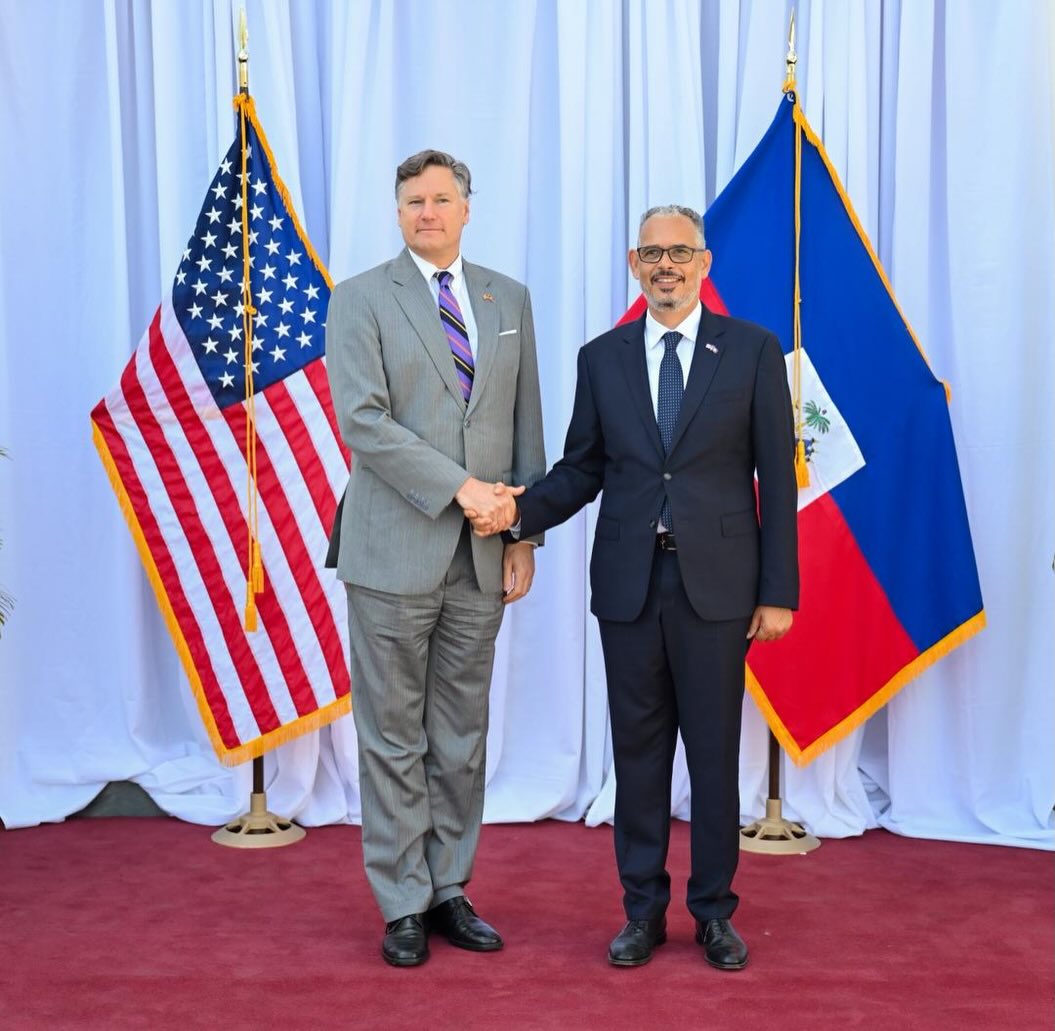
In a tense security and political context, Haitian Prime Minister Alix Didier Fils-Aimé met this Friday, May 29, with U.S. Deputy Secretary of State Christopher Landau, during an official visit by the American official to Port-au-Prince whose official agenda had not been immediately disclosed.
According to a statement from the Prime Minister’s office, the White House is aligning its total, exclusive, and unwavering support behind the head of the Haitian government. Facing the crisis, Washington chooses clarity: the United States stands with the Prime Minister to restore state authority, dismantle criminal networks, and stabilize institutions, the statement indicates.
During the talks, the Deputy Secretary of State praised the leadership and determination of Alix Didier Fils-Aimé, reiterating that his government is the legitimate pivot to lead the country toward free and sovereign elections. Several members of the Haitian government were present, including the Minister of Planning and External Cooperation, Sandra Paulemon, the Minister of Foreign Affairs, Raïna Forbin, the Minister of Justice and Public Security, Patrick Pélissier, as well as the Minister of Defense, Mario Andrésol. The Deputy Secretary of State was accompanied notably by the U.S. Chargé d’Affaires in Haiti, Henry T. Wooster.
The discussions focused on security challenges, progress made in institutional stabilization, as well as bilateral cooperation. The Prime Minister presented the concrete victories of his security forces: gradual recovery of control over strategic areas of the capital, full restoration of institutional activity at the National Palace, and the joint ramp-up of the Haitian National Police (HNP) and the Armed Forces of Haiti (FAd’H), reinforced by the decisive impact of the bilateral P4000 program.

After the official meeting, the delegation visited the Champ de Mars to assess the security situation in this symbolic area and to observe the actions taken to retake several sensitive sectors of the Port-au-Prince metropolitan region. This highly symbolic tour aimed to show that the Haitian state — with international support — was regaining a foothold in sectors once abandoned to armed groups.
But this visit comes amid a still tense political and security context. On one hand, armed gangs continue to maintain their grip on strategic areas of the Haitian capital, despite ongoing operations and advances by the Haitian National Police (HNP) supported by a Task Force. It is within this framework that the controversial deployment of the Gang Suppression Force (GSF) falls, of which the United States is one of the main architects. The GSF, officially intended to neutralize the criminal coalitions paralyzing the metropolitan region, is raising concerns in Haiti about the slowness observed in the deployment process.
Alongside the security challenges, the government is facing a backlash against a proposed electoral decree it was preparing to adopt. This proposal is being denounced by a broad coalition of political parties and civil society organizations, who see it as an attempt to manipulate the electoral process.
While questions remain about the real purpose of the visit — whether to support or pressure the Prime Minister — the Prime Minister’s office statement insists on a clear message: this historic visit seals an unshakeable pact between Port-au-Prince and Washington to annihilate armed terror and rebuild, under the exclusive direction of the Prime Minister, a stable and democratic Haiti.
However, without political consensus on the electoral framework and in the face of public mistrust, this security and institutional roadmap remains compromised.