


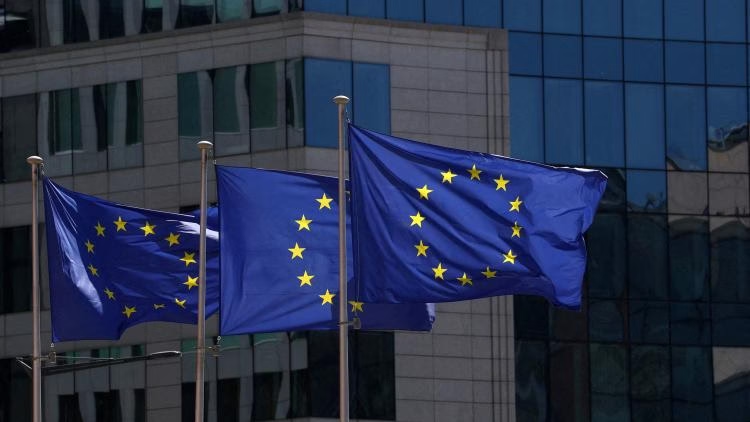
The Council of the European Union announced on Monday, November 16, 2026, the addition of four armed criminal groups operating in Haiti to its sanctions list, for their alleged involvement in serious human rights violations. The entities targeted are the groups “5 Segond,” “Gran Ravin,” “Kraze Baryè,” and “400 Mawozo.” These measures fall within the framework of the EU’s global human rights sanctions regime.
The EU Council detailed the specific grievances retained against each entity. The “5 Segond” group is accused of involvement in murders, rapes, and other forms of sexual and gender-based violence, as well as acts of violence against children. The European institution also attributes to it several attacks that affected health infrastructure and humanitarian services.
The “Gran Ravin” group, led by Renel Destina, alias “Ti Lapli,” is blamed for attacks that caused civilian deaths, triggered population displacements, and disrupted access to essential services. The group is also responsible for murders, rapes, kidnappings, and other serious crimes.
As for the “400 Mawozo” and “Kraze Baryè” groups operating in the north and northeast of the Haitian capital, they are sanctioned in particular for recruiting children into armed groups, exposing them to armed violence, as well as for acts of sexual and gender-based violence and murders. The EU Council specifies that these listings specifically target the six grave violations against children in times of armed conflict: killing and maiming, recruitment or use of children as soldiers, sexual violence, abduction, attacks on schools or hospitals, and denial of humanitarian access.

This European decision adds to a series of measures already taken by the United States, the United Nations, Canada, and the Dominican Republic. It nonetheless deserves to be placed in a critical perspective. For while sanctions rain down, the fact remains that the gang leaders targeted have, for the most part, never traveled abroad and hardly depend on international financial circuits. The question of the real effectiveness of these instruments therefore arises acutely.
Washington has indeed considerably hardened its approach over the course of 2026. On October 21, 2026, the State Department added the groups “Viv Ansanm” and “Gran Grif” to the list of foreign terrorist organizations and specially designated global terrorists, freezing their assets in the United States and prohibiting any transaction with them. In January of the same year, the State Department had already imposed visa restrictions on three members of the Presidential Transitional Council and one minister, reproaching them for tolerating armed groups designated as terrorist and for destabilizing the state. But a distinction must be made: sanctioning political officials, sensitive to international travel and their reputation, does not carry the same weight as sanctioning gang leaders whose horizon remains confined to Port-au-Prince.
On the United Nations side, the Security Council established in 2022 a sanctions regime resting on three pillars: arms embargo, travel ban, and asset freeze. In October 2026, it renewed this regime for one year, with 14 votes in favor and one abstention, that of Russia. The list currently includes nine individuals and two entities. Yet the United Nations Group of Experts itself acknowledges that the arms embargo is “frequently” violated, with an estimated 270,000 to 500,000 illegal weapons circulating on Haitian territory. The asset freeze proves even more disappointing: the Group of Experts confirmed the freezing of accounts of only two sanctioned individuals, for “insignificant” amounts, with banks acting slowly while the individuals concerned had already transferred their funds or placed them in the names of third parties.
For its part, Canada has favored a trajectory focused on political and financial elites, beyond gang leaders alone. In late October 2026, the Canadian government publicly expressed concern about attempts by certain individuals under international sanctions to run in Haitian elections, judging that their candidacy would undermine public confidence in the electoral process. Canadian logic rests on an assumption: Haitian ruling classes care about their access to the international financial system, the security of their assets abroad, and the possibility of traveling to Miami or Montreal. For this group, sanctions do indeed wield a sword of Damocles. But gang leaders do not belong to this group.
The Dominican Republic, for its part, has adopted a more directly geographical approach. In February 2025, President Luis Abinader signed a decree classifying Haitian criminal gangs as “terrorist organizations,” exposing any member crossing the Dominican border to prosecution under anti-terrorism legislation. The effectiveness of this measure nonetheless depends largely on control of the 340-kilometer border: at the time, the border wall was only completed over 176 kilometers. The terrorist designation certainly carries legal weight, but if gang leaders have no intention of crossing the border in any case, the decree’s direct impact remains limited.

Analyses of the effect of sanctions in Haiti clearly emphasize: Haitian gang leaders are “essentially internal actors, who generally do not need to travel abroad or deposit funds outside the country.” They maintain extensive international relations, but these mainly serve to facilitate criminal activities and financial profits inside Haiti, not to place their persons or assets abroad. The asset freeze and travel ban therefore strike at a game in which these individuals practically do not participate. More troubling still: the UN Group of Experts has documented that gang leaders on the list have not moderated their actions as a result. Luckson Elan and his “Gran Grif” group coordinated, between late March and early April 2026, attacks against at least sixteen communities in the Lower Artibonite, causing at least 95 deaths. The names on the sanctions list and the names of those ordering the massacres are often the same.
Ultimately, the problem with international sanctions in Haiti is not their severity, but the fact that they miss their target. By adding four groups to its list, the European Union joins an already well-established ritual: declarations, condemnations, freezes of nonexistent accounts, bans on visas never requested. The real pressure points may lie elsewhere than in Brussels or New York: with the intermediaries who sell weapons to gangs, with the local businessmen who launder their money, with the officials who let suspicious containers pass through Haitian ports. As long as these links are not touched, the lengthening of sanctions lists will remain nothing more than a moral memorandum that the international community addresses to itself.
