

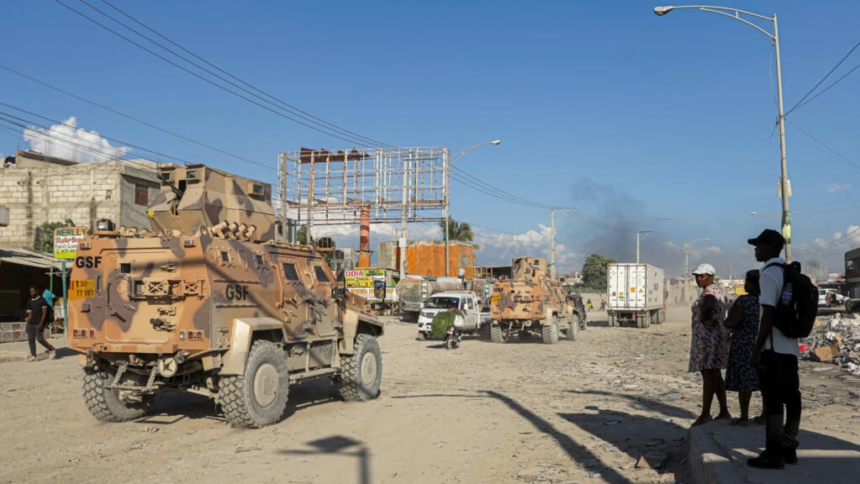
The deployment of Salvadoran military personnel in the Haitian capital entered a new phase on Thursday morning, with their appearance in other strategic areas previously controlled by criminal gangs. After Croix-des-Bouquets, where President Nayib Bukele’s troops have inflicted heavy losses on the “400 Mawozo” gang in recent days, soldiers were spotted at the Sylvio-Cator stadium, in Village-de-Dieu and in the Salomon market area. These movements mark an extension of the Salvadoran intervention, which nonetheless unfolds against a backdrop of heightened diplomatic tensions and growing criticism, despite a warm welcome from the Haitian population.
According to some reports, this deployment would be part of a reconnaissance effort in the areas concerned, in preparation for large-scale operations against gang strongholds. Other sources suggest that the Salvadoran military may be considering establishing a base at the Sylvio-Cator stadium, which had until now served as a stronghold for criminal groups operating on the southern outskirts of the capital to carry out their abuses.
These developments could put an end to rumors of a suspension of Bukele’s troops’ operations in Port-au-Prince. Such rumors had been fueled by tensions between San Salvador and Washington over the coordination of command chains among the various forces deployed on the ground. On October 31, an attack on a Salvadoran convoy of five armored vehicles near the U.S. embassy exacerbated the disagreements. The U.S. chargé d’affaires in Haiti, David Howell, then criticized San Salvador for its lack of coordination with the Gang Suppression Force (FRG) and called for a suspension of operations until appropriate mechanisms were put in place. According to Washington, Salvadoran fire also struck the U.S. diplomatic compound, narrowly missing personnel. In response to these reproaches, the Salvadoran government rejected the accusations, contesting in particular the account of the facts regarding the shots fired at the embassy and the wounding of its soldiers.
These tensions are part of a sequence that began on October 18, when four Salvadoran aviation technicians disappeared during an attack in the Santo area of Croix-des-Bouquets. In retaliation, Nayib Bukele deployed more than 2,000 military personnel to Haiti, an initiative distinct from the UN-supported mission and carried out with the approval of U.S. President Donald Trump. This military presence outside the UN framework nonetheless raises questions about coordination with other national and international forces and about compliance with rules of engagement.

Meanwhile, the Gang Suppression Force (FRG) announced that it had seized weapons and ammunition during an operation conducted on November 11 north of Port-au-Prince international airport. In a post on its Facebook page, the force said its operations were continuing with the aim of dismantling weapons caches, gathering points and supply bases of armed groups. The FRG did not, however, specify the quantity or nature of the weapons seized, nor did it indicate whether any arrests had been made.
The international Force authorized by the United Nations also stated its intention to strengthen security around the airport and in surrounding neighborhoods in order to restore freedom of movement in these areas. These operations also aim to create the conditions necessary for displaced populations to return to their neighborhoods in safety. The FRG reaffirmed its commitment to pursuing its operations “zone by zone, neighborhood by neighborhood.”
This latest security episode comes amid an already deeply degraded humanitarian context. Haiti has nearly 1.5 million internally displaced people, the vast majority of whom are outside Port-au-Prince, according to UN data. The food crisis is also worsening: more than 5.94 million people are facing high levels of acute food insecurity between September 2026 and February 2027, and around 1.8 million are in an emergency situation. Insecurity is the main driver of this deterioration, disrupting trade flows, access to essential services and household livelihoods.
On the political front, the international community continues to bet on an electoral transition to pull the country out of the crisis. In September, the Security Council extended the FRG’s mandate until March 31, 2027, while insisting on the need for a “comprehensive, sustainable and Haitian-led” solution. The Special Representative of the Secretary-General, Carlos Ruiz Massieu, recalled that security operations were only “the first step”: once areas are retaken, police, local authorities, schools, justice and economic activity must follow to prevent gangs from returning.