



Salvadoran soldiers will remain in Haiti into 2027. El Salvador’s Legislative Assembly voted on September 29 to authorize its military’s participation in the United Nations-backed Gang Suppression Force for twelve months beginning October 2, 2026 — a window that runs to October 2027 and can be extended — and Haitian officials say they want the troops to stay at least through the country’s elections, now scheduled for July 2027, according to the Latin American Post.
Haitian Justice Minister Patrick Pélissier told reporters from El Salvador this week that there was “no date” for the Salvadoran troops to leave and that officials were working on a legal framework to let them stay longer, France 24 reported.
The UN Security Council separately renewed the Gang Suppression Force’s mandate through March 31, 2027. Salvadoran officials have said their soldiers will return home once they locate four missing countrymen, the Latin American Post reported, and the agreement between the two governments has not been made public.
The four missing men are Salvadoran aviation technicians serving with the Gang Suppression Force. Gunmen ambushed their vehicle outside the capital on October 18, and Haitian police later found it burned, the Latin American Post reported. By November 18, the men remained unaccounted for. In response, President Nayib Bukele sent more than 2,000 troops, most of them operating outside the international force’s chain of command.
Thousands march in Port-au-Prince
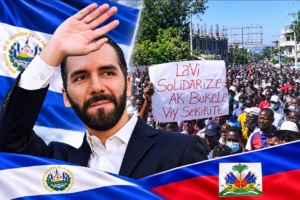
On November 18, demonstrators moved from Delmas through Pétion-Ville toward the office of Prime Minister Alix Didier Fils-Aimé, many wearing shirts bearing Bukele’s image, the Latin American Post reported, citing EFE. The marchers called for the prime minister to resign while also calling for the Salvadoran troops to stay. Opposition spokesman Sonson Dumé urged Bukele to keep his soldiers in the country; Fils-Aimé has publicly thanked the Salvadorans for helping Haiti regain territory.
The march fell on the anniversary of the 1803 Battle of Vertières, where Haitian fighters defeated French colonial forces and cleared the way to independence, the outlet noted. Among those taking part was Marie Michelle Dorville, a street vendor who told the Associated Press, as relayed by the LatinAmerican Post, that gang members had killed her partner and left her to raise three children. She said she wanted the gangs gone for good “so everyone can have a normal life.”
Since the Salvadorans arrived, Haitian forces and their partners have retaken a police post and a power plant, and, in Port-au-Prince, helped recover the Sylvio Cator stadium, where gang control had kept Haiti’s national team from hosting its World Cup qualifiers, the Latin American Post reported. The Salvadorans are now using the stadium as a base. Doctors Without Borders treated 30 people wounded by gunfire or explosions at its Tabarre and Cité Soleil facilities between October 18 and 26, the outlet reported, with some patients delayed for hours by blocked roads and bridges.
El Salvador’s record
Support for Bukele among Haitians has followed a steep drop in violence in his own country. El Salvador’s official homicide tally fell from 2,398 in 2019, the year Bukele took office, to 1,147 in 2021, and then by another 93 percent through 2025, the Latin American Post reported, drawing in part on earlier NPR reporting. The outlet cited a San Salvador street vendor, Arnulfo Mazariego, who for years paid roughly $250 a month in extortion to MS-13 until Bukele’s crackdown ended the payments; he used the savings for eye surgery.
The crackdown carried documented costs. Mass arrests began under emergency powers granted in March 2022, and by late 2024 Bukele acknowledged that authorities had released 8,000 people detained in error, the Latin American Post reported, with some families searching prison to prison for a relative. El Salvador’s homicide figures, the outlet noted, exclude suspected gang members killed in clashes with security forces.
Haiti has drawn on foreign security help before. In 2007, Haitian police and UN troops under Brazilian command pushed gangs out of strongholds in Cité Soleil, and reported kidnappings for ransom fell from 506 in 2006 to 227 the following year, the Latin American Post reported. That mission ended in 2017, and armed groups again control roads that carry food into the capital. At the November march, organizer Girot Frantz warned that the gangs could regroup because they retain allies inside public institutions, the outlet reported, adding that holding recovered ground would require Haitian police able to remain in place and prosecutors free to pursue those who finance the armed groups.
Bukele, who answered the Haitian marchers in Haitian Creole, is seeking a third consecutive term in El Salvador’s February election, the Latin American Post noted. For now, the Salvadoran soldiers remain in Haiti, with the clearest marker of their stay a Haitian election calendar that points to July 2027.
https://ctninfo.com/?p=45416&preview=true
Source:

Can Bukele Make Safe Streets El Salvador’s Most Unlikely Export to Haiti?
AI Use Policy:
Some of CTN’s journalists are not native English speakers and draft their work in French or Haitian Creole. We then use AI-assisted translation software to produce the English versions, and traces of machine-generated phrasing may occasionally remain. Every article — in any language — is written, reviewed, and edited by CTN’s staff writers and editors, who remain responsible for its accuracy. CTN also uses AI to convert text into audio.
